
Aerospace-grade pneumatic silencer selection is a backpressure-versus-attenuation trade, not a pure noise problem: most exhaust ports on aerospace pneumatic actuator systems run at 30-150 psig with cycle rates that punish any silencer whose pressure drop measurably slows spool response.
AS9100D-certified suppliers such as Aerodyne Controls (a CIRCOR company, established 1958) design and qualify fluid control products, motion switches, and high-pressure pneumatic valve systems in-house, with documented design, qualification, and production under one AS9100D / ISO 9001:2015 quality system [S1]. For silencer sourcing this matters more than published dB numbers, because aerospace programmes require full material traceability, not a generic industrial part.
Why Porous Plastic Has Replaced Metal in Most New Silencer Designs
Sintered porous-plastic silencers (polyethylene or PTFE media) typically deliver equal or greater attenuation than metal acoustical silencers at a fraction of the mass, with markedly better corrosion resistance and the side benefit of filtering particulates and aerosols out of the exhaust stream [S2]. POREX markets the same PE-structure case as lower weight, faster assembly via injection-molded integrated adapters, and reduced unit cost versus a comparable metal silencer [S2].
For aerospace that weight delta is non-trivial: a typical G1/4 sintered-PE silencer weighs roughly 3-8 g versus 25-60 g for a brass or stainless equivalent, which compounds across valve manifolds on an actuator bank. The trade is temperature ceiling: standard porous PE grades derate above ~80-90 °C, while sintered PTFE extends service to roughly 200-260 °C, which is why PTFE-bodied silencers (POREX Virtek) are the default near engines, APU bays, and other hot-zone exhausts [S2].
Thread and Port Standards You Will See on Aerospace Pneumatic Exhausts
Off-the-shelf silencers ship in NPT, BSP, M5, and push-in thread forms; push-in (cartridge) styles are the dominant quick-service form on factory automation but are uncommon on flight hardware, where JIC/MS flare-derived ports and BSPP (per ISO 228) with O-ring boss sealing dominate the bill-of-material [S2]. The practical sourcing rule: a silencer qualified for a new aerospace pneumatic line must be ordered in the same thread family as the pneumatic fitting interface on the valve, otherwise the assembly will not survive a vibration or temperature-cycling qualification.
On pneumatic cylinder and pneumatic conveyor sub-assemblies that feed ground support equipment, push-in silencers are widely used because the equipment is serviced often and the threads see no flight vibration loads; this is where the industrial POREX/LAIZE catalogues apply cleanly [S2][S3].
Attenuation, Backpressure, and Cycle Rate: The Real Selection Triangle
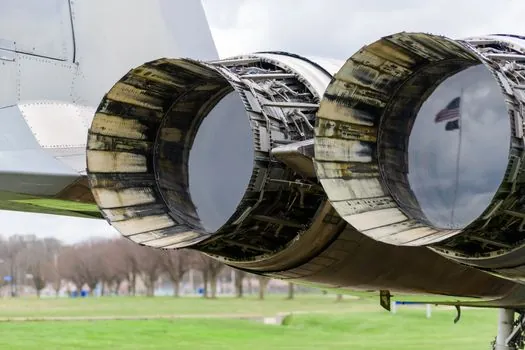
Three numbers drive silencer specification on an aerospace pneumatic exhaust: target noise reduction (typically 15-30 dB at 1 m for valve exhausts, per general industrial silencer catalogues), maximum allowable backpressure at rated flow (commonly held below 0.5-1.0 psig to keep actuator spool times inside spec), and particle/aerosol capture efficiency if the port is in any environment where exhaust contamination can migrate back into the pneumatic supply. POREX notes its porous-plastic silencers are explicitly engineered to balance these three against one another, with custom porosity grades available where a standard part will not hit the backpressure target [S2].
On high-cycle aerospace solenoids (inflight inflation valves, weapons-ejection manifolds, flotation systems) Aerodyne Controls lists application-specific valve manifolds among its product lines, and the silencer on each manifold port is sized to that port's Cv rather than the system average [S1]. The wrong porosity grade shows up as sluggish actuation, not as excess noise, so the qualification test must include measured response time, not only sound pressure level.
Material Comparison: Sintered PE vs Sintered PTFE vs Sintered Bronze
For most aerospace exhaust silencer decisions, three porous materials are on the shortlist, and they line up as follows on the criteria that actually matter in service. Sintered PE: lowest cost, lightest, good chemical resistance, but limited to roughly 80-90 °C continuous and lower pressure ratings; common in cabin and ground-support pneumatic exhausts. Sintered PTFE: temperature ceiling around 200-260 °C, broad chemical compatibility, qualified for engine-bay and APU-adjacent exhausts, higher unit cost than PE [S2]. Sintered bronze or stainless: highest pressure and temperature capability, mechanically robust, but heaviest and prone to corrosion in humid or salt-laden environments, so it is now typically specified only where pressure or temperature rules out plastics [S2].
The trade reduces to a single question for most aerospace buyers: is the exhaust port in a hot zone (PTFE) or a cold zone (PE or bronze)? POREX's published comparison frames it that way, with PTFE positioned for chemical and thermal extremes and PE for general-purpose noise and particulate control at the lowest weight and cost [S2].
Supplier and Qualification Gates for Aerospace Programmes

On a flight-qualified pneumatic system, a silencer cannot be specified as a commodity: the supplier must hold AS9100D (the aerospace quality-management standard), the material lot must be traceable, and any deviation from the qualified part triggers a re-qualification cycle. Aerodyne Controls, AS9100D- and ISO 9001:2015-certified, runs design, prototyping, qualification, and production under that single quality system, which is the structural reason aerospace primes prefer integrated pneumatic suppliers for new valve-and-silencer sub-assemblies rather than catalog resellers [S1].
For non-flight hardware (ground support, factory air, MRO shops) the gate is simpler: confirm thread standard, temperature, and backpressure, then select from a porous-PE catalog such as the POREX or LAIZE ranges, both of which publish standard, push-in, and adjustable silencer options in NPT, BSP, and M5 [S2][S3]. On the broader aerospace manufacturing equipment stack, silencer selection sits downstream of valve and actuator choice, so it should be the last sub-assembly decided in an exhaust-port design, not the first.
Common Failure Modes and Sourcing Risks to Track
Three failure modes account for the majority of in-service silencer problems on aerospace pneumatic systems: silencer icing on cold-soak exhaust cycles (drives the choice toward hydrophobic PTFE media in unheated sections), silencer blow-out under surge pressures above the silencer's rated differential (drives a minimum 1.5x safety factor on burst versus worst-case surge), and silencer clogging from oil aerosol carryover in the supply (drives either an upstream coalescing filter or a larger porosity grade). POREX porous-plastic silencers are specifically noted for filtering particulates and aerosols, which mitigates the third mode but does not eliminate it [S2].
On sourcing, push-in silencer supply is concentrated in the same factory clusters as push-in pneumatic fittings, so lead-time and minimum-order-quantity risk on push-in silencers tends to track that supply chain rather than the silencer market itself. Watch two signals over the next 12 months: AS9100D audits of porous-PTFE suppliers tightening (which would shift flight-qualified demand toward bronze and stainless in the interim), and any new aerospace-specific silencer catalogue releases from CIRCOR-tier integrators that bundle silencer selection with valve qualification, since that compresses the bill-of-material and reduces part-number count per manifold [S1][S2].