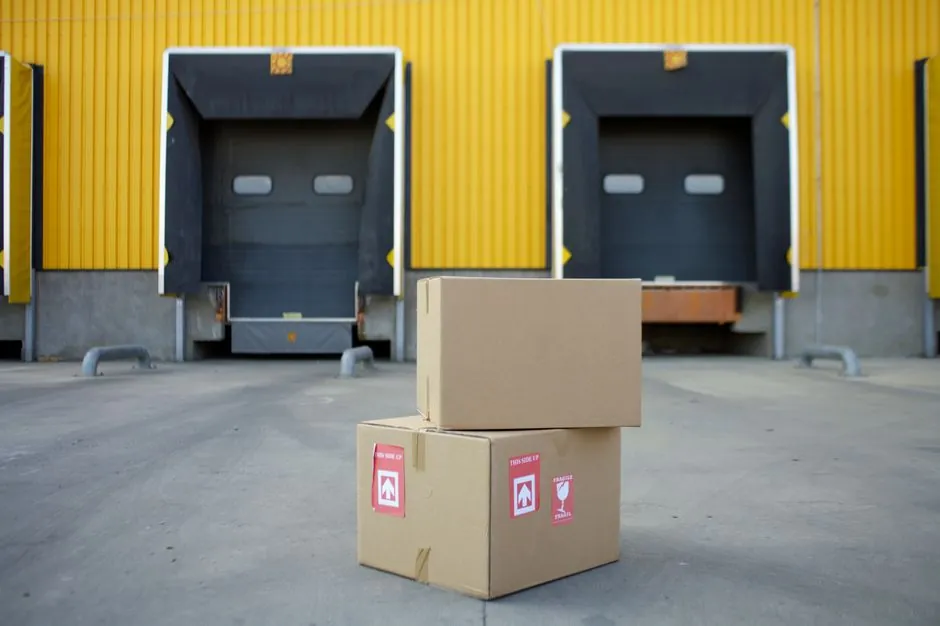
Air cargo in 2026 is evaluated on a Total Cost of Logistics basis rather than price per kilogram, and the choice of turnover box directly drives three of the highest-leverage variables: tare weight, dimensional-weight billing, and closed-loop return economics [S3].
US airline revenue-tonne data published by the Bureau of Transportation Statistics (Schedule P1.2) frames the scale: belly hold plus freighter plus mail revenue is the baseline against which any per-shipment saving from a lighter container is amortized [S1].
Air Mode Constraints That Drive Box Geometry
Air cargo mode selection begins with four explicit factors: size, weight, urgency, and sensitivity, and the turnover box must satisfy all four simultaneously because a single ULD position is a hard envelope [S6]. Standard lower-lobe container footprints on narrow-body freighters cap a single piece at roughly 1.5 by 1.2 m on the base, while main-deck 88 by 125 in (LD-3, LD-7) positions allow taller stacks but not wider bases; the inner dimensions of the box must clear those footprints with 20-30 mm of build-up tolerance for shrink-wrap and pallet edge protection [S2].
Weight economics are unforgiving: a 5 kg tare penalty on every turnover box shipped, multiplied by 10,000 annual cycles, equals 50 t of dead freight per year, which is billed out at the carrier's general cargo rate rather than recovered [S3].
Sensitivity drives the third leg: a closed turnover box blocks light, dust, and incidental touch, which is why pharmaceutical and electronics lanes default to rigid bins even when a cheaper carton box would pass a rate quote [S2].
Material Options: PP, HDPE, and Corrugated Compared
Material choice for an air-cargo turnover box collapses to three practical options: virgin polypropylene (PP), high-density polyethylene (HDPE), and double-wall corrugated fiberboard, and each behaves differently on the four cargo-mode factors listed above. [S2]
PP bins at 1.4-1.8 mm wall thickness survive a 5-cycle minimum closed-loop return at roughly 1.5-2.0 kg for a 600 by 400 mm footprint, with operating temperature range of -20 to 80 degrees C; HDPE is the heavier cousin at 2.0-2.6 kg for the same footprint but absorbs impact better at sub-zero handling, which matters on ramp transfer during winter operations. Double-wall corrugated in BC-flute or EB-flute hits 3.8-4.5 kg for the same 600 by 400 mm envelope and is a one-trip or 1-3 trip box at most; collapse strength drops sharply above 65% relative humidity unless the board is wax-impregnated [S2].
The decision grid lines up cleanly: pick PP for high-cycle closed loops above 5 round trips on electronics or apparel lanes, pick HDPE for cold-chain or rough-handling lanes where impact survival outweighs tare, pick corrugated only for one-way air freight under 3 cycles or for shape-fill on odd-sized freight where return logistics do not exist [S2][S3].
Weight, Dimensional Billing, and Chargeable Mass
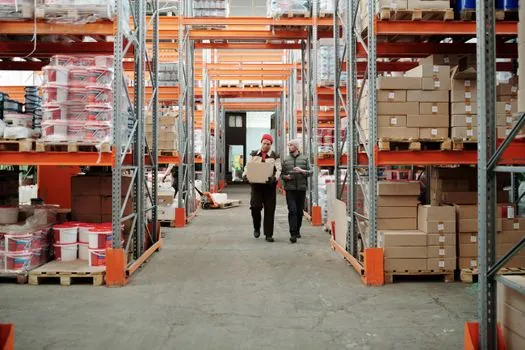
Air carriers bill on chargeable mass, which is the greater of gross weight and volumetric weight using a 167 kg per cubic meter divisor for general cargo or 1:6 ratio for IATA-defined dense cargo, and the turnover box outer dimensions feed directly into that volumetric divisor [S1].
IATA ULD contours matter here: the LD-3 (88 by 125 in contour) has a maximum gross weight of 1,588 kg and a maximum volume of 3.5 cubic meters, while the LD-7 main-deck pallet position tops out at 4,636 kg and 9.9 cubic meters, so a turnover box must nest or stack to those ceilings to avoid deadhead volume [S1].
Two practical cutoffs follow. Below 50 kg per box, dimensional weight dominates the invoice and the right move is to minimize outer dimensions, not wall thickness. Above 200 kg per box, gross weight dominates and the right move is to upgrade wall thickness or add a steel-edge runner for forklift handling, accepting the tare penalty.
Closed-Loop Return Logistics and Pooling
Air cargo turnover economics break when the box does not come back, and the Standard Equipment Provider (SEP) model used by ULD managers is the reference pattern: equipment is pooled, tracked, and billed through an IATA-registered pool, with daily rental fees replacing capital purchase for the carrier or freight forwarder [S1].
For shipper-owned turnover boxes, the same pooling logic applies at smaller scale: a 3PL running a domestic air network with 8-12 daily flights can sustain a closed loop of 2,500-3,500 PP bins at 2-3 day return cadence, assuming a 90%+ recovery rate, and breaks even against one-trip corrugated at roughly cycle 6 on a 60 by 40 cm footprint [S3]. Below cycle 4, corrugated wins on capital efficiency; above cycle 8, rigid plastic wins on per-trip landed cost even after pooling fees and washing costs of roughly 0.30-0.55 USD per cycle.
RFID or barcode tagging on the box itself is no longer optional: air cargo management software now assumes per-piece tracking through the booking and interlining workflow, with 45% of BCOs reporting that confirming a single spot booking still takes up to two days without digital integration [S4].
Handling, Marking, and ULD Compatibility
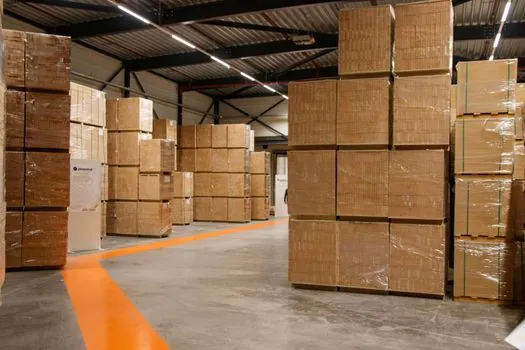
Air waybill marking rules require every package in a consignment to carry consignee name, street, city, and ZIP or postal code matching the air waybill, and the turnover box is treated as a single package for that purpose [S7].
Handling symbols on the box face must include the standard IATA orientation arrows, "This Side Up" or "Do Not Stack" pictograms where applicable, and any UN packaging marks for dangerous goods, which is why a flat, abrasion-resistant label panel of at least 100 by 150 mm is hard to skip. Block and brace internal fitments (foam, corrugated inserts, inflatable air bags) are still required inside the turnover box to prevent the 0.5-1.5 g lateral shock events recorded during ramp transfer and turbulence, and light-but-strong internal fitments are the recommended approach over heavy wood crating [S8].
ULD compatibility is the final gate: the turnover box must stack into the chosen ULD without void space above 50 mm and without overhang off the pallet edge, or the carrier will refuse the load and the booking collapses to general loose cargo at a higher rate [S1][S6].
Who Should Use a Turnover Box for Air Cargo
The turnover box is the right pick on a domestic air lane when the consignment clears 500 kg per shipment, repeats 4 or more times per month on the same origin-destination pair, and the contents are unit loads of 5-30 kg per piece; under those conditions the box pays back inside 8 cycles versus corrugated, and tare reduction shows up on the next invoice [S3].
Related apparel distribution turnover box selection follows the same PP/HDPE rules at higher cube utilization, while warehouse-automation turnover box choices overlap on footprint standardization but add AS/RS dimension and tare targets that air cargo does not enforce.
Trackable signals to watch into late 2026: airline revenue management software rollouts that move spot booking confirmation below 24 hours, and any update to IATA ULD contour or chargeable-mass divisor rules that would re-rank rigid versus corrugated on dense lanes. Both will shift the payback cycle on the same box by a full quarter.
Component reference pages worth checking: air pick.