Anti-static equipment for combustible-dust handling and ESD-safe equipment for electronics share the same physics, but the acceptance criteria, standard families, and failure costs are not the same. In a powder-handling context, the discharge is the hazard, because a brush discharge from a non-conductive hose can ignite a dust cloud at voltages a person cannot feel [S2]. In an electronics context, the discharge is also the hazard, but because it damages electrostatic-sensitive devices on a populated board, not because it ignites the air around the bench [S1][S8].
Both regimes sit on a controlled-conductivity middle ground. Static-dissipative materials are typically rated in the 10^6 to 10^9 ohm surface-resistivity band, which lets charge bleed to ground slowly instead of accumulating on an insulator or dumping instantly through a conductor [S1]. That same middle band is what EN 1149-5, EN ISO 20345, EN 16350, and IEC 61340 all reference when they qualify garments, footwear, gloves, and workstation gear, and why an item specified for one regime is not automatically accepted in the other [S3].
Where the Two Disciplines Diverge: Goal, Hazard, and Standard Family
The ignition case is governed by ATEX, NFPA, and OSHA, with the goal of preventing a static discharge from becoming an ignition source for a flammable vapor or combustible dust. In a powder facility, the standard guidance is to use conductive or static-dissipative materials with a surface resistivity below 10^11 ohm/square, and to maintain a bonded, grounded path from the hose tip through the wand and the unit to earth, so charge bleeds continuously instead of accumulating exactly where dust concentration is highest [S2][S5][S7].
The component-protection case is governed by IEC 61340 and the ANSI/ESD S-series (including ANSI/ESD STM2.1 for garments), with the goal of keeping any discharge below the damage threshold of the device being handled. The hazard list is different: field-induced device damage, data corruption, latent failure, and the up-to-33% production-loss figure attributed to static-related device failures in electronics manufacturing [S3][S8]. A facility that mixes the two, for example a battery plant handling combustible electrode powders on the same line as ESD-sensitive cells, has to name both requirements in the specification; picking one vocabulary and assuming coverage is how projects get signed off on the wrong equipment [S2].
Decision Matrix: Powder vs Electronics, by Selection Criterion
The fastest way to avoid mis-specification is to compare the two regimes against the same four criteria:
1. Primary goal. Powder: prevent a discharge igniting a dust cloud or flammable vapor, so a hose, wand, and vessel must be bonded and grounded through a resistance to earth below 1 MΩ as a condition of ATEX certification [S5]. Electronics: prevent any discharge above the device damage threshold from reaching a populated board, so flooring, wrist straps, work surfaces, and packaging are verified as a continuous dissipative chain under IEC 61340 [S3][S8].
2. Surface-resistivity target. Both regimes use the dissipative band, but the upper limit is tighter in dust service: below 10^11 ohm/square for powder-handling surfaces per common electrostatic-hazard guidance [S7], versus the 10^6 to 10^9 ohm range typically called out for ESD-protective materials and the 10^8 ohm ceiling for EN 16350 dissipative gloves [S1][S3].
3. Standard family. Powder: ATEX 2014/34/EU for equipment, EN 1149-5 / EN ISO 20345 for clothing and footwear, and OSHA / NFPA grounding practice for installation [S3][S5]. Electronics: IEC 61340 for process-level ESD control, ANSI/ESD STM2.1 for garment test methods, and EN ISO 18080 for textile evaluation [S3][S4].
4. Failure cost. Powder: a single discharge can be a primary ignition event for a dust deflagration, with the secondary consequence of a process unit shutdown and regulatory finding [S5]. Electronics: a single under-100-volt event that an operator never feels can kill a device, and the loss shows up as field returns and the static-related share of production scrap [S3][S8].
If your line touches combustible dust, lead with the ATEX vocabulary, require a documented bonding path with measured resistance, and reject any hose or wand that is plain plastic; a standard shop vacuum is unsuitable in a dust area even before its motor is considered [S2]. If your line only touches boards and components, lead with IEC 61340 and the S-series test methods, and verify the dissipative chain at the workstation, not just on the garment label. For mixed lines, the spec has to cite both standard families and the same item has to pass both test plans.
Equipment Types That Cross Over, and Ones That Do Not
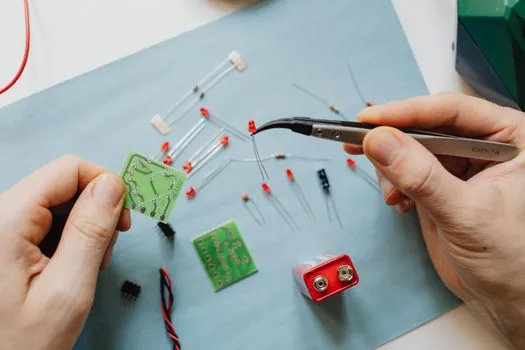
Ionizers, ionizing bars, and ionizing blowers work in both worlds because they actively flood the local air with balanced positive and negative ions, neutralizing charge on a nearby surface without requiring a hard ground path [S4]. They are commonly used near plastics, film, paper, labels, and circuit boards, which makes them the easiest crossover device to specify when a line has both a static-cling problem and an ESD-sensitive product on it. Passive devices, including anti-static mats, static brushes, conductive flooring, and grounding straps, are the workhorse in either discipline, but the test method, the resistance limit, and the audit cadence are not interchangeable between ATEX dust service and IEC 61340 ESD programs [S4][S8].
Anti-static sprays and topical treatments are the equipment category most often misapplied across the two regimes. They reduce charge buildup on a surface for a limited window, but they do not control how charges dissipate, which is the explicit function of a true ESD material, and the resistivity they leave behind can drift out of the dissipative band as the coating ages or picks up process contamination [S1][S4]. A vacuum specified for dust service has to carry a combustible-dust area classification, for example Class II, Division 1, Groups F and G, with a temperature code such as T3C, and the certification number has to be readable on the asset, not buried in a submittal; certification on the nameplate does not by itself make a facility compliant with any standard or regulation, but it is the entry ticket to the area [S2].
Personal Protective Equipment: One Standard Does Not Cover Both
Anti-static PPE is the category where the two vocabularies collide most often in purchasing. EN 1149-5 is the performance spec most commonly called out for dissipative clothing, EN ISO 20345 covers anti-static safety footwear, and EN 16350 sets the surface-resistivity ceiling for dissipative gloves at below 10^8 ohm [S3]. EN ISO 18080 is the textile-side test method used to back those clothing specs. On the electronics side, ANSI/ESD STM2.1 is the garment test method, and ASTM F1506 is the US spec that bundles anti-static behavior with arc-flash and flame resistance for electrical-worker clothing [S3].
The practical rule is to spec the clothing, glove, and footwear standard to match the dominant hazard on the line. A disposable vs reusable smock decision is a separate call, and the trade-offs there (cost per shift, wash-cycle ESD performance drift, particulate shedding into a cleanroom) are covered in this smock selection guide. For flammable-liquid transfer and drum handling, the grounding and bonding rules under OSHA and NFPA add another layer on top of the garment spec, and the drum-side requirements are detailed in this bonding reference. Mixing the two without naming both in the purchase spec is how lines end up with ATEX footwear that fails an ESD audit, or with an ESD smock that is not approved for a Class II dust area.
Limits, Failure Modes, and Cross-Contamination
The shared physics hides three recurring failure modes. First, the dissipative band only works if the chain is continuous: a dissipative mat on an insulative floor is not grounded, and a conductive hose on a non-conductive wand is not bonded, so the path to ground is only as good as its weakest link, and a discharge tends to originate at that weak link [S2][S5]. Second, contamination, including oils, powder dust, and topical anti-static sprays, can move a surface in or out of the dissipative band during a shift, so a one-time resistance reading at commissioning is not the same as a process control; routine testing of the bonding and grounding system is the standard remediation [S5][S8]. Third, an item qualified for one regime can be actively dangerous in the other: a plain plastic hose is a charge generator in a dust area, and an uncoated metal tool that is fine for ESD work is an ignition source in a flammable-vapor space, so the equipment list, not the standard list, has to be reviewed per area [S2].
For facilities that handle both regimes in the same room, the practical control set is layered: dissipative flooring and workstation surfaces verified to the electronics spec, bonded and grounded hose, wand, and vessel verified to the ATEX spec, active ionization over the most charge-prone transfer points, and a written test cadence that covers both resistance-to-earth limits and ESD-program audits. Long-lead items such as certified vacuums, ionizing bars, and dissipative flooring should be on the procurement list early, because fabrication and certification lead times are a known schedule risk on fast-track builds; the long-lead strategy is laid out in this procurement reference. Filtration usually enters the conversation at the same time, since the same environments that need ignition control and ESD control are the ones where exhaust air quality matters and HEPA retention is a separate test plan on top of the electrical one [S2].
Component reference pages worth checking: anti static equipment, material handling, and storage handling.