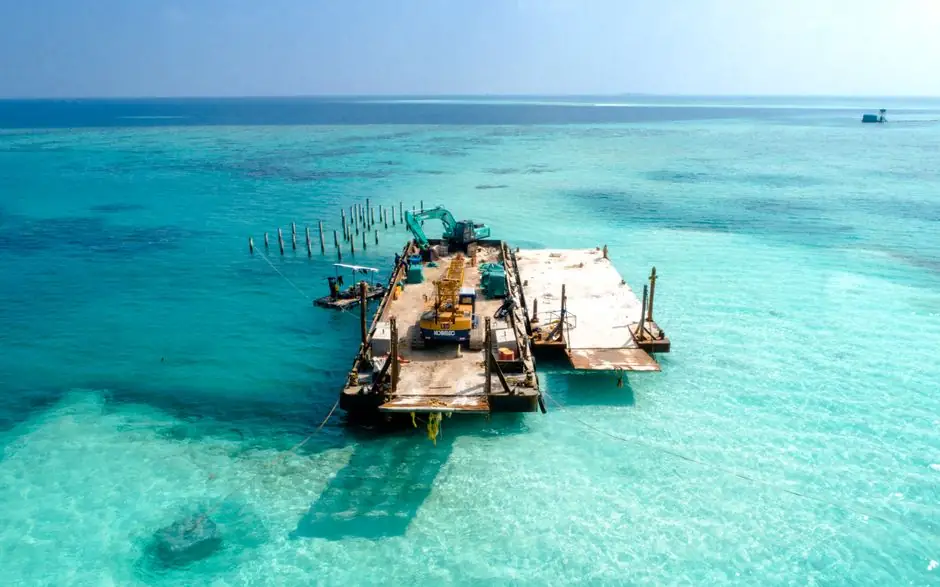
Anti-washout admixtures are water-soluble polymers, most commonly high-molecular-weight cellulose ethers or refined polysaccharides, that raise the plastic concrete's cohesion so a free-falling mix resists dispersing into the water column [S3][S8].
They are specified whenever concrete must be placed below the water table or in tidal and saltwater exposure, including drilled shaft foundations, pier piles, tunnel tremie seals, and dam repairs [S1][S2]. For chemical admixture context and how AWAs compare to other admixture classes, see the concrete admixture reference page.
How an AWA Actually Works in the Mix
Cellulose-based AWAs work by swelling in the mix water and forming a long-chain network that traps fines and increases plastic viscosity, slowing diffusion of cement particles into surrounding water [S5][S8]. MasterMatrix UW 450, a patented ready-to-use liquid cellulose admixture, is engineered to impede the blending of external water into the plastic concrete while still allowing flow through a tremie pipe [S5].
The viscosity bump from an AWA is what lets the concrete hold together as a coherent mass on impact and through the water column; without it, even a well-proportioned tremie mix loses cement and fines to the surrounding water and ends up with a watered-up, low-strength interface [S3][S6]. AWAs are routinely combined with concrete admixture superplasticisers so the mix can still flow under its own weight without segregating [S4].
Dosage, Water-to-Cement Ratio, and Slump Targets
Mix designers pair that with a water-to-cementitious ratio (w/cm) of roughly 0.40-0.55, since lean, high-w/cm mixes are the hardest to keep cohesive underwater [S6].
Target slump at the tremie hoppers sits around 150-225 mm (6-9 in), high enough to pump, but the thixotropic set from a cellulose AWA stiffens the mix within minutes of placement so laitance and segregation are minimised [S5]. For mixes where the placing method is grout rather than concrete, the higher fluidity window pushes AWA demand toward the upper end of that range, and most suppliers offer a separate "grout" guidance on their data sheet [S5].
Standards and Acceptance Tests
USACE CRD-C 661-06, Specification for Anti-Washout Admixtures for Concrete, is the dominant US acceptance protocol and is met by products such as MasterMatrix UW 450 [S5]. The test exposes a freshly mixed sample to a controlled water column and measures the mass loss of fines; the acceptance threshold is a washout loss below roughly 5-8% by mass, depending on the referencing spec, with lower values indicating better cohesion [S3][S5].
In Europe, AWA performance is generally evaluated under EN 934-2 concrete admixture provisions combined with project-specific washout criteria, while the UK Concrete Society treats AWAs as a complementary class that is normally used with a superplasticiser to produce flowing, self-levelling underwater concrete [S4]. Where a US Department of Transportation spec applies, products like Sikament-100 SC are listed for the anti-washout / specific performance type under ASTM C494-type provisions [S2].
Main Product Families on the Market
Cellulose-ether AWAs (MasterMatrix UW 450, Fritz-Pak Hydrocizer) are the most common commercial family and rely on long-chain cellulose polymers for viscosity build [S1][S5]. They are stable across a wide pH window, dose cleanly into the mix water, and are the default choice for general marine and freshwater tremie work [S5].
Polysaccharide / gum-based AWAs (including welan gum and diutan gum systems, as well as rheology-modifying admixtures such as Chryso V-Mar 3) deliver a different rheology: more shear-thinning and a stronger thixotropic recovery, which helps in highly fluid or self-consolidating underwater mixes [S7]. Acrylic and synthetic-polymer AWAs exist for niche applications, but cellulose and polysaccharide chemistries cover the bulk of commercial placements [S3][S6]. For marine and high-exposure pours where reinforcement corrosion control is also a concern, designers often pair the AWA system with concrete fiber reinforcement to add post-crack toughness.
Comparison Across the Three Main AWA Chemistries
On temperature tolerance, cellulose systems hold viscosity down to around 5 deg C, which matters for cold-water placements, whereas some polysaccharide gums lose effectiveness at high temperatures above 30 deg C without retempering the dose [S6].
On washout performance, well-dosed cellulose and polysaccharide systems both land in the 3-6% washout loss range under CRD-C 661-style testing, while cheaper or under-dosed cellulose-only mixes can climb above 10% loss on deep placements [S3][S5]. The practical pick for a marine pile cap or cofferdam tremie is cellulose-ether at 0.8-1.2% by cement weight, and the practical pick for a self-consolidating underwater grout is a polysaccharide RMA at the same dosage but with tighter slump-flow control [S5][S7].
Placement Method and Field Constraints
Anti-washout mixes are almost always placed by tremie pipe, pump, or hydrovalve, never by free skip because the water-exposure distance is what the AWA is designed to survive [S4][S5]. The tremie pipe must be sealed at the bottom and embedded at least 1-2 m into the fresh concrete during the pour to prevent water re-entry, and the AWA only does its job if the mix reaches the water column as a coherent mass [S4].
Common failure modes: an AWA that has been pre-blended into dry cement and stored too long loses potency; high-salinity water can shift the dose-response curve and require a re-temper at the hopper; and over-dosing above roughly 2.0% by cement weight can lock up the mix so badly that tremie flow rate drops and cold joints form inside the pour [S3][S6]. Logistics, not just chemistry, decide whether the admixture is supplied in 200 L drums, 1000 L IBCs, or bulk tanker, and the cost trade-off is laid out in the IBC tote vs bulk tanker delivery cost guide.
Limits, Misconceptions, and What an AWA Will Not Do
Anti-washout admixture is a placement aid, not a waterproofing system: it does not by itself reduce the long-term permeability of the hardened concrete, and it does not replace good tremie practice, proper embedment depth, or a sound mix design [S4][S6]. It also does not retroactively fix a mix that was too lean or too wet at the batch plant; the underlying w/cm and fines content still drive the in-place strength [S6].
For aggressive marine exposure with high chloride ingress, the AWA must be paired with supplementary cementitious materials (slag, fly ash, silica fume), low w/cm, and adequate cover, otherwise the hardened concrete still suffers the same durability penalties as any other cement paste in that environment [S3]. The AWA's job ends when the concrete is in place; from there it is a normal marine concrete durability problem [S3][S6].
Trackable signals for upcoming spec movement: CRD-C 661-06 revision activity in USACE publications, EN 934-2 harmonisation updates on washout testing, and a growing number of state DOT qualified products lists adding anti-washout entries alongside their standard Type F / Type S [S2][S4][S5].