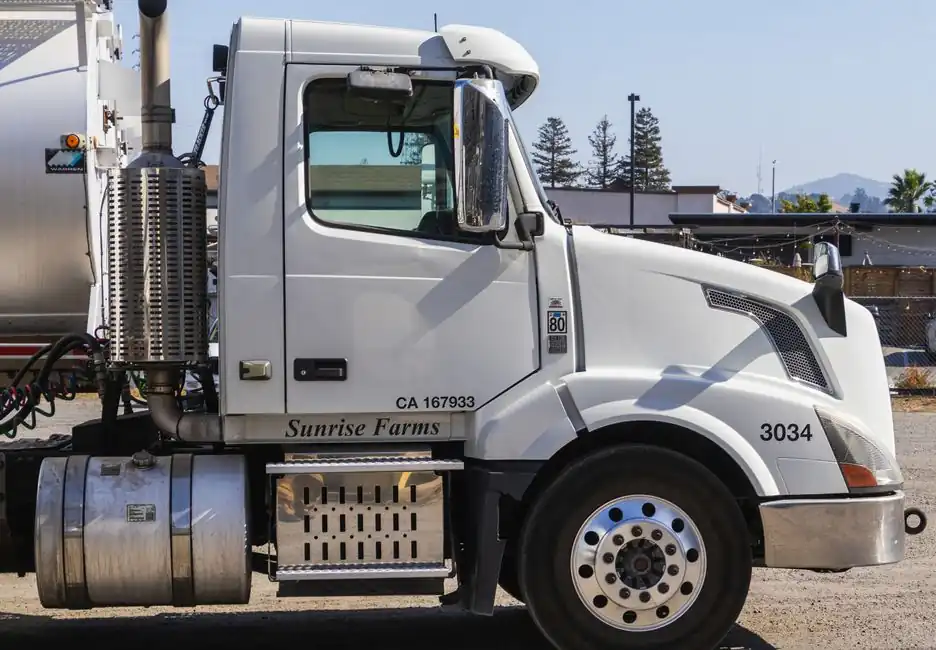
For liquid admixtures used in concrete, water-treatment, and chemical dosing, the practical break point between an IBC tote and a bulk tanker delivery is weekly tote consumption, not headline unit price.
The container ladder is fixed by physics and standardisation: a 55 gal (208 L) drum, a 275-330 gal (1,041-1,250 L) IBC tank, and a 5,000-6,500 gal bulk tank truck, each with its own handling footprint, tare weight, and re-order cost profile [S1].
Container capacity, footprint, and weight bands
Standard IBC totes are sold in two capacities, 275 gal (1,041 L) and 330 gal (1,250 L), both built on a 45 in x 45 in (1,143 mm x 1,143 mm) pallet base so a forklift or pallet jack can move the unit without special gear [S4][S5]. The integrated pallet, galvanized steel cage, and HDPE inner bottle are not optional accessories; they are what makes the container stackable 2-3 high in a truck or warehouse, and what makes it UN/DOT certifiable for hazardous liquids [S2][S5].
Gross weight, not volume, decides whether a forklift and rack can handle the load. For a 0.79 g/mL admixture such as an acetone-extended defoamer, a 275 gal tote carries roughly 1,815 lb (823 kg) of product and a 330 gal tote roughly 2,180 lb (988 kg); a full tote with its cage and pallet runs near 2,000 lb gross for that fluid, before factoring density [S1]. Admixtures based on aqueous polymers, lignosulfonates, or naphthalene blends run at 1.05-1.20 g/mL, which pushes a 330 gal tote to 2,880-3,290 lb (1,305-1,492 kg) and rules out light-duty pallet rack.
A bulk tanker truck, by contrast, hauls 20,000 L or more per load and pumps directly into an on-site storage tank, eliminating the per-tote handling loop entirely [S3].
Per-gallon cost and waste: when bulk beats totes
Per-gallon delivered cost falls as container size rises, mainly because packaging, drum/tote disposal, and reconnect labour are amortised over more product. Once a site is opening totes on a weekly cadence, bulk tanker delivery into an on-site storage tank almost always lowers both the per-gallon cost and the packaging-waste stream versus continuing on IBC totes [S1].
The savings come from three line items, not from a bulk discount headline. First, container cost: a single 330 gal tote replaces six 55 gal drums on one pallet position, and a full tanker replaces roughly fifteen to twenty totes in one delivery [S1][S4]. Second, handling: totes still need a forklift driver, a discharge valve connection, and a rinse/disposal step at end-of-life; a bulk delivery needs one pump-up and one line-rinse. Third, waste: HDPE inner bottles and steel cages accumulate as scrap or reconditioning fees; bulk delivery returns as a near-empty tanker.
The break-even is site-specific, but a useful rule from the container-ladder data: a single drum order is the right answer up to a few hundred gallons per month, an IBC tote fits the band where one chemical feeds a line continuously at roughly 1,000-4,000 gal/month, and bulk tanker delivery becomes the economic default above several thousand gallons per order with on-site storage permitted [S1].
Selection criteria: volume, storage, and switching cost
Volume is only the first filter. Tote-versus-bulk also turns on storage infrastructure, site permits, and the cost of switching between chemistries. An IBC tote needs only a flat, bunded floor area, a forklift-rated path, and secondary containment sized to 110% of the largest single container; a bulk installation needs a permitted storage tank, a concrete pad, spill containment, a level sensor or pressure transmitter for inventory, and a pump skid [S1][S7].
Material compatibility constrains the choice further. Caged HDPE totes are rated to roughly 1.9 specific gravity for dense fluids and are FDA Title 21 / 21 CFR 177.1520 compliant for food-contact duty, with NSF/ANSI 61 certification available for potable water [S5]. For aggressive caustics, solvents, or high-purity polymers, stainless 304/316L IBCs or dedicated chemical IBCs are specified instead, and those units cost two to four times a standard HDPE tote before the bulk-vs-tote math even starts [S2][S4].
For sites running multiple admixture chemistries in parallel, totes are often the right answer even at high volume, because each bulk tank ties up capital and a containment footprint that only pays off when a single chemistry dominates. A concrete admixture plant dosing five different products in similar volumes usually runs totes; a municipal water-treatment plant dosing one coagulant at 20,000 gal/week almost always runs bulk.
Decision matrix: drum, IBC tote, bulk tanker
The decision compresses into a small table once the volume band and site constraints are fixed [S1][S3][S5].
Drum (55 gal / 208 L): lowest capital cost, hand-dollied, suits up to a few hundred gallons per month per product; per-gallon delivered cost is the highest of the three because packaging, drum disposal, and re-order handling recur on every cycle. IBC tote (275-330 gal / 1,041-1,250 L): mid capital cost, forklift-handled, UN/DOT and FDA-compliant HDPE options standard, suits 1,000-4,000 gal/month per line; cuts connections, spill points, and footprint versus drums by roughly 5:1 on a per-gallon basis. Bulk tanker (5,000-6,500 gal per load, 20,000 L+): highest capital cost (tank, pad, containment, pump skid), lowest per-gallon cost and packaging waste, suits several thousand gallons per order and continuous plant-scale use.
Cross-check the chosen option against four criteria: usage rate per month, secondary containment space available, handling equipment (drum dolly vs forklift vs pump skid), and chemistry compatibility (HDPE 1.9 SG limit, stainless needed for aggressive fluids) [S1][S5].
Operational signals worth tracking
Three numbers tell a site when to re-spec the delivery mode. First, tote consumption cadence: if the plant is opening more than one 330 gal tote per week of a single chemistry, model the bulk-tank ROI against the tote run-rate. Second, tote return and disposal cost: rising scrap or reconditioning fees shift the crossover point earlier. Third, density of the admixture in use: aqueous admixtures near 1.10 g/mL push a 330 gal tote to about 3,000 lb gross, which forces heavier rack, wider forklift, and tighter floor loading, all of which are sunk costs that bulk delivery would have avoided [S1].
A practical 2026 reference point from the IBC market: the US IBC segment was worth roughly USD 2.43 billion in 2021 and is projected to reach USD 3.59 billion by 2030, so the supply chain, reconditioning, and valve-fitting ecosystem around totes is mature and will not be a procurement risk in the near term [S3].
Spec note for adjacent decisions: the same logic that pushes admixture delivery from drum to tote, and from tote to bulk, recurs in industrial valve and flow meter sizing, where mid-range standardised units beat one-off specials until plant-scale demand justifies a custom skid, and recurs in rack and scale decisions where a structural beam makes economic sense only above a duty cycle the lighter section cannot survive. Track the per-gallon delivered cost weekly, not the per-tote sticker price, when the next container-mix review comes up.
Related analysis: EN ISO 14555:2025 sets quality baseline for arc stud welding.