
A rotary laser level with slope mode projects a laser plane at a user-defined angle, typically 0° to 25°, by disengaging or overriding the self-leveling lock on one or both axes, and is the standard instrument for setting pipeline grade, drainage fall, and ADA ramp pitch from a single setup [S4].
Single-axis units handle one-way runs (a pipe at constant fall, a sports field slope), while dual-axis models are required for compound grades such as a parking bay that slopes 2% along its length and 1.5% across, since the second axis must be set independently without disturbing the first [S6].
How the self-leveling lock is overridden
Standard self-leveling instruments use a pendulum or servo gimbal that actively corrects the laser head to true horizontal within a compensation window, typically ±3° to ±5°, which is what makes them fast and accurate for level reference work but is exactly the behaviour that has to be defeated to set a deliberate slope [S4].
A slope-capable rotary laser adds either a manual tilt drive (hand-crank or thumbwheel on the axis) or a secondary motorized axis that the instrument's firmware uses to hold a commanded angle; the auto-level lock is then disabled on the commanded axis while the perpendicular axis remains self-leveling, so a dual-grade can be set without the head wandering [S1][S4]. Most slope rotaries ship with a remote control so a single operator can dial grade while standing at the receiver rod, which is a practical necessity on long pipe runs [S1].
Three methods to set grade: manual, digital, and auto grade match
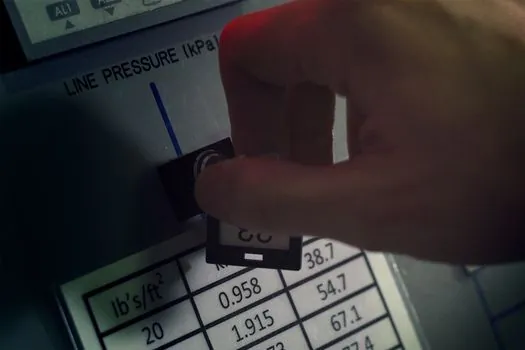
Manual grade setting uses the remote to slew the laser plane up or down on one or both axes while the operator watches a rod-mounted receiver; it is the cheapest method but depends on the operator reading the percentage off a chart, since the head itself has no numeric feedback [S1].
Automatic grade match tracking is a third mode in which the operator sets a target height on the receiver, then walks the receiver up or down a rod; the laser's motorized axis actively slews to follow the receiver and locks on when the operator stops, which is the fastest way to match an existing reference surface such as an old road kerb or a formed slab edge [S1].
Slope range, accuracy, and units: the numbers that actually matter
Most slope rotary lasers cover 0° to 25° of tilt, with some specialty units extending to 90° for vertical alignment work, and the operating range is a hard limit, not a suggestion, because driving the head past it usually triggers an out-of-range warning and disables the beam [S4].
Grade accuracy is specified as a percentage of distance plus a fixed offset, and typical mid-grade rotary slope lasers run roughly ±1.5 mm at 30 m, or about ±0.005%, which is more than adequate for drainage at 1% to 2% but is the spec to verify when the application is a tight-tolerance pipe laser run; pipe lasers, a sub-class, are built specifically for that work and run at higher accuracy in the plumb direction [S4][S5]. Slope can be expressed in degrees, percent grade, or mm/m, with 1° ≈ 1.75% ≈ 17.5 mm/m, and the choice of unit is purely a convenience, since the math converts exactly [S4].
Slope laser options compared on four selection criteria
The four instrument classes that handle sloped references are rotary slope lasers, line lasers with slope mode, cross-line lasers with grade lock, and pipe lasers, and they line up against the decision criteria as follows [S4]:
Rotary slope lasers: working range typically 300 m to 600 m radius with a detector, slope range 0° to 25° (some to 90°), dual-axis on premium models, IP54 to IP66 weather rating, and they are the default for outdoor earthworks, drainage, and concrete slab prep. Line lasers with slope mode: working range under 30 m, single-axis slope only, typically IP54, suited to interior fit-out such as staircase handrails. Cross-line lasers with grade lock: 10 m to 20 m range, single-axis, lower IP rating, used for short-run interior drainage channels. Pipe lasers: 100 m to 300 m in-pipe range, very high accuracy in the vertical plane, IP67 or better for in-pipe use, dedicated to sewer and storm pipe installation [S4].
The criterion that usually forces a rotary over a line laser is detector range, because outdoors the beam is invisible past roughly 6 m to 10 m in daylight and the detector is what makes longer runs practical, while slope range alone is similar across the rotary and pipe-laser classes [S4][S5].
Where automatic slope alignment pays off, and where it does not

Auto grade match and digital slope are worth specifying on jobs where the same grade is set repeatedly, the operator is a one-person crew, or the consequence of a wrong slope is rework, which covers most pipe-laying, drainage, and slab-on-grade pours [S1][S4]. For a one-off interior stair rail or a small ramp, a manual line laser with slope mode is faster to set up and cheaper to buy [S4].
Standard self-leveling rotaries without slope mode should not be forced into slope duty, because the self-leveling servo will fight the tilt and the result is a wandering, inaccurate plane; a slope-capable instrument is a hard requirement, not an optional accessory [S3][S4]. A common misreading on trade forums is that a self-leveling line laser can be tilted to push the beam higher on a wall, but the pendulum-based compensator will refuse to lock once the body is past its ±3° to ±5° window and the unit typically alarms and shuts off, so the workaround is to raise the tripod, not to tilt the head [S3].
Field procedure: aligning a dual-axis slope setup
Step one is to set the cross-axis (the axis perpendicular to the main run) to 0% and align the laser to the receiver on that axis, so the receiver reads on-grade with no input from the slope function; this is the step that gets skipped and causes the entire dual-grade to drift as the main axis is changed [S6].
Step two is to enter the main-axis grade on the laser's keypad or remote (1.5% for a typical storm line, 8.33% for an ADA ramp), let the motorized axis slew, and confirm the receiver still reads on-grade on the cross-axis, which proves the two axes are independent and not cross-coupled [S1][S6]. For more on how an automatic level establishes its horizontal reference in the first place, the operating principles of a self-compensating telescope are worth reviewing, since slope mode is conceptually an override of that very compensator. Dual-axis slope rotaries in the same equipment family as standard rotary laser levels are the most common form factor, and the same IP and accuracy considerations apply. Step three, for matching an existing surface, is to put the receiver at the target height and let the auto grade match function slew the head to lock on, then walk the rod to check the matched grade at several points before pouring or trenching [S1].
Trackable signals for specifiers: confirm the manufacturer's published slope accuracy figure at a stated distance, verify the slope range covers the steepest run on the project (8.33% for ADA, up to 25% on some access roads), and check the IP rating against the worst on-site exposure, since IP66 is the practical minimum for outdoor earthworks in rain [S4].
Detailed specification references: automatic molding line.
This topic is covered further in Automatic Level Recalibration Cost: Service Fees, Tiers, and TCO.