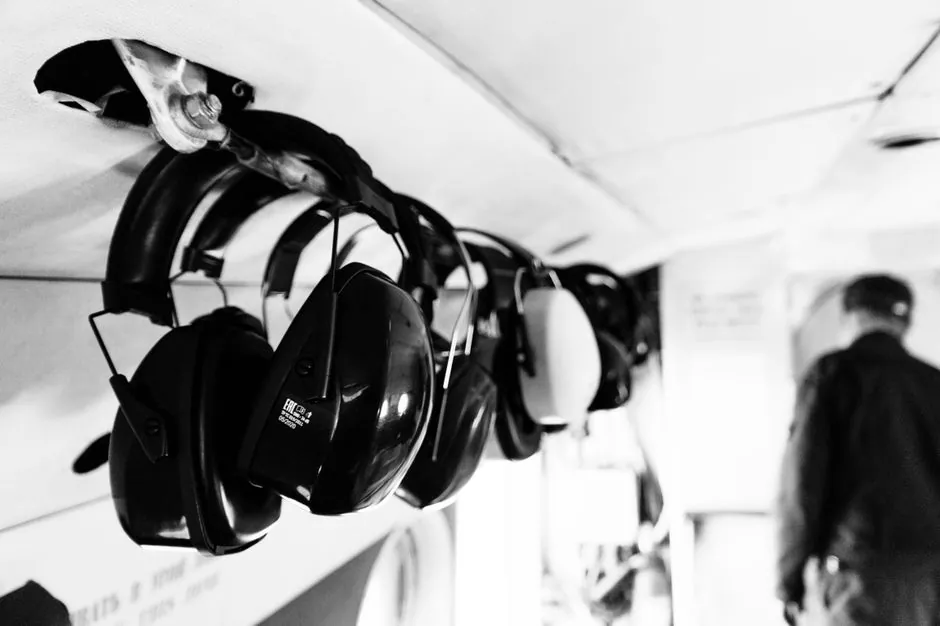
Select a behind-the-neck earmuff when headgear prevents an overhead band from fitting, such as a hard hat, bump cap, or welding helmet. Select an over-the-head earmuff when fast repeated use, a simple head-size adjustment, or broad headwear compatibility outweighs the need to keep the top of the head clear.
The two designs use the same basic protection principle: rigid ear cups enclose the ears and soft cushions seal against the head, while a band or neckband maintains cup position. The practical difference is geometry, not a different acoustic principle, and the specified model must be evaluated by its rating and fit rather than by band position alone.
Define the selection criterion
The governing comparison is available headgear space. A behind-the-neck, or neckband, design routes the connector behind the head and neck instead of over the crown [S3][S4]. An over-the-head design uses a thermoplastic or metal headband fitted across the top of the head, with a cushion or cup at each end [S3].
The GE PPE GM454 is a behind-the-neck earmuff with a 26 dB NRR, ANSI S3.19 rating, and compatibility with hard hats, priced at $19.95 each [S4].
The decision boundary is straightforward: use the neckband when the crown is occupied or top-mounted equipment makes an overhead band impractical. Use the overhead band when the wearer can repeatedly place and remove the protector without repositioning other PPE, and when a conventional headband provides the preferred adjustment range and cup stability.
Compare the main options
Against headwear compatibility, a behind-the-neck earmuff is the stronger choice because the band does not cross the top of the head. The GM454 is specified as compatible with hard hats, bump caps, and welding helmets, and its neckband avoids interference with a hard-hat suspension [S4]. An over-the-head earmuff has the advantage when no hat, helmet, or other crown-mounted equipment is worn.
Against donning and doffing, an over-the-head earmuff normally gives the user one obvious placement path, with the band over the crown and both cups lowered into place. A neckband design must be positioned behind the neck and adjusted at both cups. Its Velcro strap and tilt pivots improve the setup process, but the published data do not establish a measured time advantage for either design [S4].
Against acoustic performance, band position does not determine protection by itself. The GM454 is rated at 26 dB NRR and 30 dB SNR under ANSI S3.19 [S4].
The research does not provide equivalent construction or attenuation data for a specific over-head model, so a blanket claim that either style is quieter, tougher, or longer-lived would not be supportable. Compare certified model data, adjustment range, seal design, and field condition.
Match the design to the use case
Use a behind-the-neck earmuff in construction, manufacturing, woodworking, and similar settings where a hard hat is already required. Its 26 dB NRR and 30 d SNR make it a rated option for those applications, subject to fit and exposure assessment.
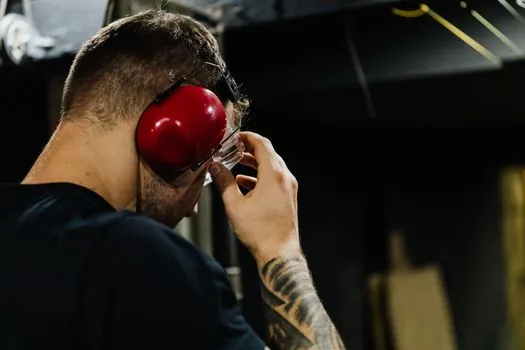
Use an over-the-head earmuff for short-duration work, frequent removal and replacement, or environments without crown-mounted PPE. This configuration avoids the need to route a band around the back of the neck and works naturally with a single overhead placement action [S3]. It is also a practical choice for users who do not wear hard hats and who prefer the full adjustment range of an over-the-head headband.
For a mixed PPE profile, treat the style as condition-specific rather than universal. Workers changing between a bare head, hard hat, and welding helmet may need both formats if task changes make one incompatible. Head circumference and wearing conditions still need verification on the selected model; the GM454 example provides a 13.33–13.97 cm adjustment range, but that figure cannot be transferred to another neckband [S4].
Protect the seal, not just the label
A properly worn earmuff must fully enclose the ear and seal tightly against the head; protection depends on continuous contact between the cushion and the wearer [S6]. Cushion condition, head position, eyewear, facial hair, and movement can therefore reduce effective protection even when the product carries a published NRR or SNR.
For the GM454, the fit controls include adjustable Velcro, cup tilt pivots, and a 13.33–13.97 cm width range [S4]. Inspect the polyurethane cushions for compression, cracking, or contamination, and confirm that the cups sit fully around the ears before entering a high-noise area. Do not infer a compromised seal from the lower-frequency performance alone: the GM454 rating varies from 21.0 dB at 125 Hz to 41.8 dB at 3,150 Hz [S4].
Neither style solves poor fit automatically. Over-head earmuffs rely on correct band tension and cup placement; neckband earmuffs rely on both rear-band position and front cushion contact. The GM454 has separate adjustments for width and cup angle, but the field test is still whether the cushions seal around the ears without being twisted or compressed [S4][S6].
Apply the rating correctly

Use ANSI S3.19-1974 only where the marking or product documentation identifies that rating method, as with the GM454 at 26 dB NRR and 30 dB SNR [S4]. The two values are not interchangeable: the NRR is the US Noise Reduction Rating under ANSI S3.19-1974, while the SNR is the European attenuation value shown for this product [S4].
Do not subtract an advertised NRR directly from the workplace dBA level and treat the result as a guaranteed protected dose. The measured frequency data already show that attenuation varies with frequency, and real protection also depends on fit and use duration [S4][S6]. Noise assessment, exposure control, and hearing-conservation decisions should use the applicable workplace method rather than a catalog number alone.
For procurement, require the model identifier, rating method, NRR or SNR, materials, adjustment dimensions, replacement-cushion availability, and compatibility with the exact headgear used on site. The GM454 provides model GM454, 26 dB NRR, 30 dB SNR, ANSI S3.19-1974, ABS cups, polyurethane cushions, stainless-steel neckband, and 19.85 lb (9 kg) case weight for 20 units [S4].
Install the selected format correctly
For a neckband earmuff, place the rear band against the back of the neck, fit both cups around the ears, adjust the width, and then set the tilt pivots to remove gaps or pressure points. For an over-head earmuff, place the band over the crown, lower both cups simultaneously, and adjust the headband so the cushions seal evenly without excessive clamping force [S3][S6].
Inspect the protector before every use and replace degraded cushions rather than relying on the band adjustment to recover lost sealing area. The GM454 case contains 20 units and weighs 9 kg, or 19.85 lb, so unit weight should be checked for repeated-use programs rather than inferred from packaging data [S4].
Track two verification signals for any fleet: the percentage of users who can achieve a full seal with the assigned headgear, and the replacement rate of cushions or headbands. If hard-hat users repeatedly reposition the protector or bypass it because of fit, recheck the neckband adjustment range and cushion geometry before ordering more units.
