
A 5G-ready, FCC and IC-certified marine signal repeater with 50 dB gain across five bands and 50-mile offshore range now sits at the top of the shortlist for vessels from open skiffs to multi-deck motor yachts, per Wilson Amplifiers' weBoost Drive Reach Marine (470154-M) listing at $699 [S2].
Three product tiers cover the 2026 buyer: small-boat single-user repeaters under $600, mid-tier vehicle-class marine bundles ($579 to $699), and large-vessel distributed systems (TS526010 at $2,699.99) using a weBoost Office 200 amplifier with 24 to 25 dBm uplink power and four inside broadcast antennas for multi-deck coverage [S2][S3].
Definition and Scope: What Counts as a Marine Signal Repeater
A marine signal repeater is a three-block RF chain: an outside marine antenna captures tower signal, a bidirectional amplifier boosts it, and an inside antenna re-broadcasts to user devices, with the whole chain certified to FCC and IC rules for in-motion and moored use [S2].
Wilson Electronics markets the Drive Reach Marine and Drive X Marine kits with 5G readiness across 700 to 2100 MHz, covering the 4G LTE and 5G bands used by AT&T, T-Mobile, Verizon, US Cellular, Boost Mobile, and Cricket [S2]. Marine Coastal Cellular Signal Booster (TS526010) extends that scope to North America, much of the Caribbean, Central America, and South America while using eight runs of pre-terminated low-loss 400-type coax [S3]. For a primer on how repeating differs from conditioning and isolating the same RF signal, see the signal repeater reference page.
Selection Criteria: Gain, Uplink, Coverage Footprint, and Cable Run
Four specs separate the three tiers in 2026: peak gain (dB), uplink output power (dBm), number of inside broadcast antennas, and cable run length to the outside antenna, since longer cable requires lower-loss coax at higher cost [S1][S3].
Entry-level marine kits quote 50 dB gain across five bands and ship with 40 ft of ultra-low-loss exterior cable plus a 20 ft interior run, supporting 7+ simultaneous users and coverage up to 5,000 square feet inside the vessel [S1]. The weBoost Office 200-based TS526010 pushes uplink to 24 to 25 dBm, a critical margin when the tower is far offshore, and uses XDR (eXtended Dynamic Range) technology to prevent overload when the outside signal suddenly becomes strong near a harbor [S3]. The color LCD touchscreen on TS526010 displays per-band status and gain, an option absent from the $579 to $699 vehicle-class kits [S2][S3].
Who It Is For and Who It Is Not

Marine signal repeaters are designed for vessel classes from breakbulk carriers, container ships, bulk carriers, tankers, fishing vessels, oil-industry barges, cruise and passenger ships, ferries, and tugs, with coverage extending to oil-well sites and on-water platforms within roughly 50 miles of a cell tower [S1].
They are not for blue-water passagemaking: cell towers do not exist beyond roughly 50 nautical miles of coast, and a signal repeater cannot synthesize signal from nothing where there is no donor signal to amplify [S1][S2]. For offshore passages, the working solution shifts to a WiFi bridge such as the Wave WiFi Rogue Reach (2.4 GHz, $336) or Rogue Reach DB (2.4/5 GHz dual-band, 125 Mbit aggregate throughput, 600 MHz CPU, 500 mW output, $761) connected to a satellite link upstream [S5]. Buyers should also rule out repeaters for any application where the input is a sensor or transducer requiring linearisation, a use case covered in the signal conditioner and signal isolator reference pages.
Comparison of Main Options on Decision Criteria
The three 2026 marine tiers line up on gain, uplink power, antenna count, and price so a buyer can pick by vessel size and offshore ambition [S1][S2][S3].
Entry marine kit (signalbooster.com 5,000 sq ft model): 50 dB gain, five bands, 7+ users, 40 ft exterior cable, 5,000 sq ft coverage, $599 to $899 typical street price, intended for general cargo, fishing, ferry, and small tanker classes [S1]. weBoost Drive Reach Marine (470154-M): 5G-ready 700 to 2100 MHz, FCC/IC certified, marine antenna included, $699, intended for 4G/5G multi-device coverage on marine vehicles [S2]. weBoost Drive X Marine (475021-M): 5G-ready 700 to 2100 MHz, complete kit, $579, intended as the lower-output sibling of the Drive Reach Marine for 4G-only multi-device coverage [S2]. Marine Coastal Cellular (TS526010): weBoost Office 200 amplifier, 24 to 25 dBm uplink, four inside antennas, eight coax runs, 6 to 9 dBi Poynting OMNI-493 or 4.5 to 8.5 dBi RFI CDQ7199 outside antenna, XDR, color LCD, $2,699.99, intended for multi-deck motor yachts, naval support, research, and feeder vessels with metal hulls [S3].
Antenna and Cable Specs That Drive Offshore Performance
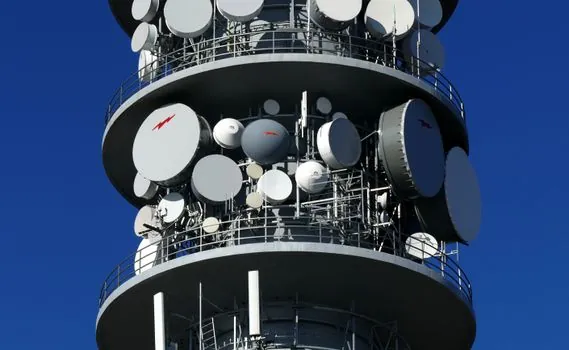
Two antenna options ship with the TS526010: the 29.5-inch Poynting OMNI-493 in UV-stable ASA at 6 to 9 dBi, and the 81.9-inch RFI CDQ7199 Q-Fit fiberglass antenna at 4.5 to 8.5 dBi with a quick-release mount for fast deployment on charter or transient vessels [S3].
Inside the vessel, the same kit supports your choice of four puck or panel antennas: Poynting PUCK-1 omnidirectional dome at up to 7 dBi with six mounting options, or Top Signal EDGE directional panel at 4.3 to 7.5 dBi with four mounting options [S3]. Coax length matters because every additional foot of 400-type cable at cell frequencies costs measurable gain, and the eight pre-terminated runs in TS526010 are cut to specific lengths to feed four inside antennas from one amplifier location [S3]. For smaller rigs, the Shakespeare SuperHalo (CA-VAT-10-R, $1,299.99) is a 2G/3G/4G voice-and-data five-band unit that supports 10+ simultaneous users with one external and two internal antennas, now discontinued but still present in 2026 marine catalogs [S5].
Standards, Certifications, and Sourcing
All weBoost marine repeaters are FCC and IC-certified devices, and the 5G-ready models in the Drive Reach and Drive X Marine lines operate across the 700 to 2100 MHz range that hosts current North American 4G LTE and 5G deployments [S2].
The weBoost Office 200 amplifier inside the TS526010 is designed and assembled in St. George, Utah, and ships with eight pre-terminated low-loss 400-type coax runs and a custom-component option for vessels with non-standard layouts [S3]. Buyers should confirm carrier compatibility for any specific voyage: the entry kit covers all USA and Canadian carriers (Verizon, Sprint, T-Mobile, AT&T, Bell, Telus, Rogers), while TS526010 adds Caribbean, Central American, and South American coverage, so an Atlantic-crossing or Mediterranean charter needs a separate check [S1][S3]. For procurement teams comparing supplier lists, the spec map in Marine timing pulley selection: pitch, material and teeth-in-mesh gates follows the same first-principles format and pairs naturally with this repeater spec map.
Failure Modes and Limits to Plan For

Weak outside signal is the binding constraint: a repeater's coverage inside the vessel scales with available signal outside it, so an offshore buy of the $599 to $899 entry kit will not deliver the 5,000 sq ft figure on the box unless a tower is within roughly 50 miles [S1].
Three predictable failure modes drive most returns: amplifier overload near a harbor (mitigated by XDR on Office 200-class units) [S3], cable run that exceeds the amplifier's loss budget, and antenna choice that does not match the band's polarization [S1][S3]. Metal-hull vessels are a particular concern because the hull itself blocks signal from reaching inside spaces, and a 4-antenna distributed system is the typical fix rather than a single high-gain inside antenna [S3]. For reliability programs that need a calibration-grade signal source instead of an amplifier, the signal calibrator reference page covers the bench-side option.
For 2026 buyers, two trackable signals worth watching: the carrier-by-carrier 5G band refarm announcements that move 4G LTE customers off 700 MHz and onto mid-band 5G, and any revision to FCC Part 20 in-building and maritime booster rules that would shift the 50 dB / 24 to 25 dBm figures quoted here. To match antenna hardware to a specific deck layout, request the antenna selection guide from the marine-cellular supplier before ordering, since the choice between Poynting OMNI-493 and RFI CDQ7199 changes both the 81.9-inch air draft and the quick-release vs fixed-mount workflow [S3].