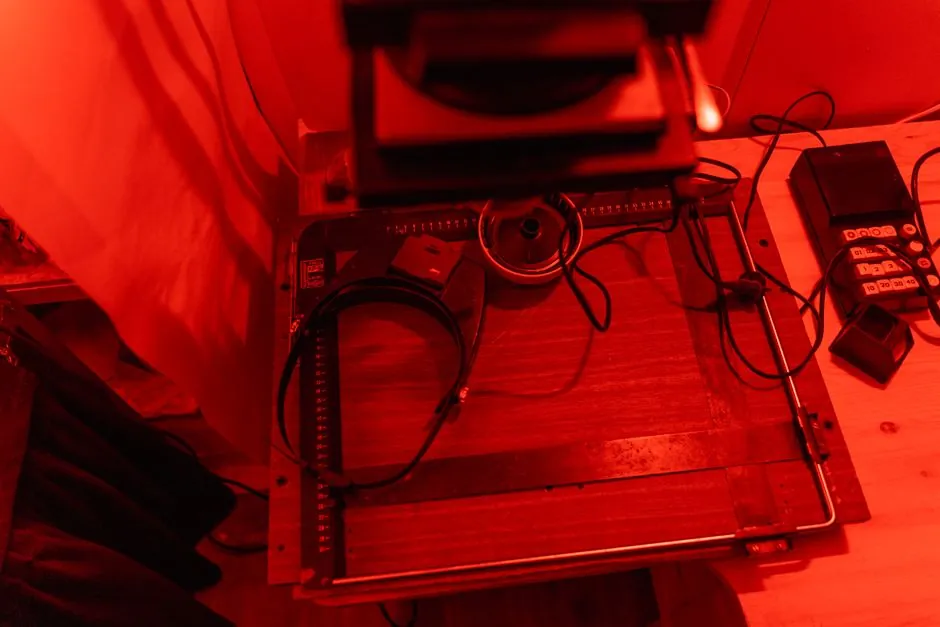
A portable radiation source needs an engineered boundary based on measured dose rates, not an assumed perimeter, with shielding placed at the source where practical and access controlled around the work area [S3][S5].
The setup must combine source shielding, worker separation, exposure-time limits, survey instruments, and written zone rules; for low-activity sources, iterative dose-rate measurements can support the design [S1][S5].
Define the exclusion zone from survey data
The exclusion zone should be drawn from measured radiation levels and the dose criterion that personnel or public access must satisfy. For low-activity source applications, the shielding design process described by an experienced radiation safety adviser starts with dose-rate measurements, adds or relocates shielding, and repeats the measurements until the space meets regulatory requirements [S5].
A boundary should also distinguish restricted access from unrestricted public access. Those values belong to the cited example and must not be transferred to another jurisdiction or application without regulatory review.
Compare distance, time, and shielding controls
Distance provides the strongest leverage of the three basic radiation-control principles because exposure follows the inverse-square relationship with distance under the cited conditions. Doubling separation from an X-ray source can reduce radiation exposure to one quarter rather than one half [S1].
This produces a practical comparison: distance is often the least intrusive control because it requires no material at the barrier; time depends on operator proficiency and correct equipment positioning; shielding reduces exposure at a chosen barrier but adds weight, bulk, and handling constraints [S1]. No single control is universally superior. A compact shielded source with short exposure duration may outperform a distant unshielded source, while a mobile barrier may be necessary where equipment geometry prevents either approach.
For portable radiography, distance alone is not always practical in a crowded clinical space. A previous study reported that standing two steps behind the mobile support structure decreased radiographer exposure by about 80% [S1].
Put shielding on the source when geometry allows
This approach is better suited to a fixed orientation or known component shape than to a source that must be repositioned rapidly without changing the shielding configuration.
Portable-area shielding remains necessary where direct beam paths, scatter angles, bed geometry, or surrounding traffic prevent complete source coverage. A 2026 study used two three-panel mobile units, one on each side of a bed. Each unit had a chromed steel frame measuring 210 by 180 cm, with a 66 by 100 cm panel containing nominal 0.6 mm lead sheet beneath vinyl, and the panels were mounted on wheeled castors for bedside deployment [S4].
Check angular gaps and real deployment geometry
Shielding performance depends on where panels sit relative to the source and scatter directions.
These results apply to the tested configuration and geometry, so they should not be treated as a universal attenuation rate for another lead thickness, panel size, source output, or room arrangement.
The weak directions identify where additional shielding, relocation, access control, or operator positioning may be needed. An enclosure that performs well from the sides can still leave open ends exposed. A pre-job walk-through should therefore map the source, patient or workpiece, primary-beam path, scatter directions, occupied boundaries, cables, doors, and castor movement before panels are positioned.
Use virtual or physical barriers for access control
A physical exclusion zone is appropriate where portable-source work requires preventing people or equipment from entering the area around a moving beam, while a virtual safety exclusion zone can track worker proximity to a defined digital boundary. Virtual systems place a digital barrier around hazardous or moving equipment and use proximity tracking to identify workers approaching it [S6].
The two approaches serve different functions. Physical barriers provide a visible separation that can support shielding, crowd control, and work authorization. Virtual zones add monitoring and event visibility, but they cannot create radiation attenuation and should not replace adequate separation or shielding. For a portable source, the practical sequence is to establish a controlled work area, position the source and shielding, restrict entry during exposure, and use personnel or proximity monitoring where movement creates a risk of inadvertent entry.
Portable boundaries also need to move with the work. A fixed tape perimeter can become ineffective when the source, detector, patient bed, or mobile shielding changes position. Surveying at the actual exposure position is more defensible than relying on a floor-plan perimeter inherited from an earlier setup. The 2026 mobile system’s requirement for positioning guidance is relevant here because its strongest reductions were tied to angular coverage rather than panel presence alone [S4].
Match controls to the work and accept residual risk
Source-mounted shielding is best for fixed geometry and repeatable operation because it attacks the hazard close to the source and can reduce the amount of general-area shielding required [S3]. Mobile panels are better for shared clinical environments where distance and area clearance are difficult, but they add deployment, stability, and angle-coverage issues [S4]. A virtual zone is useful for monitoring and access enforcement, not for reducing dose by itself [S6].
This approach is not suitable for establishing compliance from a generic product catalogue, for a high-activity source without a source-specific radiation survey, or for any work where the boundary cannot be physically maintained. A robust program also establishes source inventory and movement records, restricts access during use, checks source shutters and remote-control functions, maintains shielding integrity, and records worker doses [S5].
Personal protective equipment remains necessary but cannot compensate for a poorly designed exclusion zone. The available equipment includes caps, lead glasses, thyroid protectors, aprons, and radiation-reducing gloves, although shielding devices can be expensive and uncomfortable [S1]. Worker training should therefore cover correct positioning, time control, distance, equipment checks, and emergency response rather than treating dosimetry or apparel as a substitute for engineered controls.
Verify the setup with radiation surveys
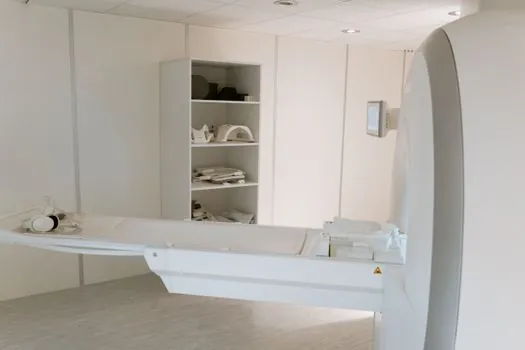
Commissioning should document the source configuration, shielding material and thickness, source output, area layout, survey instrument, measured locations, and resulting zone dimensions. For the mobile system evaluated in 2026, measurements used a radiation survey meter and portable X-ray unit during phantom radiography, covering 320 measurements across the stated angular and distance matrix [S4].
Under a representative high-workload scenario, the two-panel system reduced estimated annual occupational doses across all projections, with post-shielding means remaining below the referenced average annual occupational dose limit of 20 mSv/year [S4]. This is a study-specific estimate rather than a universal design limit. Actual work planning must use the governing exposure limits, dose constraints, source activity, expected workload, and applicable local regulations.
The most trackable implementation signals are measured dose rates before and after shielding, the percentage reduction at the exposed boundary, and confirmation that no critical angle remains uncovered. For the 2026 system, those signals are explicit: 94.1% median reduction, 96.91% mean reduction at 90 degrees, and lower mean reductions of 54.02% and 75.69% at the two open axial ends [S4].