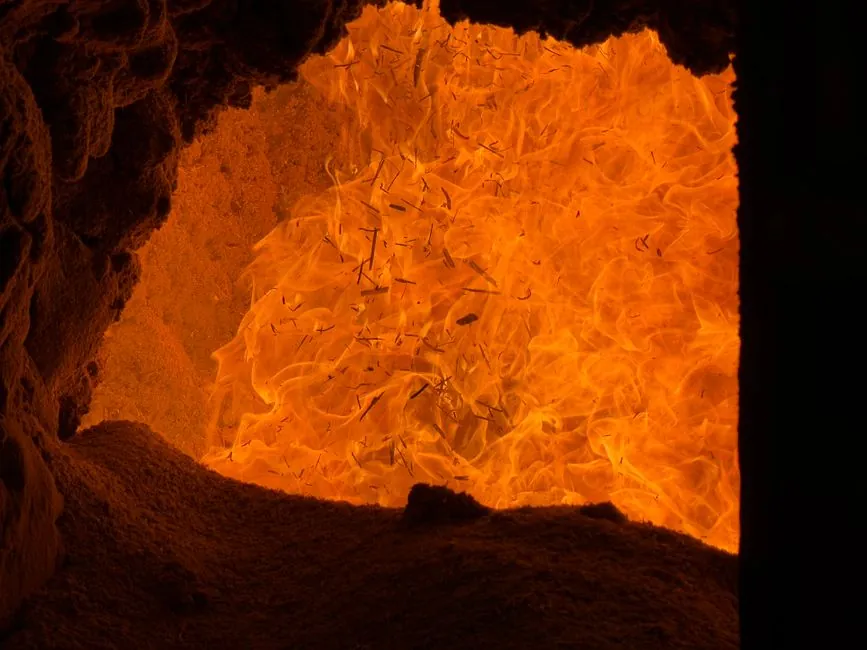
Calcium aluminate cement refractory materials typically operate between 1200°C and 1650°C, with the usable continuous-service limit determined by cement chemistry, aggregate, and installation method [S1].
Refractory cement typically operates within a temperature range of 1200°C to 1650°C, depending on the formulation.
What Temperature Can Calcium Aluminate Cement Withstand?
Calcium aluminate cement, or CAC, contains alumina and develops ceramic bonding as temperature rises, allowing refractory applications that are unsuitable for Portland cement [S3].
The practical maximum service temperature is not a property of cement alone. It applies to the complete refractory concrete or castable, including the aggregate, filler, water-to-cement ratio, installation density, and curing conditions [S2][S8]. A material rated at 1200°C continuous service should not be treated as equivalent to a formulation intended to operate at 1650°C.
Compare The Main Refractory Cement Types
The main options differ more clearly by cement content, alumina level, and lime content than by the word “refractory” alone.
Refractory concrete consists of hydraulic calcium aluminate cement as the binding agent combined with heat-resistant refractory aggregates or fillers. That chemistry can cap performance even when the binder itself appears suitable.
Who Should Specify CAC Refractory Concrete?

Calcium aluminate cement is suited to furnaces, kilns, boilers, incinerators, steelmaking areas, metallurgical equipment, ceramic production, cement plants, and heat-containment structures [S1][S6]. It also offers faster setting and earlier strength development than Portland cement, together with strong acid resistance in applicable repair mortars [S3].
It is not the normal choice for ordinary structural concrete, exposed concrete, or installations where sustained service remains below the useful refractory range. The broader heat-resistant concrete spectrum starts around 300–400°C, the approximate upper limit associated with Portland-cement-bound concrete, while specialist refractory concrete extends toward 2000°C or more [S2].
For thermal-energy-storage concrete, CAC blended with blast furnace slag has been investigated over 75 charge and discharge cycles between 290°C and 550°C. That work demonstrates thermal-fatigue use at moderate temperatures, not qualification for 1200–1650°C refractory service [S5].
Heat Treatment Can Reduce Early Strength
This explains why a casting that is weak after installation can become a competent refractory after proper heat treatment, and why incorrect commissioning can cause damage before useful ceramic bonding forms.
Dehydration is not the only dimensional concern.
Installation And Aggregate Control The Real Limit
Refractory concrete behaves as a composite system: cement paste, heat-resistant aggregate, water, and any added filler all contribute to performance [S3]. A concrete mix based on high-alumina cement blended with blast-furnace slag was exposed to as many as 75 thermal cycles between 290°C and 550°C.
Conventional, low-cement, ultra-low-cement, self-flowing, and gunning castables represent different installation classes.
The supplier’s declared service temperature should be checked against the intended aggregate and maximum operating temperature. Calcium aluminate cement literature explicitly instructs users to select for the anticipated service temperature rather than treating refractoriness or melting behavior as the sole criterion [S8].
Short-Term Exposure Is Not A Service Rating
A short thermal spike does not authorize operation above the declared continuous rating unless the product has a separately documented exposure limit and a tested duty cycle.
Published material assigns about 1600°C as the melting point of a calcium aluminate cement cited for refractory applications, while another product literature states refractoriness above 1500°C [S6][S9]. Those figures are not substitutes for maximum continuous service temperature. Refractoriness describes heat-resistance behavior, whereas service rating also depends on the installed castable and operating conditions.
Calcium aluminate-based mortars and concretes fall within the scope covered by European Assessment Document EAD 150002-00-0301, which assesses composition, compressive strength, setting time, alumina content, chloride, alkalis, sulphate, sulphide, and refractoriness [S4]. Annex A guidance in EN 14647 can also be taken into account where applicable to the mortar or concrete [S4].
Specification Checklist For A Safe Temperature Rating

A defensible specification identifies the complete product rather than naming only calcium aluminate cement. It should record maximum continuous service temperature, short-term exposure limits, alumina content, cement percentage, aggregate type, density, installation method, curing regime, and heating schedule [S1][S2][S4].
For conventional castables, confirm both the binder and aggregate because their combination governs the upper service limit [S2]. For low-cement and ultra-low-cement systems, verify the reduced cement and lime content rather than assuming the temperature of a conventional mix [S2]. For repair mortars, distinguish between Portland-cement blends and CAC-only or high-CAC formulations because setting, adhesion, and compressive strength vary with the blend [S3].
The closing verification point is the product-specific refractory test record. EAD 150002-00-0301 includes refractoriness as an assessed characteristic and also requires composition and mechanical-performance information [S4]. Confirm the declared value against the maximum continuous temperature expected at the installation, then reserve any higher figure for documented short-term exposure.