
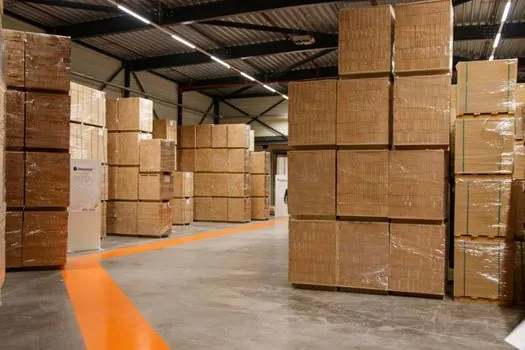
A 10-layer pallet of 5 kg cartons places 45 kg, or 99 lb, on the bottom carton before the safety factor is applied [S4].
The required compression capacity depends on filled-carton mass, layers above the carton, pallet height, storage duration, humidity, and the finished box's compression strength.
Load carried by the bottom carton
The bottom carton does not carry its own product weight when checking vertical stack load. It carries the cartons above it: load equals filled-carton weight multiplied by the number of layers above the bottom carton [S4].
For 10 layers with 5 kg per carton, the bottom carton supports 5 kg × 9 = 45 kg, equivalent to 99 lb [S4]. If each carton weighs 25 lb and the pallet has 8 layers, the bottom carton supports the weight of the 7 cartons above it, totaling 175 lbf [S4].
Stacking pallets inside a container adds another load case. The carton calculation must include the pallet mass and the load transmitted by any pallet stacked above it [S4]. When the carton box is selected by footprint rather than by BCT, it cannot be assumed to carry the same vertical load.
Convert stack load into required BCT
Apply a safety factor to the calculated static stack load before comparing it with box compression strength.
The selection sequence is explicit: calculate the supported weight, multiply by the safety factor, then specify a carton with adequate BCT or request an ECT grade linked to vertical compression performance [S4]. The comparison below separates the main packaging inputs:
ECT is not interchangeable with BCT. ECT measures a board property in force per unit length, while BCT measures the completed carton in total force [S1].
Use the McKee formula for box geometry
The McKee equation is BCT = 5.87 × ECT × √(caliper × perimeter), with ECT in lbf/in, caliper and perimeter in inches, and predicted BCT in lbf [S5]. For a rectangular carton footprint, the full perimeter is 2 × (length + width) [S5].
The method is most reliable for regular single-wall RSC cartons within its published range: carton height must be at least perimeter ÷ 7, and the footprint length-to-width ratio must not exceed 3:1 [S3]. A simplified expression such as BCT = (ECT × perimeter) ÷ height omits caliper and can mislead a precise design [S2].
That estimate remains subject to the actual box construction, board grade, storage conditions, and physical testing.
Set pallet height, duration, and humidity limits
PackCalc provides safe-working-load categories for short-term storage of 1–7 days, medium-term storage of 8–30 days, and long-term storage of 31–180 days [S3].
Warehouse and transit conditions affect corrugated BCT, so they should be considered when sizing a box for its stacking requirements [S1]. PackCalc accounts for environmental derating in its required-ECT and stack-safety calculations, provides safe-working-load categories for short-term, medium-term, and long-term storage, and warns that the simplified McKee formula is most accurate for regular single-wall RSCs [S3].
Offset columns also change the result. For planning around a pallet rack, do not transfer a rated rack load directly to carton stacking capacity.
Choose the right test and production controls

TAPPI T804 measures BCT on a finished carton between two flat platens, typically compressed at 0.5 in/min until failure [S5]. ECT is measured under TAPPI T811, while Mullen burst under TAPPI T403 measures hydraulic burst pressure and relates to puncture resistance rather than direct stacking performance [S5].
Physical BCT testing is the appropriate final check for prototypes and production samples [S1]. The related decision between ECT, BCT, and Mullen ratings matters because a Mullen value cannot be substituted directly for finished-carton compression strength.
Apply the calculation to procurement
A traceable carton specification should state the finished dimensions, board construction, ECT grade, caliper, BCT requirement, safety factor, storage-duration basis, humidity basis, and pallet-layer count. The supplier can then quote an equivalent grade, while finished-box BCT testing confirms the conversion [S1][S5].
For a 10-layer, 5 kg carton stack, the minimum planning load before derating is 99 lb, and the required ECT can be estimated with the McKee formula before physical qualification [S2][S4][S5].
Track two signals before releasing the pallet pattern: the qualified BCT-to-stack-load ratio and the storage duration covered by testing. If either changes, recalculate the carton grade rather than carrying forward the original pallet-height assumption.