
The correct calculation combines sand consumed per mold, planned mold rate, operating time, reclaim yield, and mixer cycle time rather than relying on mixer nameplate capacity alone.
Start With Sand Demand at the Molding Line
Calculate gross sand demand by multiplying net sand per mold by planned molds per hour.
Separate gross demand from reclaim demand. If 25% of the returned sand is reclaimed and reused, the new-sand requirement is 75% of gross consumption, or 4.05 t/h in this example. Any sand lost in transport, spillage, dust extraction, or disposal must be added as a separate loss factor rather than hidden inside the reclaim percentage.
Use the actual production plan, not peak nameplate speed. A 300-mold/h machine that runs for 2 shifts produces a different hourly requirement from one operating for 3 shifts, while breaks, planned maintenance, changeovers, and short starvation periods still affect the material buffer. The mixer must meet the line's average consumption and have enough surge capacity to refill that buffer.
Convert Batch Mass and Cycle Time to Capacity
For a batch mixer, the basic capacity equation is net batch mass divided by effective cycle time. A 2,720 kg batch with a 120-second cycle produces 22.7 kg/s, or 81.6 t/h before deductions.
Effective cycle time is not merely the timer setting. Include charging, wetting, mulling, discharge, door travel, and the minimum interval before the next batch can begin. If the mechanical cycle is 120 seconds but charging and handling add 20 seconds, use 140 seconds. At 2,720 kg, that lowers theoretical output to 69.9 t/h.
Apply planned availability after the cycle calculation. At 80% operating availability, 69.9 t/h becomes 55.9 t/h of delivered capacity. If each batch is fully usable, this meets the 5.4 t/h line requirement with more than 10 t/h of margin. That margin may be unnecessary if the mixer runs continuously and downstream storage requires little surge capacity.
Use Continuous Mixer Capacity for High-Volume Lines
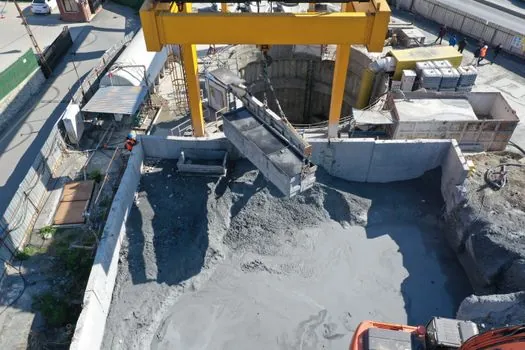
For a continuous mixer, derive output from the calibrated sand mass rate at the discharge and confirm it against the operating retention time and contained mass.
The continuous calculation should be cross-checked with metering equipment. For chemically bonded systems, sand, binder, catalyst, and additives enter at controlled rates [S1]. If the calibrated dry-sand rate is 200 t/h and the binder addition is 4% by mass of sand, total mixed-material discharge is 208 t/h, while the relevant sand-plant throughput remains 200 t/h. Adding liquid without distinguishing its mass basis creates an avoidable sizing error.
Continuous preparation can be appropriate where a molding line consumes large volumes at a steady rate. Batch equipment remains practical for smaller foundries, specialty molds, intermittent schedules, and sand systems requiring separate charge control.
Compare Mixer Types Against Four Decision Criteria
Batch mulling and continuous mixing differ in cycle behavior, surge capacity, property control, and handling complexity. Batch systems charge a defined mass, mix it as a batch, and discharge after the retention period. Continuous systems meter ingredients and move the mixture continuously through the mixing chamber [S1][S2].
On steady demand, continuous systems can remove charging and discharging interruptions and deliver a continuous sand supply [S2]. On variable demand, a batch system can hold a defined recipe and stop between production cycles, although it creates larger downstream gaps. Sand-property consistency depends on accurate metering, retention time, moisture control, and maintenance rather than mixer type alone.
For green sand, batch mulling combines silica sand, bentonite, water, and additives through pressure and kneading action [S1]. Chemically bonded sand requires continuous or metered binder and catalyst addition, with sand temperature affecting resin behavior [S1][S3].
Account for Reclaim, Moisture, and Binder Mass
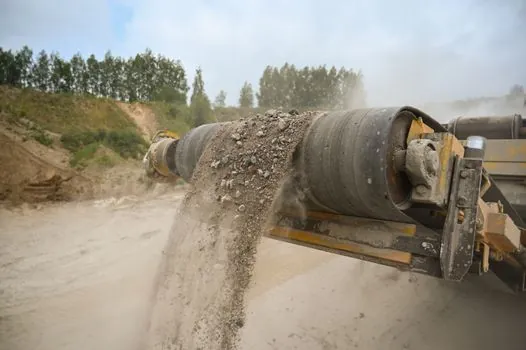
Dry-sand throughput is the preferred basis for comparing equipment. Measure the mass entering the mixer over a defined interval, then separate entrained or added water if the molding recipe is specified on a wet-sand basis. A 100 t/h wet-sand stream containing 4% moisture contains 96 t/h of dry sand and 4 t/h of water. [S1]
New-sand input is the molding line's gross consumption multiplied by the non-reclaimed fraction. Reclaimed sand still needs mulling and property correction, so it must pass through the mixer capacity calculation. The mixer does not only make up fresh sand loss; it conditions the entire usable circulation stream.
Green-sand control requires daily testing of compactibility and related properties, with laboratory testing able to reveal changes between the muller and mold [S4]. For each molding line at Grede-St. Cloud, daily tests are used to quantify variation within the sand system and make corrections as needed to keep it within the optimal performance range [S4]. Use this kind of daily measurement to reconcile calculated throughput with actual line consumption.
Set the Mixer for the Sand System
Short mixing times of 1–3 minutes are associated with high-volume production mixers, but the appropriate time must be established through trials for the actual sand, binder, moisture, and mixer configuration [S8]. The broader selection criteria include batch size, cycle time, sand temperature, moisture-control method, discharge arrangement, and molding-line demand [S1].
For green sand, mulling pressure and kneading must distribute moisture and develop the clay bond around the grains [S1]. For chemically bonded sand, sand and resin temperature affect set time and gas-generation risk; a published reference gives a preferred sand and resin range of 85–95°F and notes that PUNB set time can double or halve for each 18°F change in sand temperature (2014-01-17) [S3].
Do not accept a high-rate mixer that cannot hold binder ratio, sand temperature, water addition, and retention time within control. A higher nameplate rate will not correct poor compactibility, inconsistent coating, or unstable mold properties.
Validate Capacity Under Real Operating Conditions
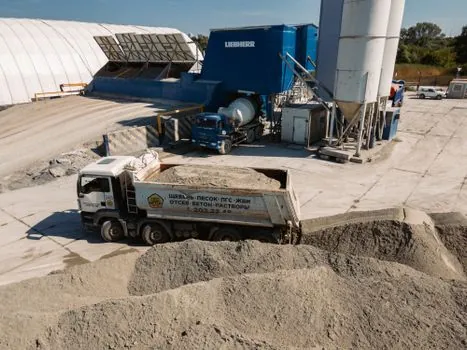
Validate the calculation with three measured quantities: sand delivered per hour at the molding station, new sand added per hour, and reclaimed sand returned per hour. The mass balance should satisfy delivered prepared sand equals new sand plus reclaimed sand minus measured losses, subject to the moisture and sampling uncertainty of each stream. [S1]
Measure the line's actual consumption over at least one full operating shift and compare it with the calculated requirement. Check sand depth, compactibility, moisture, and property variation at both the mixer outlet and mold station. Daily compactibility testing can identify variation within the sand system, while paired automatic and manual checks can expose drying or loss of compactability between muller and mold [S4].
The final sizing decision is traceable when the equipment sheet states gross demand, reclaim percentage, new-sand rate, usable batch mass, total cycle time, availability, and calculated delivered t/h. Track planned output against measured t/h and mixer retention time each shift, because any sustained gap between the two values identifies either an undersized mixer or excess downstream demand.