
Sheet molding compound made from carbon fiber recyclate cuts compression-mold cycle time to 1-3 minutes per part versus the multi-hour room-temperature cure that defines hand wet layup, making SMC the only realistic option for automotive body-panel programs above roughly 1,000 parts per year [S3].
Wet layup, by contrast, remains the lowest-barrier process for prototype and low-volume composite body panels, with hand-saturated fabric, ambient cure, and tooling that can be built for an order of magnitude less capital than the matched-metal compression press SMC demands [S2][S4].
Process Fundamentals: Resin Control Defines the Tier
The single largest performance gap between carbon-fiber SMC and wet layup is resin-content control: SMC sheets arrive from the compounder with fiber volume fraction fixed in the 40-55% range, while wet layup depends on the operator's hand to meter epoxy, polyester, or vinyl-ester resin into dry fabric, leaving fiber-to-resin ratio variable from part to part [S2][S4].
Compression molding of SMC applies 500-1,500 psi at 120-160 °C for 60-180 seconds, producing a near-net-shape panel with both surfaces formed by tool steel, whereas wet layup typically cures at 20-25 °C for 12-24 hours under vacuum bag or open mold [S3][S4]. This is why wet laminates consistently show higher void content (commonly 2-5% by cross-section microscopy) than SMC press-molded parts (well under 1%), with direct consequences for paint-pinhole rate on Class-A body panels [S2].
Mechanical Performance per Kilogram of Panel
Carbon-fiber SMC using reclaimed or virgin chopped tow (typically 12-25 mm length) lands in the 150-200 MPa tensile strength and 15-25 GPa modulus window for automotive-grade formulations, behind continuous-fiber prepreg but ahead of glass-fiber SMC and well ahead of hand-laid random-mat laminates [S3][S4].
Wet layup with stitched or woven carbon fabric reaches 400-600 MPa tensile strength in a unidirectional lay, but in the quasi-isotropic stacks actually used for body panels (typically [0/+45/-45/90]s), effective in-plane properties fall toward 200-300 MPa, with stiffness sensitive to operator-dependent compaction and resin-rich pockets [S2][S4]. For a same-thickness fender or door panel, the SMC part is heavier than an equivalent continuous-fiber laminate but lighter than a wet-laid random fabric part of equal areal weight, and the SMC number is the one the production scheduler can hit on the 10,000th part.
Tooling, Capex, and Cycle-Time Economics
Wet layup wins on entry cost: an open female mold in epoxy tooling board or sprayed gelcoat over a plaster master can be produced for USD 5,000-20,000, with no press, no oven, and no chilled SMC storage required [S2][S4]. SMC demands a heated matched-metal compression press rated 500-2,000 tons, hydraulic or electric, plus an oven for compounding the sheet if in-house; realistic installed cost for a production cell sits between USD 2 million and USD 8 million [S3].
The payback math depends on volume: at 5,000 panels per year the SMC press cycle of 90-180 seconds per part delivers 200-400 parts per shift per mold cavity, which wet layup cannot approach even with five operators hand-rolling. At 200 panels per year, the wet layup shop pays back its tooling in weeks and the press sits idle [S2][S4]. Programs between 500 and 1,500 parts per year sit in a genuine gray zone where high-pressure RTM with carbon preforms is increasingly specified instead of either pure wet layup or SMC.
Surface Finish and Paint-Shop Compatibility
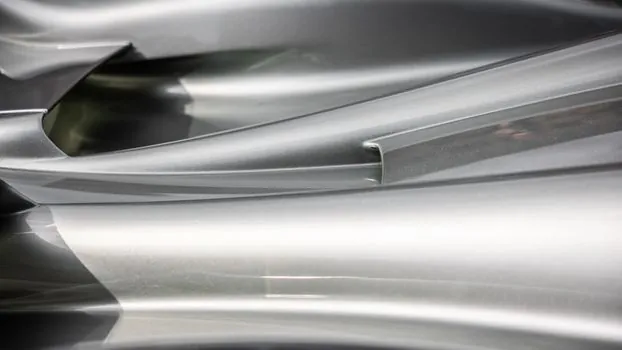
Dry carbon (prepreg) and properly compounded SMC both deliver surfaces smooth enough for direct clear-coat after light scuff, because both are cured under heat and pressure against polished tool steel [S1][S2]. Wet layup against an open mold, in contrast, is documented to leave air-bubble pockets, fiber print-through, and thickness variation that forces a heavier filler-and-primer block-sanding step before paint [S4][S5].
For OEM paint lines that run 40-60 °C e-coat plus 140-160 °C topcoat bake, SMC formulations using vinyl-ester or low-profile-additive polyester carriers survive the thermal cycle with class-A surface intact, while wet layup panels are at risk of microcracking at the resin-rich surface unless the resin system is selected specifically for paint-bake compatibility [S3][S4]. UV stability of the gelcoat or topcoat layer is a separate concern: wet-layup polyester resins yellow visibly under prolonged sun exposure, while epoxy-based prepreg and most SMC systems hold color longer because they are not the outer surface to begin with [S4].
Decision Matrix: Which Process Fits Which Program
Match the process to the program's volume, surface target, and capex ceiling. Use the table below as a one-line selection rule. [S2]
For an automotive body-panel program above 1,000 parts per year needing Class-A direct-paint finish, specify carbon-fiber SMC with vinyl-ester or epoxy-vinyl-ester hybrid resin, chopped-fiber length 12-25 mm, and a 500-1,500 ton heated press [S3]. For a motorsport or low-volume boutique run under 500 parts per year where the buyer can absorb heavier surface finishing and accepts batch-to-batch variation, wet layup with stitched carbon fabric and ambient-cure epoxy remains the cheapest route from CAD to physical panel [S2][S4]. For structural Class-A programs under 1,500 parts where continuous-fiber properties are needed, route to high-pressure RTM rather than either extreme.
Limitations and Failure Modes to Engineer Around
Wet layup fails in opposite ways: (1) dry spots and voids where the roller did not compact the fabric, requiring post-cure ultrasonic inspection; (2) resin-starved or resin-rich zones from operator variance, visible as fiber print-through or sink marks under paint; (3) higher scrap rate on the first 20-30 parts of any new mold as the layup team learns the draping sequence [S2][S4][S5]. For both processes, design the panel with a minimum 1.5-2.0 mm wall thickness and 3-5 mm corner radii to keep fiber wet-out and press flow within process window.
Sourcing and Standards Reference
Specifying carbon-fiber SMC for body panels should reference the OEM's material standard (for example, a GM 7000-series or equivalent SMC material specification) and the press-molded panel standard for paint-shop compatibility, while wet layup panel specs typically cite ASTM D5687 for hand-layup layup procedures and ASTM D3171 for constituent content verification. Detailed process guidance for both routes, including resin-system selection and cure-cycle windows, is also catalogued at the carbon fiber reference page. [S4]
Track two signals over the next 12 months: (1) commercial availability of longer-chop (50 mm) carbon SMC that closes more of the mechanical gap to continuous-fiber laminate; (2) any OEM body-panel program that publicly converts from wet layup or prepreg to carbon SMC for a structural closure panel, which would be the first hard proof that the cycle-time advantage is outweighing the property penalty at series volumes [S3].