
A carburized-and-ground worm shaft typically lands at 58-64 HRC surface hardness with a 0.5-2.0 mm case depth and 28-42 HRC core [S1], while a through-hardened worm shaft carries a uniform 28-42 HRC section through its full diameter with no distinct case.
Both routes are running in industrial gearboxes in 2026, and the practical question for a process engineer is which route matches the actual load, sliding-velocity, distortion, and accuracy budget of the drive [S5].
Where Each Process Belongs on a Worm Shaft
Case hardening, carburizing or nitriding followed by finish grinding, is the dominant route for cylindrical worms in industrial speed reducers because the worm tooth is loaded almost entirely in sliding contact against a bronze wheel, and the bronze is the sacrificial member [S5]. The standard material palette for case-hardened worms is 16MnCr5 (DIN), 8620 (AISI) and SCM420 (JIS) for carburizing, and 42CrMo4 or 4140 for nitriding, all finished to DIN 4-8 grade after heat treatment [S1]. Nitrided worm shafts run 900-1,200 HV surface hardness with case depth limited to roughly 0.1-0.6 mm and very low distortion, which is why precision gearboxes with tight lead and profile tolerances lean toward nitriding rather than carburizing [S1].
Through-hardening, by contrast, is a quench-and-temper operation that converts the entire worm section to a uniform hardness, typically 28-42 HRC for alloy worm-shaft steels [S1], and is preferred where the worm is large in diameter, sees heavy or fluctuating load, and must resist deflection across the full section. Forum field data from heavy-equipment shaft production backs this split: bigger shafts are less likely to be run through-hard, and through-hard parts are almost always finish-ground to clean up quench distortion [S2].
Decision Criteria, Side by Side
The four criteria that swing the spec are surface hardness, case depth, distortion, and the grinding step that follows. Carburized worms deliver 58-64 HRC at the surface and 0.5-2.0 mm of effective case, at the cost of moderate distortion that mandates thread grinding to hold profile and lead [S1]. Nitrided worms give 900-1,200 HV with only 0.1-0.6 mm of case depth but very low distortion, so the finish-grinding stock allowance can be tighter [S1]. Through-hardened worms skip the case process entirely, run uniform 28-42 HRC through the section, and still need a final grind because the quench step moves the worm axis [S2].
Case-hardened gears score on wear resistance, fatigue strength, and production cost for moderate loads; through-hardened gears score on uniform strength and simplicity for large or heavily loaded parts, at the price of higher brittleness and, for some alloys, higher material cost [S3]. For a worm running against a bronze wheel at high sliding speed, the harder, thinner case of a carburized or nitrided worm is almost always the better tribological match [S5], while a through-hardened worm tends to show up where the shaft itself is the structural bottleneck.
Module, Size, and Accuracy Mapping
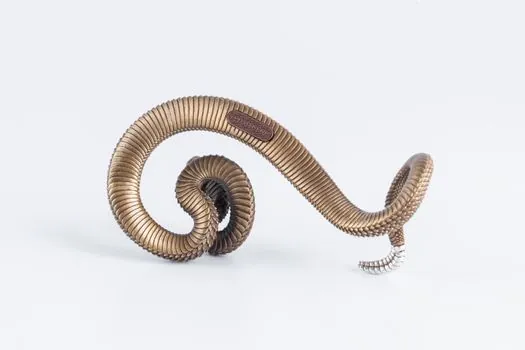
Module range drives case depth. A 0.3-1.0 module worm is comfortable with a 0.5-0.8 mm case, while a 5-20 module industrial worm needs the full 1.5-2.0 mm case to keep subsurface contact stresses in the hardened layer [S1]. Nitrided 42CrMo4 is reserved for precision worms where the case is shallow by design and the thread is finish-ground to DIN 4 or better [S1].
Size and rigidity are where through-hardening earns its slot. Large-diameter worm shafts, low-speed hoist worms, and any drive where the shaft bending stress is comparable to the tooth contact stress, are commonly run as through-hardened 4140 or 42CrMo, then ground, rather than case-hardened [S2]. The same logic is echoed in the worm-design guide: a hard surface is not enough on its own, the worm must also be ground, and the heat-treat route must be picked to keep that grind within budget [S6].
Material Pairing With the Bronze Wheel
The classic industrial pair is a hardened steel worm shaft meshing with a phosphor-bronze or aluminum-bronze worm wheel [S4]. The bronze wheel is the conformable, embeddable sacrificial member, and the steel worm is the wear-resistant driver, so the harder and more fatigue-resistant the worm surface, the longer the set runs before the bronze needs replacement [S1].
Research on worm-gear load capacity confirms this asymmetry: gearbox life is almost always limited by the bronze wheel, through wear, pitting, or tooth fracture, while the worm shaft itself is normally only checked against deflection per DIN 3996 and ISO/TS 14521 [S5]. That is exactly why a case-hardened, ground worm is the default: it shifts the wear budget onto the cheaper bronze member, and it leaves the worm with enough hardness and surface finish to survive the sliding contact [S5]. A through-hardened worm is the choice when the load on the shaft section itself, not the tooth flank, is the limiting failure mode, for example very large hoist or steel-mill drives.
Failure Modes and Spec Pitfalls

Three failure patterns drive most worm-shaft warranty returns. First, scuffing and adhesive wear on a worm that was specified too soft, often a through-hardened worm running at high sliding speed against bronze [S5]. Second, case crushing or subsurface pitting when the Hertzian contact depth exceeds the case depth, which is why the 0.5-2.0 mm case range has to be tracked against module and load [S1]. Third, quench distortion that was not budgeted in the grind stock, leaving the worm out of DIN accuracy on lead and profile, a problem nitrided worms largely avoid and through-hardened worms cannot [S1][S2].
Field reports on hardened-steel worms driving bronze wheels also flag tooth geometry as a hidden variable: a multi-thread worm shifts the load share per tooth and changes the contact pattern, which interacts with the case-depth choice rather than with the through-hard choice [S7]. The conservative spec is to fix the heat-treat route first, then pick the thread count and module to match.
Selection Recommendation by Drive Type
For a standard industrial right-angle speed reducer in the 0.5-20 kW range, 1:5 to 1:60 ratio, with a bronze wheel, a carburized 16MnCr5 or 8620 worm ground to DIN 6-8 is the default; switch to nitrided 42CrMo4 only when distortion control on the shaft is the binding constraint [S1]. For a precision servo or indexing worm gear where lead error is budgeted in arc-minutes, nitrided 42CrMo4 ground to DIN 4-5 is the safer pick, accepting the 0.1-0.6 mm case in exchange for near-zero growth [S1]. For a large hoist, crane, or steel-mill worm where shaft bending dominates, a through-hardened 4140 or 42CrMo worm at 28-42 HRC, ground after quench, is the structurally honest answer [S2].
Trackable signals for a buyer in the next sourcing cycle: confirm the OEM's case-depth test method and acceptance range, ask for the post-grind DIN grade on the drawing, and verify whether the worm is carburized or nitrided, since the difference between 58-64 HRC and 900-1,200 HV is the difference between a wear part and a precision part [S1]. For more on the sliding-contact side of this trade-off, see the worm reducer material notes in the worm reducer encyclopedia entry, and for the shaft side, the shaft coupling and shaft fastening pages cover the adjacent fit and retention questions that follow once the worm blank is heat-treated. Related comparisons on heavy-duty shaft and coupling trade-offs are laid out in the beam helical vs bellows coupling spec map.