
Automatic case packing machine capacity includes a 1–16 cartons-per-minute rating and stated operating speeds of 15 to 60+ cases per minute across the cited manufacturer and integrator sources [S4][S6].
The figures apply to different machine architectures, including side-load, top-load, robotic, dual-case, and integrated case-erecting systems, so they are not directly interchangeable without checking the tested product and case format [S1][S2][S5].
Published Throughput Ratings and Their Limits
Combi states that its drop packers, including configurations with an integrated case erector, can run at speeds of up to 30 cases per minute [S1]. These are maximum or range statements rather than a guarantee that every product, case, and plant configuration will reach the upper figure.
Published lower-end examples define the practical range more clearly. The CP-S50 is rated at 1–16 cartons per minute for cartons measuring 240–500 mm in length and 200–400 mm in width [S4]. Hamrick lists operating speeds of 15 to more than 60 cases per minute, while Brenton's RT1000 robotic case packer has a pick-and-place rate of up to 20 cases per minute and a maximum payload of 70 lb [S6][S7].
A useful comparison therefore starts with architecture rather than headline speed:
How to Convert Cases per Minute into Line Output
One case packer operating at 35 cases per minute for 280 minutes produces 9,800 cases, matching a documented performance example [S3]. At 25 cases per minute over the same 280-minute period, output would be 7,000 cases. The difference is 2,800 cases, or 35.7% of the 7,000-case lower result [S3].
For a production target, the calculation is straightforward: rated cases per minute multiplied by scheduled running minutes gives theoretical output. The defensible planning figure must then be discounted for planned changeovers, stops, reduced-speed running, and rejected cases. An 8-hour shift contains 480 minutes, but one documented operating pattern allowed only 280 minutes of actual case-packer runtime because 80 minutes were assigned to changeover and 60 minutes to downtime [S3].
That 280-minute example produced an availability ratio of 58.3%, because 280 divided by 480 equals 58.3% [S3]. At 35 cases per minute, the resulting average over the full 480-minute shift was 20.4 cases per minute. At 25 cases per minute, the shift average was 14.6 cases per minute. These figures show why a nameplate cases-per-minute rating should not be used as the shift planning rate without an availability allowance [S3].
Side Load, Top Load, Robotic, and Dual-Case Options
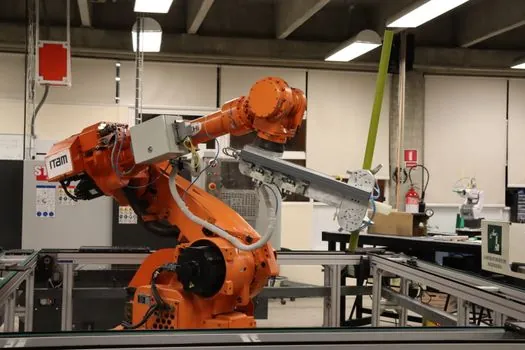
Side-load and horizontal-load systems introduce products into cases from the side and are used when product orientation must be maintained [S2][S5]. Combi's integrated drop-packer approach combines case erection with packing in a system rated up to 30 cases per minute [S1].
Top-load systems place products vertically into open cases and can accommodate different product shapes and packing arrangements [S5]. Robotic packers use pick, orient, and place motions, giving them flexibility across product sizes and pack patterns. Brenton's RT1000 example combines a 20-case-per-minute pick-and-place rating with a 70 lb maximum payload [S7]. That payload limit applies to the cited model and should be checked against product weight, grip geometry, and handling configuration.
Dual-case packing is different from merely operating at a higher single-case speed. Compared with side load at 75-plus cases and trays per minute, the dual-case system offers a narrower published ceiling but a different handling method. Compared with robotic packing at up to 20 cases per minute, it may suit repeatable arrangements, while robotic handling is more readily configured for changing products and patterns [S2][S5][S7].
Selection Criteria for Production and Case Constraints
The product and case format define the credible rating. The CP-S50 specification ties its 1–16 carton-per-minute range to carton lengths of 240–500 mm and widths of 200–400 mm [S4]. By comparison,
Case weight and handling stability also narrow the practical rate. The RT1000's 70 lb payload ceiling is a defined engineering limit, not a general limit for robotic case packers [S7]. This kind of product-control equipment can determine whether a nominal packing rate remains practical, particularly with unstable or loosely packed contents.
Footprint and upstream integration should be assessed with the same discipline. An integrated erector reduces process handoffs, while robotic equipment can accommodate different sizes and product types [S1][S2]. The case case packing machine should be selected around confirmed case dimensions, product presentation, required pack pattern, available floor space, and the downstream sealing and discharge rate, not only the highest published cases-per-minute figure.
Throughput, Availability, and Quality Must Be Audited Together
OEE provides the most complete assessment because it combines availability, performance, and quality rather than treating speed as a stand-alone metric [S3]. In the documented example, availability was 58.3%, performance at a reduced 25 cases per minute was 71.4%, and quality was 96.4% because 250 of 7,000 cases were out of specification. Those three factors combined to produce an OEE of 40% [S3].
The calculation shows the commercial effect of nominal speed. Seven thousand cases were completed in the shift, but only 6,750 met the quality requirement, a loss of 250 cases [S3]. Changeover controls are therefore part of throughput engineering. Documented approaches include color-coded changeover components, tool-less adjustments, counter-based settings, and automated robotic tool changing through the machine HMI [S3].
For procurement, request the rated test condition behind each number: cases per minute or cartons per minute, product type, case dimensions, number of cases loaded simultaneously, and whether the figure represents a maximum, sustained rate, or observed run [S1][S2][S4][S5]. Then reconcile that rating with the upstream filling machine, coding machine, and downstream capping sealing machine so the fastest section does not become the line constraint.
Failure Modes That Reduce Rated Output
The most common engineering mistake is to treat a maximum rating as sustained production. A machine that can run at 35 cases per minute during the available production window does not deliver 35 cases per minute across an 8-hour shift if changeovers and downtime consume 200 minutes [S3]. In that example, full-shift average output fell to 20.4 cases per minute even while the packer was running at its ideal speed [S3].
Four losses deserve direct measurement. First, case-forming and size-change delays reduce availability, as shown by the 80-minute changeover allowance in the operating example [S3]. Second, product accumulation, uneven distribution, or over-packing can interrupt the loading cycle. Third, faults in feeding, gripping, flap positioning, or discharge can stop an otherwise fast machine [S2]. Fourth, rejects can lower saleable output even when the mechanical cycle continues; the documented example lost 250 of 7,000 cases to out-of-spec packing [S3].
Preventive maintenance, HMI-based downtime tracking, and planned tool changes are practical controls, but they still require a defined response time and loss category if OEE is used for procurement or line improvement [S3]. A useful acceptance test should record actual cases per minute, downtime by cause, changeover duration, and good-case yield under the intended product and case specification.
Market Context Does Not Replace Machine Sizing
The case packing machines market was valued at USD 712.4 million in 2026 and is projected to grow at a 3.0% compound annual rate to USD 957.4 million by 2036 [S8]. That market figure provides investment context, but it does not establish the throughput, changeover time, payload, or reliability of a specific machine. Specification should remain tied to the machine model and tested operating condition.
No single rating covers all case packing machine applications. Published figures establish a 1–16 carton-per-minute envelope for one constrained side-load model, up to 30 cases per minute for an integrated drop packer, up to 35 cases per minute for a dual-case system, up to 20 cases per minute for the cited robotic model, and more than 75 cases and trays per minute at the upper end of one side-load portfolio [S1][S2][S4][S5][S7].
The next trackable signals are the manufacturer's model-specific rating, the proposed acceptance-test product and case dimensions, and the supplier's planned-shift calculation showing how rated speed converts into good cases per hour and per shift. If those three values are documented, the headline rate becomes a usable engineering input rather than an unsupported capacity claim.