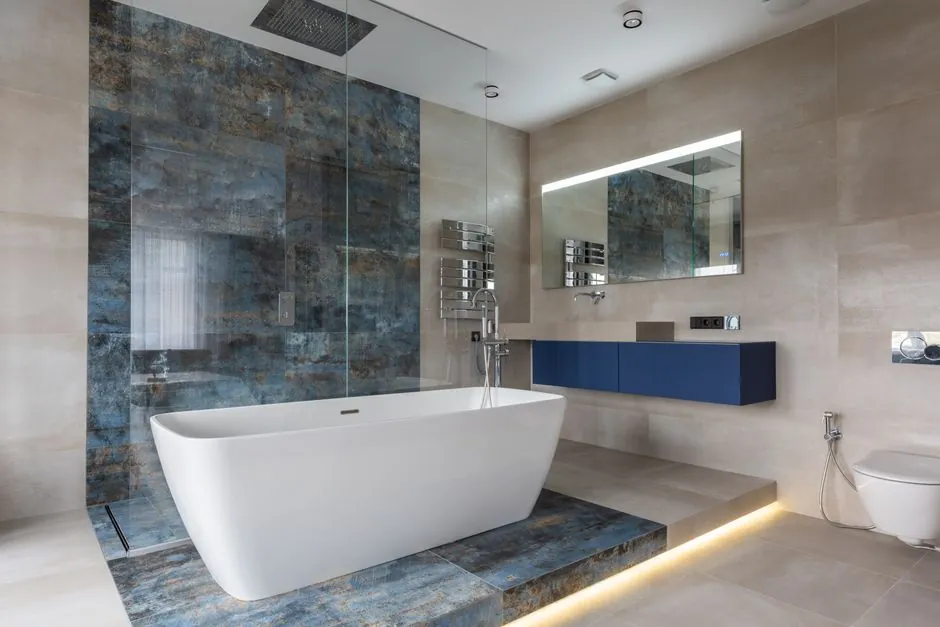
Porcelain tile has a 40–100 year service life, while luxury vinyl tile typically lasts 10–25 years under normal use [S2][S4].
For commercial projects, the comparison depends on traffic, moisture exposure, installation quality, maintenance, and whether underfoot comfort matters more than maximum service life [S1][S3].
Commercial lifespan ranges and material distinction
Porcelain tile is the stronger long-term choice for demanding commercial floors because properly installed porcelain can remain serviceable for 40–100 years [S2].
LVT is an engineered multilayer product with a photographic design layer, clear wear layer, protective finish, and backing or rigid core. Commercial LVT lifespan varies from 10 to 25 years because wear-layer thickness, installation conditions, and maintenance materially affect service life [S3]. The floor system is industrial flooring, not the decorative surface alone, that determines whether the stated life is achieved.
A practical planning rule is to use tile where the design horizon exceeds 25 years and traffic is heavy, then price the expected earlier LVT replacement rather than treating initial installation cost as the whole financial comparison.
Traffic, moisture, and heat criteria
Porcelain tile resists scratches, is completely waterproof, and is specified for hotel lobbies, retail floors, and restaurants, while LVP is more appropriate for light commercial settings [S2]. LVT construction is waterproof and its surface accepts routine damp mopping without grout, but prolonged moisture exposure can damage the core [S1][S2].
Tile provides the better wet-area solution because shower floors, spa bathrooms, and steam rooms require a non-grouted, water-stable surface [S2]. LVT can soften or warp under high heat, which restricts its use near intense direct sunlight or radiant heating, whereas porcelain remains heat-resistant [S4].
Traffic exposure also changes the failure mode. LVT can dent under concentrated or pointed loads and scratch around damaged sections [S4][S5]. Ceramic and porcelain can chip or crack when a heavy object is dropped, but an individual damaged tile can be replaced without removing the complete floor [S1][S3].
Comparison across four project criteria

Against four decision criteria, porcelain tile leads on service life, heavy-traffic durability, and water resistance, while LVT leads on installation speed and underfoot comfort [S1][S2][S4]. The comparison applies to properly installed products and normal maintenance rather than a laboratory warranty claim.
Porcelain tile combines a 40–100 year lifespan with scratch resistance and waterproof performance, but requires mortar, grout, cutting equipment, and specialist labor [S2]. LVT combines a 10–25 year lifespan with faster installation, no grout, and a softer, quieter surface, but cannot be refinished and may fade in direct sunlight [S2][S4].
Ceramic tile remains a viable middle option at 20–50 years, with lower cost than porcelain but more chip and crack risk because it is less dense [S4][S5]. The ceramic tile decision should therefore separate ceramic from porcelain rather than treating all tile as one performance class.
Installation, maintenance, and replacement economics
LVT reduces installation time because click-lock products can float over a prepared subfloor without mortar or grout, while glued LVT remains difficult to remove later [S1]. Commercial installation is quicker and less labor-intensive than ceramic or stone installation, although LVT is not treated as a do-it-yourself commercial installation [S3].
Porous grout lines require maintenance, while tile is susceptible to dents, scratches, and fading depending on the material and use. That operational difference can reduce routine cleaning labor even when LVT needs eventual replacement.
Published cost ranges also need careful interpretation. Tile generally costs more upfront than LVP, while LVP typically installs faster and more easily. These are market ranges, not universal quotations, and installation method, substrate condition, demolition, pattern, grout, and adhesive can materially alter the final cost.
Application fit and failure risks
LVT fits offices, corridors, hospitality rooms, and light-commercial areas where occupant comfort, low downtime, and simple cleaning outweigh a 40-year-plus service horizon [S1][S3]. Its 10–25 year range makes replacement planning necessary for leasehold or rapidly reconfigured interiors. Individual pieces can also be exchanged without disturbing the entire installation [S3].
Porcelain tile fits lobbies, retail, hospitality, food-service, corridors, and other spaces exposed to concentrated foot traffic or frequent water [S2]. It is harder and colder underfoot, grout adds maintenance, and impact damage can produce chipped or cracked units [S1].
LVT falls short of tile in high-traffic and high-moisture environments, and its 100% waterproof construction does not eliminate vulnerability to dents, scratches, and fading. Tile is the wrong selection when rapid installation, minimal disruption, warm footing, or a low initial material budget outweighs longevity and grout maintenance.
Specification data to verify before purchase
The commercial submittal should identify porcelain or ceramic separately, then document the expected service life, installation system, edge and joint treatment, grout maintenance, and replacement strategy. For LVT, the submittal should also state wear-layer thickness, core construction, adhesive or click-lock method, and the manufacturer’s commercial warranty conditions [S3][S4].
Wet-area tile selection also requires a documented slip-resistance basis rather than lifecycle claims alone.
Track the two project signals that can confirm the specification: the expected replacement year for LVT and the planned grout-sealing cycle for tile. If neither can be funded and scheduled, the advertised service-life ranges will not translate into durable commercial performance.