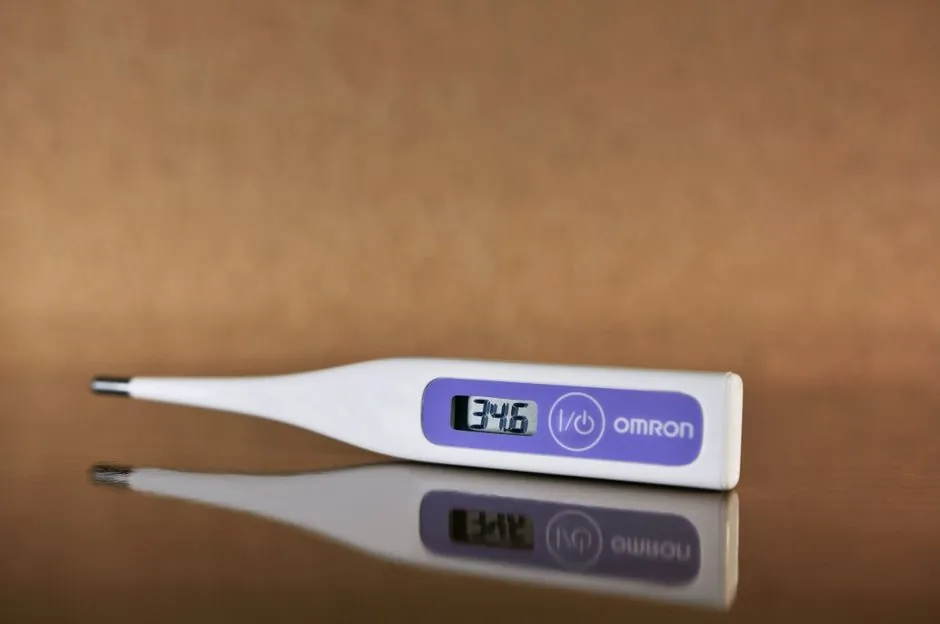
An LM35 analog temperature sensor is the lowest-cost candidate for a -50 to +150 °C installation, but its ±0.5 °C specification applies at 25 °C rather than across the full range [S3].
The LM35 family provides a linear 10 mV/°C output, a 4–30 V supply range and less than 60 µA quiescent current, but one variant must be selected for coverage from below -10 °C to above +110 °C [S3].
What accuracy at -50 to +150 °C actually means
The accuracy requirement is a full-range specification, not a single point at room temperature. The LM35 typically achieves ±0.5 °C at 25 °C without calibration, while the LM35D is specified at approximately ±0.75 °C at 0 °C and ±1.0 °C at 100 °C [S3].
That distinction determines the answer: no LM35 variant supported by the research can be claimed to hold ±0.5 °C over -50 to +150 °C. A design requiring ±0.5 °C throughout that span must use a higher-grade sensor, accept a wider tolerance, or add calibration and suitable sensing hardware.
The LM35’s scale factor is 10 mV/°C, producing 250 mV at 25 °C and 1.00 V at 100 °C. Typical nonlinearity is ±0.25 °C over the operating range, which supports straightforward ADC conversion without polynomial correction [S3].
LM35 variants and range coverage
The LM35D covers -10 to +110 °C, so it cannot remain within the specified operating envelope at either -50 °C or +150 °C [S3]. The LM35DZ extends the nominal range from -55 to +150 °C, matching the requested span, while the LM35CAZ covers -45 to +150 °C but starts 5 °C above the lower limit [S3].
For a single device operating across the complete requested span, the LM35DZ is the matching package variant. Its analog output still does not establish ±0.5 °C accuracy across the range, so datasheet operating limits must not be confused with system accuracy [S3].
The TO-92 package is identified as the lowest-cost and simplest package option, but it must be checked against the exact suffix ordered. Package and temperature range are separate selection fields: LM35D, LM35DZ and LM35CAZ use different envelopes even when their electrical interfaces are similar [S3].
Cost-oriented comparison of the main options
For component price and interface simplicity, the LM35DZ ranks first: 10 mV/°C output, 4–30 V supply and under 60 µA quiescent current suit a basic analog input [S3]. Its weakness is accuracy away from 25 °C, with the documented LM35D limits reaching ±1.0 °C at 100 °C [S3].
Thermocouples provide a cheap alternative when the probe, signal conditioning and microcontroller input are counted as a complete system. A community engineering discussion describes thermocouples as fairly cheap and very accurate when the correct type is selected for the temperature range, but it does not establish ±0.5 °C over -50 to +150 °C [S4].
Fiber-optic temperature sensors offer complete electrical isolation and immunity to electromagnetic interference, making them suitable for high-voltage environments [S2]. Their disadvantages are different: they require optical infrastructure and are positioned for electrically isolated, EMI- and RFI-sensitive installations such as transformers, generators, GIS equipment and switchgear [S2].
The TMP141 is a low-power digital option, but it does not satisfy this temperature requirement. Its specified measurement range is -40 to +125 °C, accuracy is ±2 °C from -25 to +85 °C and up to 3 °C from -40 to +125 °C, with 0.25 °C resolution and a typical 110 µA quiescent current [S1].
Choice by accuracy, range and installation method
The LM35DZ is suitable when a -55 to +150 °C nominal range, an analog 10 mV/°C signal and minimum component cost matter more than guaranteed ±0.5 °C accuracy at the extremes [S3]. It is appropriate for enclosure, HVAC and industrial monitoring designs where the ADC, wiring and enclosure provide adequate thermal coupling.
A thermocouple is the better low-cost choice when broad range, flexible probe placement or electrical isolation is required and the system can accommodate the appropriate thermocouple type, cold-junction compensation and analog signal conditioning [S4]. The reference material does not establish that an unspecified thermocouple will maintain ±0.5 °C over the complete interval.
Fiber-optic temperature sensors offer complete electrical isolation and immunity to electromagnetic interference, making them suitable for high-voltage environments [S2]. The three principal optical approaches are fluorescent fiber-optic sensors, fiber Bragg grating sensors and distributed temperature sensing [S2].
The TMP141 fits battery-powered electronics-health monitoring rather than this process range. Its 2.7–5.5 V supply, 0.25 °C resolution and ability to place up to four devices on one single-wire SensorPath bus are useful, but its 125 °C upper limit and 3 °C maximum accuracy over -40 to +125 °C rule it out [S1].
Accuracy risks beyond the sensor specification
Self-heating can shift the reading even when the sensor itself is within tolerance. The LM35’s self-heating is below 0.1 °C in still air when operated from 5 V at minimum load, but PCB copper, enclosure geometry and nearby heat sources can change thermal coupling [S3].
Response time is another constraint. A TO-92 LM35 has a thermal time constant of approximately 60 seconds in still air, falling to roughly 10–20 seconds with forced airflow [S3]. For control loops or thermal-shutdown functions, this lag must be included in the control design rather than treating ±0.5 °C as the only selection criterion.
Two-point calibration can reduce offset and slope error during production, but the research does not establish that it can recover the LM35’s full-range ±0.5 °C performance. Thermal coupling, ADC error, supply noise, sensor placement and calibration budget must therefore be validated together in the final enclosure.
Recommended specification for procurement
Specify an LM35DZ only if ±0.5 °C means at room temperature or a narrow calibrated operating band. For guaranteed accuracy across -50 to +150 °C, request a sensor with an explicit full-range tolerance, identify the probe or package, and state whether the limit is at 25 °C or over the complete range. [S3]
A practical procurement line for the low-cost analog option is “LM35DZ, TO-92, -55 to +150 °C, 10 mV/°C, 4–30 V supply, typical ±0.5 °C at 25 °C.” This wording prevents the full-range requirement from being confused with the point accuracy claim [S3].
For the full-range accuracy class, use a fiber-optic probe with documented ±0.5 °C performance and suitable overlap with -50 to +150 °C. Fluorescent, FBG and DTS architectures cover different installation scales, while all avoid metallic sensing elements and provide electrical isolation [S2].
Before releasing the design, compare the quoted sensor price with the complete channel cost: probe or package, ADC resolution, compensation, enclosure, calibration and installation. The lowest purchase price is not the lowest installed cost if drift or calibration work reverses the initial saving.