
Climbing-style hard hats with four-point chin straps are now mainstream across U.S. construction, utilities, and tower work, with ABS and HDPE shells, EPS inner liners, and quick-release buckles as the dominant build pattern [S4][S6].
Current offerings split into ANSI Z89.1-2014 Type I Class C vented models for general construction and Type II Class E non-vented models for live electrical and lateral-impact work at heights, with EN 12492 clauses 4.2 referenced for mountaineering-style retention [S4][S5].
ANSI/EN Class Combinations and What Each Rating Actually Covers
The ANSI/ISEA Z89.1-2014 standard sorts industrial head protection into Type I (top impact), Type II (top plus front, side, and rear impact), and three electrical classes: Class G (up to 2,200 V), Class E (up to 20,000 V), and Class C (no electrical protection) [S4][S5].
Climbing-style helmets with a four-point chin strap appear in every combination: the Traverse industrial climbing helmet is certified Type II Class E with ABS shell and EPS foam liner, meeting EN 12492 clauses 4.2 for retention under load [S4]. The Jackson Safety CH400V is Type I Class C vented HDPE for non-electrical work-at-height and scaffolding, while the Bullhead HH-CH2-B is Type II Class C with optional venting for confined spaces without arc-flash exposure [S2][S5].
For European climbing work, EN 12492 (mountaineering helmets) imposes a stronger chin-strap retention test, and several U.S. climbing helmets explicitly cite compliance with its clause 4.2 alongside ANSI Z89.1, giving buyers a dual-certification path on a single SKU [S4].
Shell, Suspension, and Chin-Strap Build Differences
Four-point chin straps come in two dominant layouts: a Y-style strap with two rear anchor points and a cross-over front buckle, and a strap with four equally spaced anchors around the shell rim [S4][S9].
Traverse pairs the cross-over strap with a SURE-LOCK wheel ratchet, a 4-point HDPE suspension, an above-brow comfort pad, and an ABS shell, weighing roughly the same as a Type II competitor at 16 oz class shell mass [S4][S5]. The Ceros XP300A uses a removable four-point chin strap on a full-brim ABS shell aimed at users who swap chinstraps between jobs, while the PIP Rocky industrial climbing helmet combines a polycarbonate/ABS shell with a nylon suspension and wheel ratchet for a low-profile 280 g-class fit [S6][S7].
Common to all is a quick-release buckle below the jaw: the Traverse lists an adjustable 4-point cross-over chin strap with quick release, the Aolamegs Type I Class C uses a chin-strap design that pairs with a built-in flip-up visor, and Jackson's CH-350 adds a 3-pt. chin strap plus integrated high-impact polycarbonate visor for hot-work and cutting tasks [S1][S4][S5].
Comparison: Four Common Climbing-Style 4-Point Chin-Strap Models
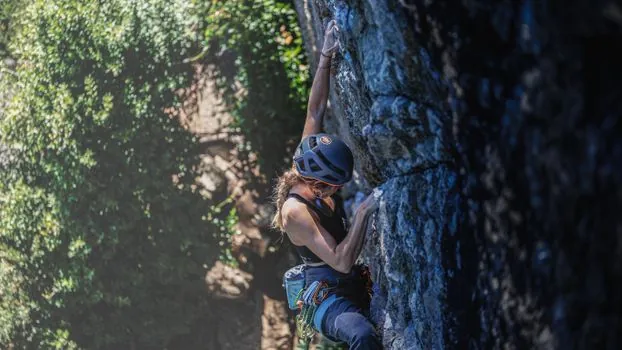
Side-by-side, the spec sheet shows how each model lines up on the four buying criteria: certification, shell, suspension, and intended environment. [S4]
Traverse Type II Class E Non-Vented (ABS shell, EPS liner, 4-pt. HDPE suspension, EN 12492 clause 4.2, 4-pt. cross-over strap with quick release) targets live electrical and lateral-impact work at heights [S4]. Jackson CH400V Type I Class C Vented (HDPE shell, chin cup, ANSI Z89.1 + OSHA) targets non-electrical scaffolding and construction where airflow matters [S5]. Bullhead HH-CH2-B Type II Class C with optional venting (4-pt. chin strap, ratchet suspension) targets confined spaces and industrial climbing without arc exposure [S2]. PIP Rocky Industrial Climbing Helmet (polycarbonate/ABS shell, nylon suspension, wheel ratchet, 4-pt. chin strap) targets general industrial work at heights on a lighter build [S6].
Selection Criteria: When to Pick a 4-Point Climbing Helmet
A four-point chin strap is the right call whenever a fall, slip, or sudden inversion could dislodge a standard 6-pt. hard hat, including tower climbing, scaffold erection, wind-energy work, shipboard work, and confined-space entries where the wearer's head is frequently tilted below horizontal [S3][S4][S6].
Specify Type II Class E non-vented ABS when work involves up to 20 kV of incidental contact, lateral impact risk (steel erection, oil and gas derricks), or hot work where vent openings can admit sparks. Specify Type I Class C vented HDPE when the job is scaffolding, residential framing, or general construction with no electrical exposure and the user values airflow in hot climates [S4][S5]. Specify EN 12492 plus ANSI Z89.1 dual certification when the helmet must be shared between U.S. construction crews and European-style rope-access or rescue teams, since EN 12492 imposes a stronger chin-strap retention test under dynamic load [S4].
Skip the four-point chin strap for ground-only tasks where the helmet rarely tips, since the extra strap can snag on low-clearance equipment; a standard 6-pt. cap-style hard hat is the better fit, and the trade-offs are detailed in a separate bump cap vs full hard hat spec sheet.
Limitations, Failure Modes, and Compliance Pitfalls
Four-point chin straps fail in three predictable ways: buckle fatigue after roughly 12 to 24 months of daily use, strap fraying at the anchor points where the strap rubs the shell, and chin-cup deterioration from sweat and UV exposure, all of which require replacement rather than re-use [S4][S9].
Class C vented helmets must never be substituted for Class E where electrical contact is possible, because vent openings can admit conductors to the head and no dielectric rating is provided [S4][S5]. Conversely, a non-vented Class E helmet in a hot, low-airflow environment raises heat-stress risk, and a vented Class C with chin strap is the safer pick for summer scaffolding at the cost of zero electrical protection [S5].
Compliance-wise, OSHA 29 CFR 1926.100 requires head protection in construction where objects can fall or strike workers, and ANSI Z89.1-2014 is the consensus standard cited in most U.S. safety programs; the four-point strap itself is not a separate certification but a retention feature evaluated under Z89.1 and EN 12492 retention clauses [S4][S5]. Buyers should confirm the SKU actually carries a third-party Z89.1 stamp rather than only an "ANSI-compliant" marketing claim.
Procurement Signals to Track Through Q4 2026
Two trackable signals: first, the spread of dual ANSI Z89.1-2014 + EN 12492 certified climbing helmets, with the Traverse SKU at 280-HP1491R-09 currently the clearest example, and a credible data point on how many SKUs add EN 12492 over the next two quarters [S4]. Second, pricing on Type II Class E ABS climbing helmets, where the Traverse lists at $74.95 in October 2026 and competing Type II Class C vented or non-vented models from PIP and Bullhead cluster lower, so watch for sub-$60 Type II Class E SKUs entering the major industrial channels through the end of 2026 [S4][S6][S2].
For selection context, the vented vs non-vented hard hat trade-off and the 4-point vs 6-point suspension comparison cover the adjacent decision points buyers face when moving from a standard cap-style hard hat to a chin-strap climbing helmet.