
Color mark sensors detect a preset color mark and are suitable for packaging, printing, textile, and labeling applications.
A practical selection compares mark contrast, sensing distance, optical spot size, ambient-light immunity, enclosure rating, and output type rather than treating every colored target as the same detection problem [S1][S2][S3].
Operating Principle and Detection Scope
A color mark sensor illuminates a target and evaluates reflected light, commonly using RGB channels, then switches a digital NPN or PNP output when the learned color threshold is met [S3]. This arrangement lets a machine use the mark as an electrical reference for cutting, sealing, indexing, positioning, or registration [S3].
The key distinction is contrast rather than absolute color matching. A color mark sensor can learn the difference between a printed registration mark and its surrounding substrate, which can be more stable than judging a specific hue that changes with process conditions [S1][S4]. It differs from an ordinary photoelectric presence sensor, which detects an object boundary without evaluating color or chroma, and from a general RGB color sensor, which classifies true color for sorting or inspection [S3].
Color discrimination can also stabilize detection for combinations that are difficult to distinguish with a single wavelength [S4]. For registration marks, including eye marks printed on packaging film or labels, this multi-channel evaluation gives the PLC a more selective event signal than a simple presence transition [S3][S5].
Advantages for Automated Production Lines
Color mark sensors support accurate detection of printed labels, registration marks, and color-coded components while enabling automated cutting, positioning, sorting, and quality-control functions [S3]. Their principal production advantage is accurate and repeatable color-mark detection, which supports quality control, production-line speed, and waste control.
Compared with a standard photoelectric sensor, a color mark sensor adds discrimination of the actual surface color or contrast difference while retaining a fast digital decision [S3].
RGB technology can make a registration mark easier to identify when the mark and background share similar visual characteristics, provided the controller has been taught the correct mark and background colors [S5]. The sensor also avoids requiring a separate mechanical alignment fixture when a printed mark can serve directly as the machine's positioning reference [S3].
Lighting, Calibration, and Environmental Constraints

The principal disadvantage of optical color detection is sensitivity to ambient lighting and the need for calibration [S2]. A sensor reports the light returned by the surface under its own illumination, so changing the distance, geometry, or lighting can alter the color signal it evaluates [S7].
Installation therefore needs controlled geometry. The sensing distance must fit the machine structure, and the optical spot should be smaller than the color mark so that surrounding material does not contaminate the measurement [S3]. For uneven or moving surfaces, consistent orientation, working distance, illumination, and lens alignment are more defensible than simply increasing receiver sensitivity.
As a comparison point, a capacitive sensor can detect a target through some nonmetallic materials, but it does not evaluate printed color or optical contrast, so it cannot replace a color mark sensor for registration control.
Comparison Across Four Selection Criteria
Against a standard photoelectric sensor, a color mark sensor adds color or contrast discrimination but requires optical setup and calibration; against a general RGB color sensor, it offers faster, task-specific mark recognition but is not intended to classify unlimited true colors [S1][S2][S3].
The compact color mark sensor category includes units with a maximum sensing distance of 50 mm or less and white or RGB LED illumination [S6]. These figures describe the cited product class, not a universal limit for every color mark sensor.
Best-Fit Applications and Required Accessories
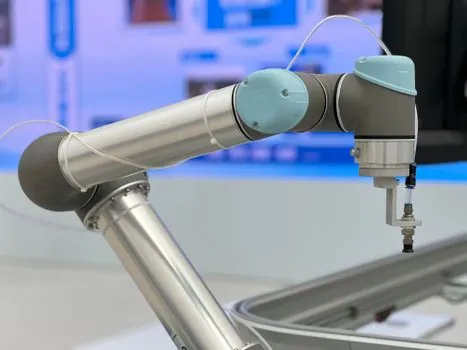
Color mark sensors fit food and beverage packaging, pharmaceutical labeling, roll-print registration, PCB mark detection, and conveyor sorting where a printed color signal must trigger a machine action [S3]. Takex positions mark sensors for detecting specific marks, color changes, and process-indication marks or bars, including labels [S8].
These sensors are not the best choice for simple object counting, where an ordinary photoelectric sensor provides the required presence signal with fewer calibration variables [S3]. They are also a poor substitute for a full machine-vision system when the task requires character recognition, defect geometry, multiple independent colors, or surface inspection beyond the selected mark [S3][S5].
For inspection applications, a fiber-optic sensor can reach confined spaces, but a photoelectric color mark sensor remains better suited to a defined printed reference with a digital trigger. In either case, the selected output must match the PLC input architecture, including NPN or PNP requirements and the intended machine sequence [S3].
Acceptance Tests Before Production Use
Commissioning should verify at least 5 operating conditions: the taught mark, the background without a mark, minimum and maximum working distance, ambient-light changes, and operation at maximum intended line speed [S1][S2][S3]. The output must also fail safe when the mark is absent, dirty, torn, or outside the optical spot.
During validation, record missed detections and false triggers through production variation, including changes in product color, print registration, film tension, and illumination. Calibration should be repeated after any change to sensor angle, working distance, LED source, or lens setup because the evaluated reflected spectrum changes with those conditions [S3][S7].
For procurement, the practical specification package should state the sensing distance, maximum spot size, minimum response time, LED type, output configuration, cable length, supply voltage, and required ingress rating [S3][S6]. On listed compact models, the combined envelope is a 50 mm maximum sensing distance, white or RGB LED illumination, and high-speed photoelectric mark discrimination [S6].
The next trackable signal is not a market statistic but a process acceptance result: a production sample demonstrating zero missed marks and zero false triggers at the maximum specified line speed, across the full range of product and lighting conditions [S1][S2][S3].