
Combination smoke/CO detectors are sold as a single 2-in-1 or 3-in-1 (smoke + CO + heat) unit, but Consumer Reports has long noted that "few combination detectors are effective at detecting carbon monoxide, smoldering fires, and flaming fires" all at once [S5].
Standalone smoke and CO detectors remain the configuration most fire-safety authorities and insurers recommend for full residential coverage, because each hazard class has its own optimal sensor type, placement rule, and end-of-life window.
What a "Combination" Detector Actually Contains
A 2-in-1 combination unit typically pairs a photoelectric smoke chamber with an electrochemical CO cell; a 3-in-1 adds a thermistor for fixed-temperature heat detection, all on one PCB and one sounder [S3].
Photoelectric sensors dominate the smoke channel because they trigger fewer nuisance alarms from cooking, and they outperform ionization sensors on smoldering fires; ionization sensors, in contrast, respond faster to open-flame fires with sub-micron combustion particles [S5]. A combo unit therefore trades some flaming-fire response speed for fewer kitchen false alarms, and the CO channel has no way to compensate for that trade.
Sensing Principle Gap: Smoke vs CO
Smoke and carbon monoxide are fundamentally different threats and require fundamentally different sensors: smoke alarms use either ionization or photoelectric chambers, while CO alarms use electrochemical cells tuned to CO oxidation at a working electrode, with a stated useful life of 5 to 7 years [S4].
This is why the two devices have different replacement cadences. The widely cited service life is 10 years for smoke alarms and 5 to 7 years for CO alarms [S4]; an integrated unit therefore forces either premature replacement of the still-functional smoke channel, or operation with an expired CO cell, and the device itself has no separate date stamp for each sensor.
Placement Rules: Why the Two Hazards Want Different Walls
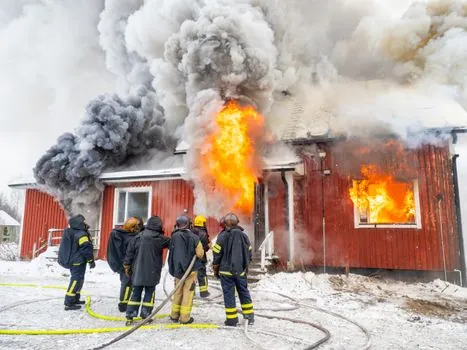
The National Fire Protection Association recommends smoke detectors on every level, inside each bedroom, and outside each sleeping area, mounted on the ceiling 6 inches from the wall or on a wall 6 to 12 inches from the ceiling, because smoke rises [S5].
Carbon monoxide, by contrast, disperses evenly through a room, so CO detectors can be installed high or low on a wall and the placement guidance follows the appliance risk map (near furnaces, water heaters, attached garages) rather than the ceiling rule [S5]. Mounting a 2-in-1 unit on the ceiling to satisfy smoke rules puts the CO sensor in the wrong vertical zone for some CO clouds, which are slightly warmer than ambient air and stratify differently from smoke.
Performance Evidence From Independent Testing
Patriot Insurance Co. cites Consumer Reports directly: "Few combination detectors are effective at detecting carbon monoxide, smoldering fires, and flaming fires" simultaneously, a finding consistent with CR's broader observation that combination units often pass two of three test categories but lag in the third [S5].
For context on the underlying CO hazard, the U.S. consumer-product safety data set cited in the same source records roughly 50,000 emergency-room visits and over 400 deaths per year from CO poisoning in the United States, with CO generated by furnaces, kerosene heaters, gas stoves, portable generators, vehicle exhaust, and burning charcoal or wood [S5]. A CO channel that is "adequate" on a CR bench test is not the same as one that is optimal, and that gap is what separate electrochemical CO alarms are designed to close.
Interconnect, Voice Annunciation, and Smart Features
Modern stand-alone and combination units both ship in interconnected and Wi-Fi variants, so the "one device per hazard" configuration no longer means losing whole-home voice alerts; the trade-off is per-device cost and per-device battery management, not feature parity [S1].
Newer smart detectors increasingly use Matter over Thread, which lets a dedicated CO alarm and a dedicated smoke alarm join the same smart-home fabric and trigger each other's alerts without needing a proprietary bridge [S4]. That removes the historical "combo units are simpler" argument at the integration layer, while keeping each hazard on its optimal sensor.
When a Combination Unit Is the Right Call
Combination alarms are designed to meet basic safety regulations, and they can be a decent option for smaller homes or apartments where the best practice is not always possible, for example in a studio where ceiling placement and wall placement collapse onto the same spot [S4].
They are also lower cost per device, simpler to install, and require only one battery swap cycle per location, which is a real benefit for rental property, dorm rooms, and short-term hospitality where a single mixed-use unit beats zero coverage [S3]. Code-minimum installations in jurisdictions that allow a combo device to satisfy both requirements can also use 2-in-1 units, but a separate smoke detector is the higher-performing configuration.
Selection Criteria: Combo vs Separate, Head-to-Head

On four decision criteria, the comparison reads: (1) Flaming-fire response, ionization stand-alone wins, photoelectric-only combo lags slightly; (2) Smoldering-fire response, photoelectric stand-alone or combo is comparable; (3) CO sensitivity, dedicated CO alarm with a fresh electrochemical cell outperforms most combo CO channels in CR's history; (4) Total cost of ownership over 10 years, separate units mean replacing the CO alarm once at year 6 and the smoke alarm once at year 10, while a combo unit typically means a full replacement at year 6 to keep the CO sensor in spec [S4][S5].
For applications that also need fixed-temperature heat detection (kitchens, garages, attics), a separate heat alarm is the cleanest add-on to a split smoke/CO architecture, and 3-in-1 smoke/CO/heat units exist for that niche as well, traded off the same way against sensor specificity [S3]. Buyers should also confirm the UL mark on the label, which indicates compliance with the applicable safety standard, and check the manufacture date stamp, because dated inventory ages out the 10-year smoke and 5 to 7 year CO service life before the unit is even installed [S5].
For a deeper look at the smoke-channel half of this trade-off, the Photoelectric vs Ionization Smoke Detector selection map breaks the sensor-type question out separately.
For component-level specifications, see construction machinery and equipment.