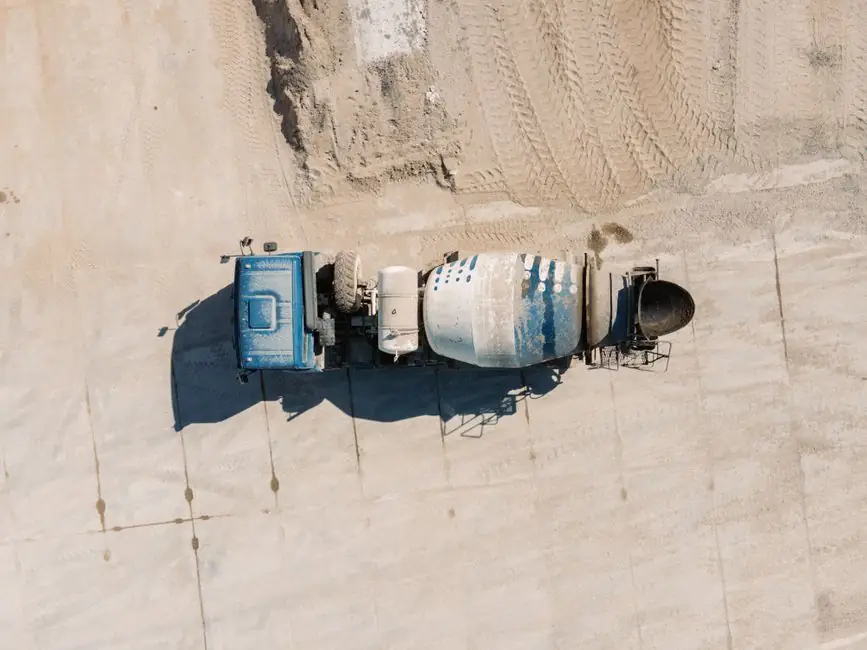
A truck-mounted pump removes concrete through a self-contained boom, while a trailer pump moves it through steel pipe or flexible hose; a line pump can exceed 1,000 m horizontally and reach 150 m vertically [S3].
For a repetitive job site, select the configuration that matches pour volume, placement reach, access, line routing, and crew setup rather than comparing maximum reach alone [S1].
Decision criteria for repetitive pumping
Measure the full operating cycle: mixer discharge into the hopper, pumping through the delivery system, repositioning the discharge hose or boom, and return to the next load [S1][S3]. Both a concrete pump truck and a stationary trailer pump require a separate ready-mix truck to discharge concrete into the pump hopper [S3].
Record the required delivery rate, number of pour windows per day, horizontal pipeline length, vertical lift, aggregate size, mix characteristics, and distance from the ready-mix truck to the placement point [S1]. Trailer pumps are identified as line or stationary pumps and are suited to smaller jobs requiring lower pumping volume [S2].
If each pour uses a different discharge point or requires a routed pipeline, retain the trailer pump layout and standardize hose connections and line support instead.
Compare placement speed and labor
Truck-mounted boom pumps are described as suitable for large construction projects and capable of placing large concrete volumes quickly; the boom is remote-controlled [S2]. A trailer pump can provide continuous concrete flow because its two pistons alternate jobs and a valve switches the cylinders between the hopper and the discharge pipe.
The comparison is therefore operational rather than promotional. A boom pump usually reduces ground-level line installation and manual hose movement for a concentrated, repetitive pour, while a trailer pump requires pipe or hose connections from the pump to the placement point [S2][S3].
Labor should be counted by task, not just headcount. Ground or line-pump work includes extending, supporting, connecting, and protecting the delivery line; boom-pump work includes deploying and stabilizing the truck and articulating the boom [S1][S3]. Confirm who performs each task during the concrete order and include that labor in the placement-cost comparison.
Reach, line routing, and site access
The cited ground-pump configuration can reach more than 1,000 m horizontally and 150 m vertically, although actual capacity depends on the delivered mix and installed pumping system [S3].
A truck-mounted boom avoids a ground pipeline but remains constrained by boom geometry, truck position, setup stability, and overhead or site obstructions. Those dimensions describe articulation, not guaranteed placement reach for every chassis, boom, or counterweight configuration [S3].
Use the trailer pump when access permits a stable trailer position and the line can be routed safely, or when the placement point is too high or distant for the boom. Use the truck-mounted configuration when the truck can approach the pour, deploy quickly, and serve a concentrated work area without long pipeline runs [S1][S2].
Best fit by work pattern
A truck-mounted pump is the stronger match for repetitive pours that remain within a compact placement area, especially where rapid repositioning and reduced pipe installation control the schedule [S2]. It is also suitable when the placement area is difficult to reach directly from the mixer truck [S1].
A stationary trailer pump is the stronger match for lower-volume work, dispersed placements, and projects that require a pipeline route such as a sidewalk or pool [S2]. It also fits sites where the pumping location can remain fixed and the line can be installed once, including applications where the required horizontal run exceeds 1,000 m or the vertical lift reaches 150 m [S3].
Neither option is ideal without a confirmed operating plan. A truck-mounted pump loses its advantage when access, setup space, or boom reach is inadequate; a trailer pump loses its advantage when line installation, hose movement, or restricted pumping location dominates each cycle [S1][S2].
Constraints before ordering concrete
Both systems move fresh concrete from a ready-mix truck to the placement point, and both depend on suitable hopper entry and continuous delivery through the pumping system [S1][S3].
Confirm the mix design, maximum aggregate size, pumping distance, required reach, placement rate, and jobsite access with the pump supplier before ordering the ready-mix truck [S1]. These factors affect whether the concrete can flow through the selected system and whether the placement sequence can keep the pump operating efficiently [S1][S3].
Allow for the physical work around each configuration. The truck-mounted unit must be positioned and stabilized, while the trailer pump requires pipe or hose, jointing, and ground routing [S2][S3]. Do not compare only advertised reach or nominal pump size; compare the complete placement path, crew tasks, and repeat-cycle setup.
Ownership, rental, and operating responsibility
Choose rental when a repeated job requires the equipment for a defined project window, and evaluate ownership when utilization supports the capital, service, storage, and downtime burden. A concrete mixer truck remains part of the operating system because both trailer and truck-mounted pumps need concrete discharged into the pump hopper [S3].
Request the quoted configuration in writing, including output rating, pipeline or boom reach, power source, included hose and pipe lengths, setup requirements, operator coverage, and support terms. These items convert an equipment label into a measurable bid comparison and expose costs that a simple daily rental rate does not show.
For the final decision, place the two options against four criteria: placement speed, setup effort, routing flexibility, and mobilization requirement. Choose the truck-mounted pump when fast, concentrated repetitive placement dominates; choose the trailer pump when lower volume, dispersed work, or long routed delivery dominates [S1][S2][S3].
The trackable decision points are the confirmed pour rate, daily repetitive volume, maximum line or boom reach, and labor required for setup and repositioning; record all four before selecting the pump [S1][S3].