
Cylinder Bank Manifold Functions
The manifold is the collection point between individual cylinders and the protected-zone distribution network. Its configuration determines how cylinders are grouped, how agent pressure is regulated, and how reserve capacity remains available after a discharge [S1][S3].
This staged arrangement separates high-pressure storage from controlled distribution, but the final hydraulic model must still calculate nozzle pressure, discharge time, and agent quantity at every nozzle [S1].
Compare Primary, Reserve, And Redundant Banks
An automatic changeover manifold can use separate service and reserve supply headers to provide an uninterrupted gas supply [S6].
The main decision criteria are post-discharge protection, physical footprint, switching complexity, maintenance access, and the approved hydraulic design.
Pilot And Slave Cylinder Arrangement

IG-541 owner documentation also specifies discharge-manifold valves in multiple-cylinder arrangements and identifies check valves for cylinder-bank use [S2].
Pressure Regulation And Flow Control
That claim defines a piping-selection advantage, not a universal pipe specification. Pipe material, diameter, routing, protected volume, required discharge time, and applicable listing still govern the final hydraulic design. IG-541 calculation must account for cylinder pressure recession, pipe friction, nozzle characteristics, heat entering the agent during discharge, and transient pressure changes [S1].
IG-541 behaves as a single-phase compressible vapor during discharge, so cylinder pressure and density change substantially as the charge leaves storage [S1]. This makes upstream storage pressure and downstream distribution pressure separate design variables, which is essential when comparing banks with different cylinder sizes or operating pressures [S1][S3].
Site Layout And Installation Constraints
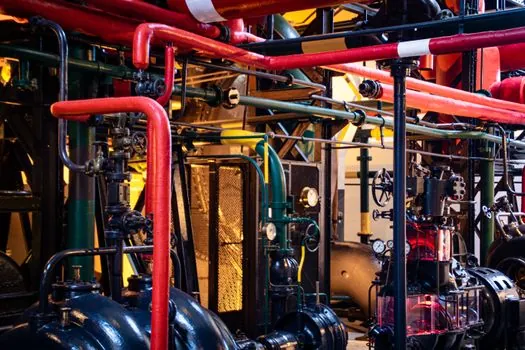
These three parameters affect the physical design together.
Rack construction is also a selection criterion. The IG-541 system is to be designed, installed, inspected, maintained, tested, and recharged by qualified, trained personnel in accordance with VdS 2344en and EN 15004-1 [S2].
Applicability And Failure Modes
IG-541 combines nitrogen, argon, and carbon dioxide, while other recognized inert-gas agents include IG-01 argon, IG-55 nitrogen-argon mixture, and IG-100 nitrogen [S4].
The bank is suitable for enclosed spaces containing critical assets, including data centers, hospitals, archives, museums, telecommunications rooms, laboratories, and process or industrial facilities where residue-free discharge is required [S3][S4]. It is not a substitute for an open-area suppression system or for hazards that cannot be safely enclosed and flooded. The design also cannot treat one universal oxygen concentration as valid for every hazard: agent identity, design concentration, occupancy, altitude, temperature, and applicable standard affect the required calculation [S4].
Common failure modes arise from an undersized agent reserve, incorrect pipe or nozzle sizing, incomplete pressure supervision, blocked actuation paths, and loss of design enclosure conditions. The activation sequence must coordinate detection, confirmation or cross-zone logic, pre-discharge alarms, any required delay, HVAC and damper status, cylinder actuation, manifold flow, and nozzle distribution [S4]. In occupied spaces, personnel safety, abort or manual-release provisions, ventilation, and the engineered cause-and-effect matrix are part of functional correctness, not ancillary controls. The gas suppression abort and manual release station selection guide addresses that control decision separately.
Specification And Acceptance Checklist
A manufacturable bank specification should identify 80 L or 140 L cylinders, 200 bar or 300 bar storage, single- or double-row manifold layout, agent type, protected hazards, nozzle count, and required reserve arrangement [S3].
The hydraulic submission should then define cylinder fill, storage pressure at the design temperature, reduced manifold pressure, pipe friction, nozzle pressure, discharge time, and agent quantity per zone [S1]. For IG-541 with an outlet reducing device, the cited reference values are almost 2,200 psi storage at 70 °F and approximately 1,000 psi after reduction [S1].
Testing and service documentation should identify whether check valves are fitted in the bank, how pilot and slave cylinders are actuated, and how reserve or changeover headers operate [S2][S5][S6]. Cylinder pressure supervision, actuator arrangement, manifold labeling, and the approved cause-and-effect matrix should be traceable in the final documentation set. A practical gas fire suppression system basis of design should preserve those links instead of treating the cylinder bank as a generic collection of steel bottles.
Track two engineering signals before releasing the bank for fabrication: confirm the selected cylinder quantity and manifold row against the protected-volume calculation, then verify that the reserve or changeover arrangement maintains the required protection after the primary bank discharges.