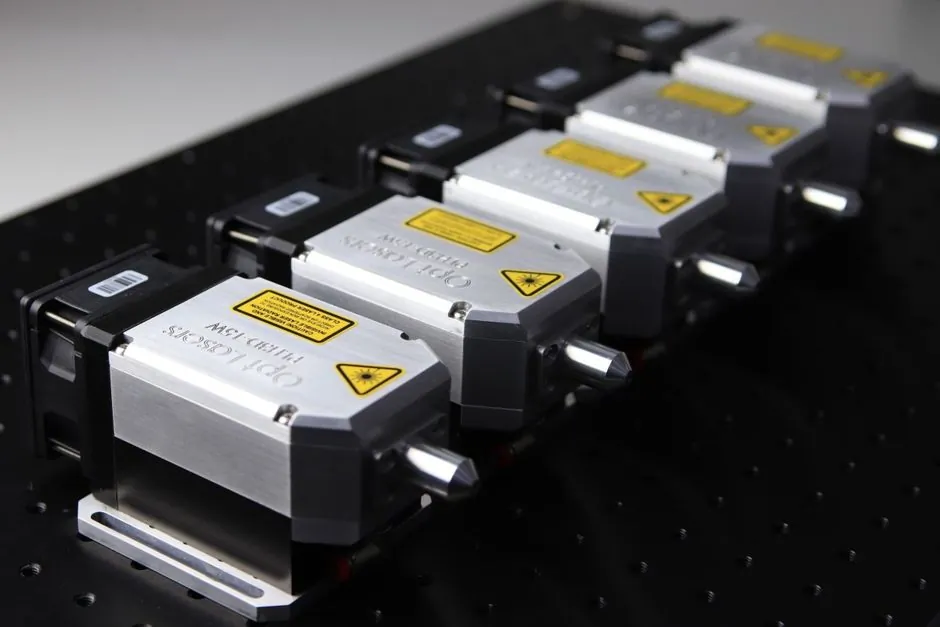
A factory-grade confocal displacement sensor head, controller pair, and cabling typically totals USD 3,500 to 9,500 in 2026 list pricing, with the Keyence CL-3000 compact head and Omron ZW-8000/7000/5000 fiber series acting as the reference benchmark for specifiers [S3][S5][S6].
Unlike triangulation or standard laser displacement sensor heads, confocal chromatic units use a polychromatic beam and calibrated fiber probe to measure thickness, position, and surface topology on transparent, mirror, or rough substrates in a single non-contact pass [S3][S6].
Where the Money Goes: 5 Cost Drivers Ranked
Optical engine and calibrated fiber probe dominate unit cost: a single ø8 mm focused-spot head, such as the Keyence CL-P007, lists near USD 1,200 to 1,800 before cabling, while larger multi-spot or high-temperature heads push to USD 2,400 to 3,200 [S3]. The ZW-8000/7000/5000 controller-plus-head sets from Omron are typically sold as bundles where the controller contributes 40 to 55 percent of the total [S6].
Resolution and linearity class move the second axis. Sub-micrometer repeatability and 0.05 percent full-scale linearity add a 25 to 40 percent premium over a standard 1 to 5 µm class head, with custom wavelength tuning for glass-on-glass or film-on-mirror stacks adding another 10 to 20 percent [S3][S5]. Buyers comparing alternatives in the displacement sensor category will see this is a sharper delta than for triangulation units.
Ingress protection, cable type, and connectorization are the third driver. IP67 heads with 5 to 10 m armored fiber extensions commonly add USD 400 to 1,100 over a 2 m PVC-pigtail laboratory version, and right-angle or vacuum-feedthrough terminators can double that premium [S3]. Specs such as the LT-9000 series from Keyence illustrate the same cost gradient, with the linear non-contact transparent variant carrying list pricing above earlier triangulation-class units [S1].
Controller I/O is the fourth axis. A base 2-output NPN/PNP controller with analog 4 to 20 mA starts around USD 1,000, while Ethernet/IP, PROFINET, or EtherCAT variants with multi-channel switching and remote teach-in modules run USD 2,000 to 3,800 [S5][S6].
Volume, lead time, and calibration certificates form the fifth driver. Single-unit spot orders carry a 15 to 30 percent premium over 10-unit releases, and ISO/IEC 17025 traceable calibration adds USD 200 to 600 per head; long-fiber custom builds push lead time from a typical 2 to 4 weeks to 10 to 14 weeks [S3][S6].
Spec Tier Comparison: CL-3000 vs ZW-8000/7000/5000 vs LT-9000
On spot diameter, the Keyence CL-P007 compact ø8 focused spot targets tight-pitch electronics and 200 µm glass features, while the ZW-8000 offers a wider measurement range at the cost of a larger beam and higher head price [S3][S5][S6].
On transparent substrate handling, all three named platforms support glass, film, and mirror surfaces natively without re-calibration between materials, with the LT-9000 marketing its transparent-target capability as a primary differentiator against standard laser triangulation [S1].
On controller flexibility, the CL-3000 series emphasizes a compact, all-in-one amplifier and the ZW-8000/7000/5000 family uses a modular controller plus separate fiber heads, easing multi-channel scaling at the cost of panel space [S5][S6].
On service network and stocking, both Keyence and Omron list same-week shipment for the most common head-controller combinations through their 2026 catalogs, with shorter delivery on 5 m and 10 m fiber lengths than on custom 20 m assemblies [S3][S6].
Who Should, and Who Should Not, Specify Confocal
Specifiers measuring glass thickness, transparent film over reflective substrate, or sub-100 µm features on a production line should pick confocal over standard laser displacement sensor heads because polychromatic confocal discrimination resolves the front and back surface in a single optical path, removing the two-sensor triangulation workaround [S3][S6].
Specifiers doing only single-point distance measurement on opaque, matte, or lightly textured steel at 1 mm standoff or more will get better cost-performance from a triangulation head at one-third the unit price and a wider choice of sub-USD 1,000 amplifiers; confocal is overkill there.
Buyers in the metrology lab replacing a dial indicator stack with non-contact probes will see a 3 to 6× price jump per axis; the dial indicator pricing benchmark for 2026 shows a USD 80 to 400 baseline that a confocal head dwarfs, so the case must be throughput or scratch avoidance, not cost.
Total Cost of Ownership: Beyond the Sticker
Annual calibration and recertification on a confocal head runs USD 300 to 800 per year when ISO/IEC 17025 traceability is required, against near-zero on a passive dial indicator or LVDT [S3].
Fiber-optic replacement is the most overlooked TCO line: a damaged ø8 probe or armored cable typically lists at USD 600 to 1,400 plus 1 to 3 weeks of downtime, so plants running three-shift inspection should keep one spare head per active station [S3][S6].
Power, air, and cooling are not major cost items, since controller consumption sits around 0.1 to 0.3 kW per amplifier, less than a comparable vision system, and no purge air is required for IP67 heads at ambient factory conditions [S5].
Sourcing and Standards Discipline
List pricing sourced from Keyence and Omron public catalogs is a starting point, not a contract figure: 2026 spot orders in the EU and US typically settle 8 to 18 percent below list when the same head is bundled with a multi-channel controller and 12-month calibration [S3][S5][S6].
Buyers mapping this against adjacent non-contact instruments can cross-check total budget using the radar level meter 2026 cost guide or the optical comparator 2026 cost drivers to validate the controller-and-head share against comparable industrial gauges.
For buyers also weighing upstream dimensional metrology, the CMM 2026 cost stack sets a useful upper-bound benchmark, since a single confocal channel typically lands below 5 percent of an entry bridge CMM with probe and controller.
Selection Rules of Thumb
Pick a compact ø8 head with a 5 to 10 m fiber for tight-pitch electronics and glass inspection, and budget USD 4,500 to 7,500 per measurement point fully configured in 2026 [S3][S5].
Pick a ZW-8000/7000/5000 modular bundle when the line needs 4 or more channels and remote teach-in, since the controller overhead amortizes faster above that count [S6].
Avoid custom fiber lengths below 2 m or above 20 m unless the optics vendor confirms the optical budget in writing, because chromatic confocal calibrations are sensitive to bend radius and ferrule losses outside the stock ranges [S3][S6].
For dimension-checking on small parts already covered by a CMM or vision system, the marginal benefit rarely justifies a confocal head; the more common gap it fills is the one between contact dial indicators and full vision, where a single confocal channel can replace 2 to 4 contact probes on a rotating index table.
For component-level specifications, see confocal displacement sensor.