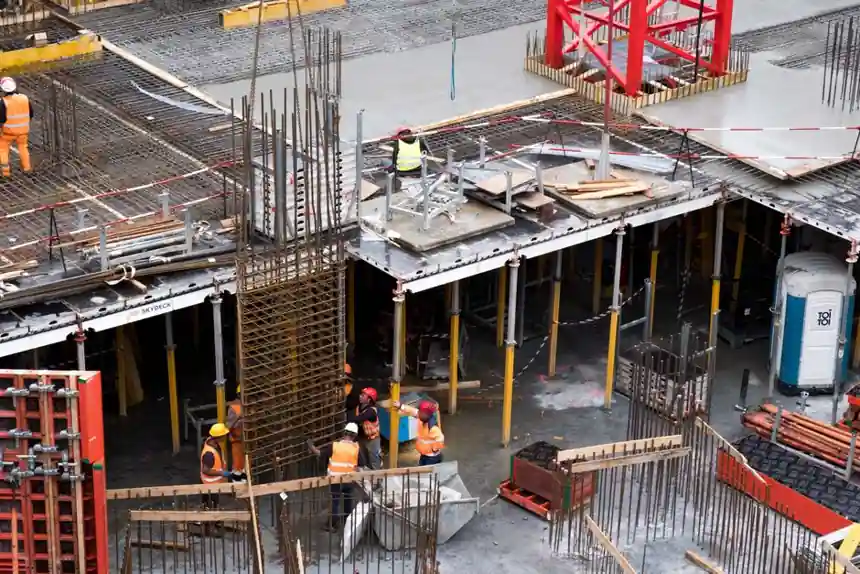
A construction-site interlock is not a single device, it is a system decision: PUWER Regulation 11 plus BS EN ISO 14119 frame the duty, and the device is then chosen by stop time, access frequency, ingress protection, and defeat risk [S2].
The construction environment is harsher than a fixed plant floor: dust, water jets, vibration, and rough handling rule out light-duty panel switches and force specifiers toward IP65+ housings, stainless or reinforced polymer bodies, and either positively-driven mechanical contacts or sealed non-contact (coded-magnet / RFID) sensing [S1][S3].
Legal Baseline: PUWER Reg. 11, ISO 12100, and ISO 14119
Regulation 11 of the Provision and Use of Work Equipment Regulations 1998 (PUWER) requires dangerous parts to be guarded, with interlocked guards used only where fixed guarding is impractical and the guard is opened regularly [S2]. The Supply of Machinery (Safety) Regulations 2008, implementing the Machinery Directive in UK law, place parallel duties on suppliers and govern UKCA / CE marking plus the Declaration of Conformity that must accompany any safety component [S2].
BS EN ISO 14119 is the governing design and selection standard for interlocking devices, including measures to reduce defeat (bypassing); BS EN ISO 12100 sets the wider hierarchy of control, applied in the order: eliminate, guard with fixed barriers, then interlock / light curtain, with administrative controls (signage, training) as a last layer [S2]. For construction-site procurement, this means an interlock is only specified after fixed guarding has been ruled out, never as a substitute for it.
Plain Interlock vs Guard Locking: Driven by Stop Time
If the hazardous motion stops essentially immediately when the guard opens, a plain interlock switch is sufficient, with a mechanical contact device such as the DAIDISIKE DX-D2 / DX-D3 providing NC / NO contacts and positive (forced) contact separation at 60 N or more over 10 mm of travel so a welded contact cannot fake a closed-door signal [S3].
If the machine has run-down time, spinning spindles, coasting fans, presses finishing a stroke, or any retained mechanical / hydraulic / pneumatic energy, guard locking is mandatory: the door physically cannot open until the control system releases it, via solenoid-locked devices such as the DAIDISIKE DX-W2, DX-W3, DX-W5 (1300 N holding force) or DX-D6 (2000 N holding force) [S3]. On construction sites this distinction matters for genset rooms, hydraulic pack enclosures, and any saw or compactor with a freewheel.
Power-to-Release vs Power-to-Lock: Pick From the Risk Assessment
Guard-locking switches split into two locking principles, and the choice is dictated by the risk assessment rather than preference. Power-to-release (mechanically locked, solenoid released) holds the door on power failure and is the usual choice when the hazard is the machine itself, because a power cut must not let a worker walk into a coasting mechanism; a manual escape / maintenance release must be planned for anyone who could be locked inside a cell [S3].
Power-to-lock (solenoid locked, mechanically released) unlocks the door on power failure and suits processes where being locked in is the greater danger, or where the lock is for process protection (avoiding scrap or tool damage) rather than personnel protection [S3]. The DX-W2, DX-W3, DX-W5 are offered in both GD (power-to-lock) and GC (power-to-release) versions, and the DX-D6 in both C-type and D-type variants, so electrical and mechanical design carries over whichever way the assessment lands [S3].
Holding Force, Coding Level, and Defeat Resistance
Holding force is sized against the realistic pull a person can apply to the specific door geometry: a large door with a long lever arm needs more margin than a small hatch, and a determined adult can pull with several hundred newtons, so four-digit-newton ratings are the working range on site. The DX-W2 / W3 / W5 family sits at 1300 N; the DX-D6 lifts this to 2000 N [S3].
Coding level under ISO 14119 determines how easily the interlock can be defeated with a simple tool, magnet, or spare actuator. Low-level coded actuators use a single unmarked key that any duplicate fits; high-level coded switches (unique RFID-coded actuators) are specified where defeat risk is high, vandalism is plausible, or access is frequent and unsupervised, which on construction sites covers site-gate interlocks and rental-fleet cabinets [S2][S3]. For comparison, three common options line up against the same four site criteria:
Mechanical key interlock (e.g. DX-K series, DX-D2 / D3): lowest cost, robust against dust and water when IP65+ rated, easy to install, but defeat-prone if actuator is duplicated; suits low-frequency maintenance access on fixed plant.
Coded-magnet non-contact switch (e.g. DX-C1): no moving parts through the guard, tolerates misalignment and door sag, good for wash-down and outdoor enclosures, but defeat-moderate and needs careful mounting within the specified magnetic gap.
RFID non-contact safety switch (e.g. DSR-series, DX-R1): high-level coded, each actuator is unique, hardest to defeat, tolerates misalignment, suits high-frequency access, rental assets, and tamper-prone sites; higher unit cost is the trade.
Contact Type, Wiring, and Mechanical Integration
Mechanical interlocks rely on forced positive opening driven through the actuator, not on a spring return, which is the only construction that survives contact welding; non-contact devices eliminate mechanical wear but require a separate coded actuator and a defined approach / miss tolerance in the door geometry [S3].
Wiring is typically 2 NC + 1 NO, or 2 NC + 2 NO on higher-end guard-locking units, feeding a safety relay or a safety controller; on construction sites the M12 connectorised option with IP67 rating is preferred over terminal-box wiring because it survives dust, water jets, and repeated re-connection by non-specialist labour. Door-bolt accessories such as the DXL slide bolt (48 mm bolt travel, 1-10 mm door gap, 1,000,000 operations) accept DX-W2 / W3 / D2 / D3 switches directly, combining a robust mechanical handle with the electrical interlock in one assembly, which is the practical answer for full-body-access gates on equipment housings [S3].
Construction-Site Selection Criteria in One Pass
For site use, walk this checklist: (1) does the hazard stop instantly, if yes, plain interlock, if no, guard locking; (2) on power failure, must the door stay locked, if yes, power-to-release (GC / C-type), if being trapped is worse, power-to-lock (GD / D-type); (3) what is the realistic pull on the door, target 1300 N minimum, 2000 N for large or lever-arm-loaded doors; (4) what is the defeat risk, low-level coded for trusted internal staff, high-level RFID-coded for shared or public-facing gates; (5) what is the ingress requirement, IP65 minimum, IP67 for wash-down or outdoor; (6) what is the access frequency, non-contact (coded-magnet or RFID) above 10-20 cycles per shift to avoid mechanical wear [S1][S2][S3].
The interlock is one node in a safety chain, the upstream device must be paired with a compliant safety relay or controller, and the chain must be documented and tested as part of the PUWER / Machinery Regulations file. For project engineers moving from electrical spec to the physical guard assembly, the same holding-force and coding logic also governs machine safety procurement for the wider site, and the certification trail (UKCA / CE, ISO 14119 conformance, Declaration of Conformity) is the audit evidence, not the device data sheet alone [S2].
To take this further, request the OEM's ISO 14119 type-test evidence and the Declaration of Conformity for the exact model and coding level, not just the family; for guard-locking devices, confirm in writing whether the unit is GD or GC and which manual release is fitted. These two documents are what the HSE inspector, and any Tier-1 contractor safety audit, will ask for first. Trackable signals: any 2026 update to BS EN ISO 14119 amendment sheets, and any tightening of PUWER guidance on construction-site guard-locking for genset and compactor enclosures.
Component reference pages worth checking: construction tools.
See also our earlier report, Insulation Board Selection for Industrial Facilities: 2026 Spec Map.