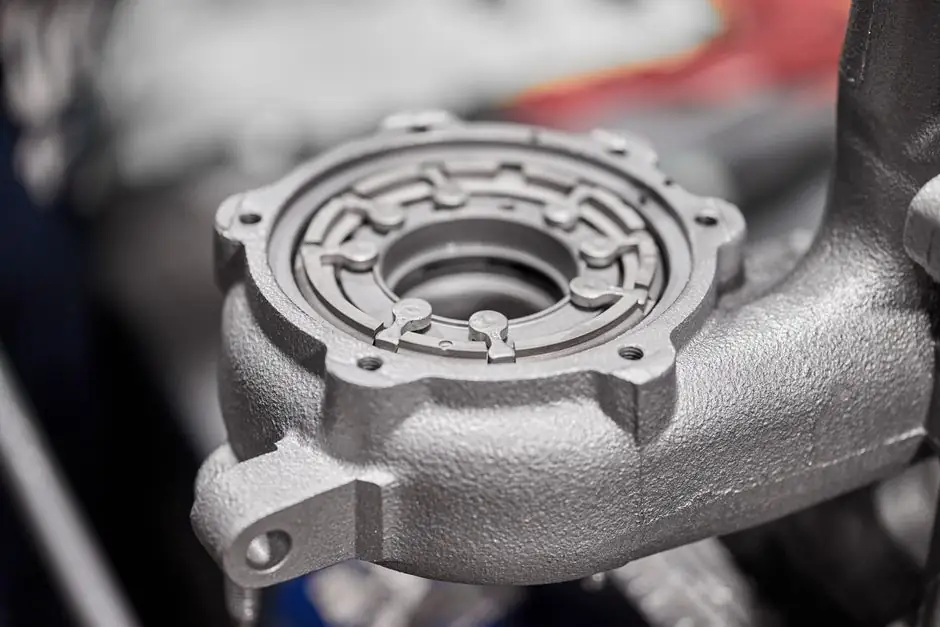
A well-executed rotary-impeller degassing cycle drops dissolved hydrogen in molten aluminum from 0.30-0.50 cc/100g down to 0.08-0.15 cc/100g, with final bath hydrogen below 0.10 cc/100g the working target for pressure-tight and aerospace hardware [S4].
Selection in hardware manufacturing hinges on four knobs: gas chemistry (argon vs nitrogen), rotor geometry, flux-injection capability, and furnace-side throughput, and the cheapest gas is rarely the cheapest casting [S4][S5]. For background on how a degassing unit fits a casting line, see the reference page.
Why Hydrogen Control Matters in Hardware Castings
Aluminum is the only structural metal that dissolves hydrogen in meaningful quantities, and solubility collapses sharply at solidification, so any hydrogen held in the melt at pour becomes microporosity in the finished part [S3]. The 2024 industrial trial at MOTOR JIKOV Slévárna a.s. set a maximum allowable Density Index range of 3 to 4% to keep porosity inside spec for cast products [S1].
Hardware applications tolerate little porosity because housings, brackets, and hydraulic bodies are often pressure-tight or fatigue-loaded; a 0.20-0.30 cc/100g hydrogen level typically produces visible microporosity and is the practical reject threshold [S4]. Degassing is therefore not optional melt polishing, it is a mechanical-property gate.
Gas Selection: Argon vs Nitrogen Trade-off
Argon is fully inert toward all aluminum alloys at any operating temperature, while nitrogen reacts at elevated melt temperatures to form aluminum nitride (AlN) inclusions that show up as hard particles in machined hardware surfaces [S4]. On quality, argon degassing delivers lower final hydrogen, fewer inclusions, and better surface finish in sensitive alloy series; on cost, nitrogen is 60% to 80% cheaper per cubic meter than argon, which is why high-volume foundries still run nitrogen as the bulk carrier [S4].
The decision matrix is well-defined: specify argon for magnesium-bearing alloys, for premium castings, and where AlN stringers would fail surface-finish inspection; specify nitrogen for structural castings, high-throughput lines, and where the melt temperature can be held in the lower part of the alloy's working window [S4]. Many foundries now run a hybrid Ar/N2 blend to balance quality and gas cost.
Unit Architecture: Rotary Impeller vs Flux Injection vs Porous Plug

Rotary impeller degassing is the dominant hardware-foundry architecture because a spinning rotor shears the incoming gas into fine, evenly distributed bubbles and gives a large gas-metal contact area for hydrogen diffusion [S3]. Compared with static porous-plug lances, rotary units typically achieve lower final hydrogen at the same gas flow because bubble size is controlled by rotor speed and blade geometry rather than by pore size of a refractory.
The Rotary Flux Injection System variant adds a granular flux stream carried into the melt by the inert gas, with the rotating impeller dispersing both gas and flux below the bath surface; this delivers more uniform refining than manual surface flux addition and addresses both dissolved hydrogen and oxide inclusions in one step [S5]. Key components are the flux feeding unit with adjustable feed rate, the gas-assisted injection lance, the rotary dispersion head, and the refining reactor zone where flux and bubbles react with impurities [S5].
Process Windows and Cycle Optimization
In the 2024 industrial trial, the largest decrease in dissolved hydrogen happened early in the refining cycle, which means cycle time can often be shortened without sacrificing final hydrogen content [S1]. The same trial recorded a total temperature drop from ladle pour to end of refining of 26 to 32°C, well within the foundry's acceptable processing window, confirming that standard rotary cycles do not over-cool the melt when timed correctly [S1].
For hardware-grade output, set the target final hydrogen inside the 0.08-0.15 cc/100g band, monitor Density Index as the in-process proxy, and cap the cycle so the bath does not lose more than ~30°C before pouring [S1][S4]. Operators should record rotor RPM, gas flow, treatment time, and bath temperature at every cycle, because those four numbers are the inputs that move the final hydrogen number.
Comparison of Main Degassing Methods for Hardware
Four methods are common in aluminum hardware production, and the right pick depends on what contamination is the dominant risk: [S4]
Flux refining uses chemical reaction plus generated gas bubbles to remove hydrogen and oxide inclusions and is general-purpose, but consistency depends on operator skill [S3]. Inert gas purging (argon or nitrogen through a lance or plug) targets dissolved hydrogen and suits high-throughput casting lines [S3]. Rotary impeller degassing uses a rotor to create fine, dispersed bubbles for higher gas-metal contact, and is the standard for high-quality aluminum hardware alloys [S3]. Vacuum degassing reduces pressure to extract dissolved gas and is reserved for special alloy production where a large hydrogen drop is needed before pouring [S3].
For most hardware foundries, the rotary flux-injection architecture gives the best balance of hydrogen control, inclusion capture, and process repeatability, and it accepts either argon or nitrogen so the gas choice can be tuned later without re-tooling [S5]. See the parallel spec guide for aerospace aluminium castings and the agricultural-machinery castings counterpart for how the same unit is sized differently across alloy series.
Selection Criteria and Sourcing Signals
Specify the unit by the four decision criteria that actually drive outcome: target final hydrogen (cc/100g), alloy series (Mg content drives the argon/nitrogen call), throughput (kg per cycle, cycles per hour), and flux capability (whether oxide-inclusion control is in scope) [S4][S5]. Demand from the OEM a published rotor-speed vs bubble-size curve, a gas-flow-vs-hydrogen-removal curve, and a refractory consumption rate, because those three numbers separate a serious rotary degassing unit from a basic lance.
Trackable signals for the next buying cycle: argon-to-nitrogen price spread per cubic meter at your site (currently the dominant variable in operating cost), emergence of hybrid Ar/N2 blend skids as a stock product rather than a custom build, and tighter Density-Index specifications (3-4% today) being written into hardware OEM casting purchase specs [S1][S4]. Reference the mechanical seal selection 2026 guide for sealing-side pitfalls on the rotor shaft, which is the most common unplanned-maintenance item on rotary degassing units.
For the relevant spec sheets and selection criteria, see additive manufacturing material, and architectural hardware.