
The workhorse dial indicator specification for 2026 shop-floor buying is a 0.01 mm resolution, 0.8 mm per-revolution indicator on a 25 mm full range with ±0.05 mm accuracy, priced from $8 to $165 across budget and metrology grades [S5].
Industrial supplier catalogues on 2026-04-28 list 17 manufacturers offering 39 dial-indicator product lines, spanning plunger indicators, test indicators, and depth bases [S1]. American-made lines from Chicago Dial Indicator (CDI, manufacturing since 1932) and Starrett, plus RS PRO and Guangdong-made test stands, cover the bulk of what process engineers and QA buyers actually order [S2][S3][S4].
Resolution vs Range: What the Catalogue Numbers Actually Mean
Resolution on a dial indicator is set by the gear train — 0.01 mm per division is the dominant 2026 catalogue value on 25 mm-travel indicators, while 0.001 mm and 0.002 mm units exist for shop-floor comparators and lab metrology [S5]. The RS PRO 25 mm / 0.01 mm / ±0.05 mm part (RS 841-2565) lists at $164.56 exc. GST, while the RS PRO plunger spindle extension (RS 705-1235) lists at $8.36, showing the 20× price jump between accessory and the indicator body itself [S5].
Selecting range is a reach-versus-resolution trade. A 25 mm / 0.01 mm indicator is the general-purpose default; a 0.8 mm / 0.01 mm dial test indicator (lever style) is the comparator-style pick for runout and concentricity on turned shafts. For a deeper dive on complementary dimensional QA tooling, the height gauge vs gauge block decision frame covers the rigid-reference side of the same workflow.
Brand Tier Comparison: CDI, Starrett, RS PRO, Import
CDI (Chicago Dial Indicator) has been building precision dial indicators in the USA for over 80 years, with product lines spanning dial indicators, contact points, depth bases, and thickness gages [S2]. Starrett publishes an accessories catalogue covering contacts, fixture configurations, tolerance hands, and backs, oriented around the question "how are you performing your measurement" [S3]. RS PRO fills the budget tier with imperial/metric, zero-resettable, and metric-imperial conversion options in stock for fast delivery [S5].
The four-tier buy table that engineers actually use in 2026:
Tier 1 — American-made metrology (CDI, Starrett): longest traceability history, Mahr-Federal-class accuracy, premium price. Tier 2 — Industrial OEM (Mitutoyo-equivalent, Mahr): mil-spec and shop-floor robust, mid-to-high price. Tier 3 — Catalogue-grade (RS PRO): 25 mm / 0.01 mm / ±0.05 mm at $164, suitable for production lines and field service [S5]. Tier 4 — Import bulk (Guangdong suppliers, FOB $45 per piece on magnetic test stands, 5-piece MOQ) [S4]: acceptable for stands and fixtures, not recommended for primary dimensional arbitration.
Indicator Type vs Measurement Task
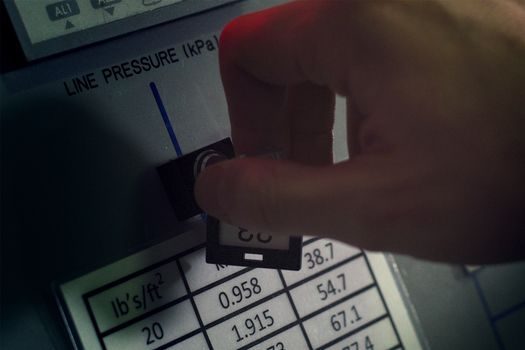
Plunger (radial) dial indicators are the default for ID/OD comparison, bore gauging, and fixture set-up. Dial test indicators (lever type, 0.2–0.8 mm range) handle runout on shafts, parallelism against a surface plate, and centre-finding on a V-block. Depth indicators carry a base that sits on the part top, with the plunger reading down into a slot or recess. [S1]
For process-side work — confirming pump-shaft endplay, compressor rod runout, or valve-seat concentricity — the plunger indicator on a magnetic stand is the common field-rig setup. Made-in-China suppliers list stainless-steel magnetic dial-indicator test stands at FOB $45 with a 5-piece MOQ, sized for the shop-floor comparator role [S4]. Magnetic bases and accessories are often bought as a separate line item from the indicator body, which is why Starrett's accessories page is split out from its indicators [S3].
Accuracy, Repeatability, and Reading Practice
RS PRO's catalogue accuracy spec on the 25 mm / 0.01 mm indicator is ±0.05 mm across the full range, meaning the worst-case indication error is 5 divisions at any point on the dial [S5]. For tighter work, a 0.001 mm or 0.002 mm comparator-class indicator is needed, and that pushes both price and required handling discipline up. The reading chain — perpendicular line of sight, bezel clamp, and a non-rotating spindle on repeat plungings — dominates the in-process error budget more than the catalogue accuracy number itself.
For a structured comparison frame on how dial indicators stack up against other comparator-style measurement tools, the Pt100 RTD selection field guide walks through the same spec-engineering discipline applied to a different sensor class, including how to read tolerance stacks and what to demand from the certificate of conformance.
Standards, Calibration, and Customs Classification
Dial indicators are classified under the dial-gauge / dial-indicator heading for customs purposes, and the ETCN database dedicates a full page to the tariff codes and import-duty data for this product group [S6]. Traceability normally runs to national metrology institutes (NIST in the US, NIM in China, NPL in the UK) through ISO/IEC 17025-accredited calibration labs; ANSI/ASQ Z1.4 sampling plans are commonly used to decide what gets recalibrated and how often in a plant gauge room.
The Chinese spare-parts portal 91beijian lists CDI (Chicago Dial Indicator) indicators, depth gauges, and portable thickness gages as a recognized brand line, confirming continued CDI distribution in the Chinese industrial aftermarket [S7]. That same listing pattern — brand, country of origin, product family — is what most Chinese factory procurement offices use to specify American-made metrology against domestic options.
Price Bands and What You're Actually Paying For
RS PRO's catalogue on 2026-05-04 shows a clear price stratification: $8.36 for a spindle extension, $164.56 for a full 25 mm / 0.01 mm / ±0.05 mm indicator, with the gap explained by the gear-train, jeweled bearing, and bezel design rather than the case finish [S5]. For a $45 FOB magnetic stand with a 5-piece MOQ from Guangdong suppliers, the cost driver is the magnetic base and articulated arm, not measurement accuracy [S4].
Total cost of ownership for a shop-floor indicator is rarely the unit price. Calibration cycle cost, replacement contact points, and stem-adapter inventory all sit in the accessory line — and Starrett's accessories catalogue explicitly frames these as the parts that "increase certainty in your measurement" [S3]. Engineers specifying new indicator fleets in 2026 should budget indicator body + magnetic stand + contact-point set + calibration certificate as one line, not as four.
Failure Modes and Limits Buyers Hit
Three failure modes show up repeatedly: (1) over-range on the plunger, which bends the rack or chip a tooth in the pinion — fixable but it ends the indicator's metrology-grade life; (2) ingress of coolant or swarf past the spindle seal, which contaminates the gear train and shows up as repeatability drift; (3) impact damage to the bezel/glass, which is cosmetic but breaks the readability chain. The CDI and Starrett lines address (2) with sealed bezels and O-ring-spindle options for shop-floor wet environments [S2][S3].
A second limit is geometric: a dial indicator measures linear displacement along its spindle axis. It does not directly measure flatness, squareness, or concentricity — those measurements need a surface plate, a squareness reference, and a V-block or centering fixture respectively. Conflating "the indicator reads 0.02 mm" with "the part is 0.02 mm flat" is the single most common spec error in QA write-ups.
2026 Sourcing Signals and What to Track Next
The most trackable 2026 signal is the Directindustry supplier index: 17 manufacturers, 39 product lines, last refreshed 2026-04-28 [S1]. A second signal is the RS PRO stock list: in-stock flags on the 25 mm / 0.01 mm / ±0.05 mm indicator and its 0.8 mm / 0.01 mm cousin tell a buyer whether to commit to RS PRO or escalate to a Starrett/CDI equivalent on longer lead time [S5]. A third signal is the magnetic-stand MOQ — $45 FOB at 5 pieces from Guangdong — which sets the import-baseline against which the American-made stand line is justified on shop-floor durability [S4].
Related: dial indicator, linear guide, weighing indicator.