
The comparison applies to abrasive concrete cutting, not wood or metal: diamond segments grind the matrix, whereas tungsten-carbide teeth shear it, making carbide unsuitable for conventional concrete-groove work [S1][S2].
Wear-rate decision for concrete groove cutters
Diamond is the defensible selection for a concrete groove cutter because concrete continuously abrades the cutting edge and reinforced work can add hard aggregate or steel to the cut [S1][S6].
Those figures are comparative test results, not transferable service-life guarantees. Workpiece hardness and abrasiveness, cut depth and length, reinforcement, blade diameter, engine or motor power, and operator loading all change the wear rate [S3]. For planning, record linear metres cut per blade and cost per metre rather than treating cut count as a lifetime specification.
A concrete groove cutter fitted with a purpose-selected diamond blade is the correct configuration for ordinary hard concrete, paving, masonry, tile, and stone. Carbide teeth become the relevant choice only when the groove cutter is used on wood, plastic, aluminium, or another non-abrasive material.
Why concrete destroys conventional carbide teeth
Concrete contains hard mineral aggregate, so carbide tips lose their cutting geometry through abrasion and chip fracture rather than producing sustained service life.
Diamond blades contain synthetic industrial diamond particles held in a metal matrix, commonly cobalt or bronze, and the diamond concentration, particle size, bond hardness, and segment design jointly control exposure rate, cutting speed, and debris removal [S1][S2]. A harder bond retains diamonds longer, while a softer bond exposes them earlier, which may improve cutting speed but increase wear.
Carbide blades use tungsten-carbide teeth brazed to a steel body, and the cutting action is tooth shear [S2]. Carbide remains effective in wood, MDF, plywood, plastics, aluminium, and light steel, where it provides clean cuts and economical replacement [S5]. That versatility does not transfer to concrete, because the abrasive mineral phase attacks the tooth edges and carbide substrate.
Diamond and carbide compared against operating criteria

On material compatibility, diamond wins for hard concrete, brick, ceramic tile, stone, and asphalt, while carbide wins for wood, plastic, aluminium, and light-gauge steel [S1][S5]. On abrasive wear, diamond is described as having excellent resistance, whereas carbide is suited to general construction and light composite materials [S5].
On cut quality, carbide produces sharp, clean cuts with minimal tear-out in wood and similar non-abrasive materials, while diamond provides moderate to high precision in tile, stone, and concrete and maintains a clean finish longer in abrasive cutting [S2][S4][S5]. On cost, carbide normally costs less per blade and is easier to replace, but diamond can reduce blade changes and downtime on long concrete jobs [S1][S5].
These are different test conditions, so they should not be combined into a guaranteed multiplier. For concrete groove cutting, the ranking remains consistent: diamond gives the longer-lived abrasive edge, while carbide is the lower-cost choice for soft materials.
Segment and blade selection that control diamond wear
Segmented, turbo, and continuous-rim configurations cover different groove-cutting duties [S5]. Segmented rims remove debris efficiently and suit concrete and masonry, continuous rims favor cleaner profiles in tile or stone, and turbo rims combine a faster cut with a relatively smooth edge. The exact choice should match the groove geometry and material rather than generic blade width alone.
Diamond blades can support wet or dry cutting, and wet use helps control heat and dust [S1][S5]. This does not make every diamond blade suitable for wet operation, so the blade marking, machine instructions, and blade speed rating remain controlling requirements. For operating limits, use Set Concrete Groove Cutter Blade RPM by Diameter as the starting point, then verify the machine, arbor, and blade specifications.
Real use cases and operating limitations

Diamond blades suit control joints, expansion grooves, floor and walkway work, patios, structural repairs, ceramic tile, brick, stone, asphalt, and reinforced concrete [S1][S5]. They are the normal choice for a powered groove cutter because the application is abrasive and service life directly affects labour and blade-change frequency.
Carbide suits timber framing, joinery, furniture, plastic sheeting, aluminium trim, and light steel cuts in mitre saws, circular saws, and table saws [S5]. A carbide blade on concrete or masonry can generate poor cut quality, rapid tooth loss, excessive heat, and additional tool loading [S1][S5]. Carbide also needs frequent replacement as its edge deteriorates from the first use, while a diamond blade retains cleaner cutting performance for longer in abrasive material [S2].
Concrete cutting introduces reinforced-concrete risks beyond blade wear. A blade can strike rebar, producing heat, sparks, glaze, and rapid segment damage. This is a machine-control and work-planning issue, not something that a higher diamond concentration can solve. The operator should locate reinforcement where practicable and follow the groove-cutter and blade manufacturer instructions.
Cost basis for blade replacement and wear tracking
A blade purchase-price comparison is incomplete because concrete work also consumes labour, consumables, and machine time during every change. A PCD-versus-carbide cost example calculates USD 0.0028 per linear foot for diamond against USD 0.0143 for carbide, an 80.4% cost reduction, and recommends budgeting conservatively at 25 times the carbide life [S4]. That example concerns a defined production comparison and must not be applied directly to every concrete groove cutter.
For field verification, record blade specification, concrete condition, reinforcement status, cut depth and width, groove length, water use, engine or motor operating time, and total linear metres completed. Compare diamond and carbide in controlled lengths of identical concrete, then calculate cost per metre as blade cost divided by metres cut. If reinforcement was encountered, exclude that interval or flag it separately because impact damage makes wear comparisons meaningless.
Replace a diamond blade when the rim is worn below its usable height, segments are uneven, the blade no longer runs straight, or visible cracking and heat damage appear. Do not rescue a worn blade by using a smaller angle grinder; mismatched machine speed, arbor size, or operating technique can turn wear into a safety failure.
Standards, procurement data, and maintenance evidence
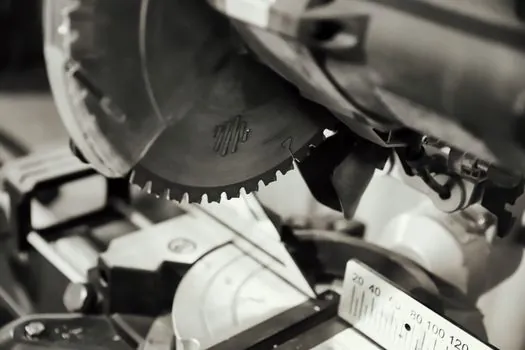
Specify the blade by diameter, arbor or bore, maximum permitted speed, cut rating, and intended material rather than by the broad label “diamond.” Diamond blades for angle grinders and masonry saws may have identical visible dimensions but different speed ratings, segment construction, and permissible applications [S5].
Procurement records should also identify whether the blade is re-sharpable, how many times it can be dressed, the dressing cost, and the turnaround time. These are decisive service-life variables in comparisons of diamond and carbide tooling, because a non-serviceable diamond product may cost more per metre than a carbide product with several usable resharpings [S4].
For concrete groove cutters, the final selection is straightforward: use a rated diamond blade for abrasive concrete and record wear in linear metres; reserve carbide for non-abrasive materials. A controlled trial against the same concrete, using the same cut width and depth, provides the defensible wear-rate factor for procurement.