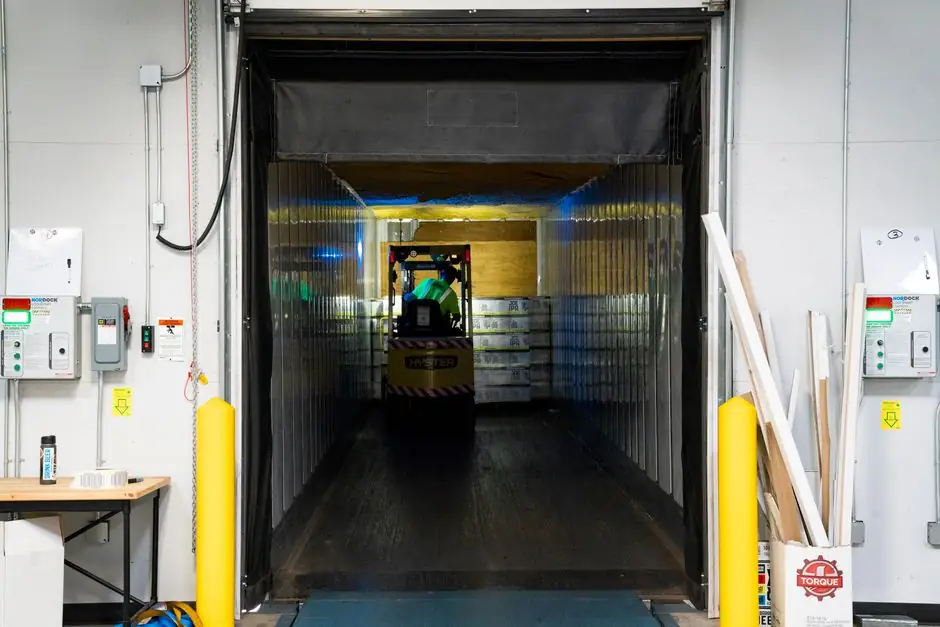
Dock levelers are available in lengths from 5 to 12 feet, with 8 feet being the most popular length, and their slope must be less than the maximum grade capability of the loading equipment.
The decision is separate from capacity and lift height: check the jack’s smallest wheel, fork underside, steering-wheel clearance, the leveler lip transition, and the narrowest trailer or dock opening before ordering.
Grade, deck length, and lip clearance
Grade equals the height difference divided by leveler length, and the leveler must not exceed the loading equipment’s grade capability [S5]. The leveler's slope must be less than the maximum grade capability of the loading equipment. Equipment-specific manufacturer recommendations take precedence because load, wheel condition, and design can change those operating limits [S5].
Dock levelers are available in lengths from 5 to 12 feet, and an 8-foot leveler is 96 inches long. The two figures describe different grade limits, so an 8-foot leveler cannot be treated as a 9½-inch manual-jack solution merely because that guide lists 8 feet as common.
For a manual jack, the minimum length for a measured height difference is: length in inches ≥ height difference in inches ÷ 0.07 [S5]. A 6-inch difference therefore requires at least 85.7 inches, normally rounded to an 8-foot unit. A 7-inch difference requires at least 100 inches, normally a 10-foot unit. This calculation controls the longitudinal grade, but it does not prove that the jack’s wheels can physically pass the lip.
Use a 10- or 12-foot recessed leveler when a manual jack must regularly handle more than about 7 inches of height difference [S2]. Longer deck service reduces grade, but every extra inch must still be checked at the lip hinge and against the underside of the trailer bed.
Recessed versus edge-of-dock clearance
Recessed dock levelers are normally installed in a formed pit and are generally at least 6 feet long, while edge-of-dock units mount on the face curb of the loading platform [S1]. Recessed dock levelers have a greater operating range, load range, and life expectancy, while dock levelers generally have a standard operating range of 12 inches above and 12 inches below dock height.
An edge-of-dock leveler places the lip and transition directly in front of the dock face, where a jack’s load wheels and steering wheels must negotiate the lip, its hinge, and the vehicle support. The 12-inch service range cited for a general dock leveler must not be transferred to every edge-of-dock design [S6].
The cited comparison gives a standard dock-leveler operating range of 12 inches above and below dock level, versus 5 inches above and below for an edge-of-dock device [S6].
That makes the recessed-versus-edge choice straightforward for a manual jack with normal 7% grade capability. Use a recessed leveler when the jack must traverse a wider truck-height range or the lip-to-wheel transition is marginal. Use an edge-of-dock arrangement only when the operating height is tightly controlled and the jack supplier confirms that the particular wheels, fork profile, and steering mechanism can cross it.
Measure the complete wheel path

Clearance must be measured from the pallet jack’s leading wheel contact point through the lip, hinge, deck, and trailer bed; measuring only the lip thickness is incomplete. Forklifts and pallet trucks require sufficient ground clearance to move freely and safely over a dock leveler, and ground clearance is specifically flagged for pallet jacks on edge-of-dock units [S5].
Record four dimensions from the actual jack and the proposed leveler: the smallest load-wheel diameter and width, the steering-wheel diameter and width, the lowest point of the fork carriage, and the jack’s rated load-wheel and steering-wheel ground clearance. Then measure the lip thickness, lip taper, exposed hinge or gap, deck surface, trailer-bed sill height, and any rear step. Do not assume a zero-degree lip angle, because trailer suspension movement changes the transition during loading [S1][S3].
The Bluff EZ-Pull manual states that the lip section tilts up to 1 inch for out-of-level compensation and warns against travel across the leveler unless the lip is placed securely on the trailer bed floor [S7]. Allow that movement when assessing a jack’s approach angle. A jack that can cross a level lip statically may still fail when the lip tips by 1 inch, especially where the load wheels are short or the steering wheels sit close to the fork heel.
For a recessed leveler, test the actual transition with a loaded jack at the lowest intended trailer-bed height. The lip’s downward approach into a trailer bed is often more restrictive than the main deck grade because the jack must transition from the dock surface onto the lip before reaching the truck floor.
Width and the tapered lip
Standard dock-leveler widths include 6 feet, 6½ feet, and 7 feet; 6 feet is the most common, while wider decks improve entry at an angle and access to side-by-side pallets [S2][S5]. A 7-foot deck gives 84 inches of nominal width, whereas a 6½-foot lip gives 78 inches, a 6-inch difference that affects straight-line alignment but does not itself establish wheel clearance.
The lip should taper from 7 feet to 6½ feet when a full-width lip would not fit a narrow trailer [S1][S5]. That taper creates side guidance but can introduce a lateral drop or edge condition for small steering wheels. Retaining the full 7-foot width maximizes maneuvering space and removes the dropoff area created by a taper, although the trailer opening must accept the lip [S5].
Do not select width by trailer label alone. Record the minimum clear opening between dock bumpers or restraints and compare it with the lip width after taper. Then check whether the jack can enter squarely, whether its load wheels can straddle frame members, and whether the steering wheel can swivel without striking a side curb or the trailer opening.
Compare equipment and operating options
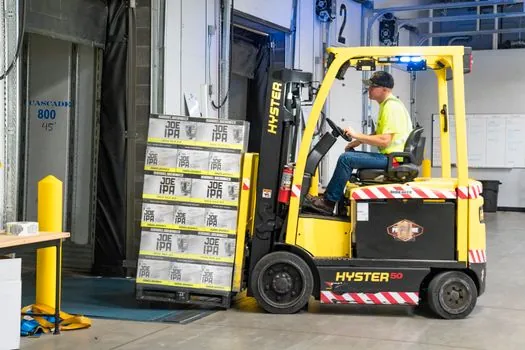
On grade capability, a manual pallet jack is the limiting case at about 7%, compared with about 10% for an electric pallet truck and 15% for an internal-combustion forklift [S5]. On installation depth, a recessed leveler needs a formed pit and is generally at least 6 feet long, while an edge-of-dock unit mounts directly to the dock face [S1].
On operating range, a standard recessed leveler may cover 12 inches above and below dock height, and special configurations may cover 18 inches above and below [S1]. The cited general comparison also gives a dock leveler a 12-inch range versus 5 inches for an edge-of-dock device, while the specific Bluff LO-DOCK manual limits its EZ-Pull installation to 5 inches above and below dock [S6][S4].
On activation and maintenance, hydraulic and air-powered levelers provide push-button operation, while mechanical units use a pull-chain or release mechanism and require more frequent lubrication and adjustment [S1][S3]. Mechanical units can operate during a power failure, while powered equipment requires an available air or hydraulic power source [S1]. Clearance does not improve merely because activation is powered, but automatic operation reduces the chance that the lip is left partly deployed during a jack crossing.
The practical selection order is: reject any lip-to-wheel geometry that cannot be crossed; apply the 7% grade limit; then select recessed or edge-of-dock architecture; then set width, lip projection, capacity, and activation system. If any two criteria conflict, choose the geometry that keeps the jack stable rather than forcing an undersized lip or excessive grade.
Lip projection, capacity, and installation checks
The dock-leveler lip must extend at least 4 inches into the truck in accordance with ANSI MH30.1 [S5]. A standard 16-inch lip projects 12 inches in front of the dock bumpers, while a refrigerated trailer rear step may require a lip projecting 14 inches or more past the bumpers [S5].
Capacity must cover the combined weight of the powered handling vehicle and its heaviest load, not merely the payload. The cited selection method applies a 2.5 multiplier for normal use and at least 3 for heavy, multi-shift operation: a 9,000-pound forklift carrying 4,000 pounds produces a 13,000-pound combined weight, leading to a 32,500-pound design basis and a 35,000-pound selection at the 2.5 multiplier [S2].
U.S. dock levelers are tested to ANSI MH30.1, which is identified as the industry standard for dock-leveling devices [S2]. Require the leveler manufacturer to state the rated capacity, tested configuration, deck length, lip projection, service range above and below dock, and permitted equipment grades. Verify the jack’s own rated grade and clearance with its manufacturer, because the 7% figure is a normal selection guideline rather than a universal guarantee [S5].
For an existing installation, place a straightedge across the lip and deck, measure the transition with the lip fully supported on the trailer bed, and drive the loaded jack over the path under controlled conditions. If the smallest wheel bridges the hinge or strikes the lip, replace the geometry or select a recessed leveler with a longer approach rather than improvising a ramp.
Recommended decision by operating case

For a manual jack handling frequent trailer-bed heights within about ±7 inches, specify a recessed leveler sized so the calculated grade remains at or below 7%, normally at least 8 feet for a 6-inch difference and 10 feet for a 7-inch difference [S2][S5]. Verify the lip transition with the actual jack because grade compliance alone does not prove wheel clearance.
For an edge-of-dock arrangement, accept it only where the controlled height range is no more than the manufacturer’s stated limit. The Bluff EZ-Pull example is limited to 5 inches above and below dock level and its own manual says that most pallet trucks are unsuitable at the stated 18.5% down and 20% up grades [S4]. Separate mounting heights, wheel risers, or another bridge arrangement may be required when freight and refrigerated trailers share one dock [S4].
For a narrow trailer, use a 6½-foot lip from a 7-foot deck only after checking the trailer opening and jack alignment [S1][S5]. For a wide trailer with side-by-side pallets, retain the 7-foot width if the opening permits, because full width improves maneuvering and eliminates the side dropoff associated with a tapered lip [S5].
The final purchasing record should include the measured minimum and maximum trailer-bed heights, lowest wheel and carriage clearances, lip thickness and taper, trailer opening width, calculated grade, and resulting selection. A pre-installation mock-up with the loaded jack remains the best verification when the calculated grade and lip geometry leave little margin.
Track jack wheel diameter and replacement model, lip angle under the lowest trailer position, trailer-bed sill dimensions, and service incidents at the lip. Any change in jack geometry, trailer type, or dock height requires the 7% grade and wheel-path checks to be repeated.