EN ISO 10077-1 defines the whole-window U-value Uw as the area-weighted mean of the glazing transmittance Ug, the frame transmittance Uf, and the linear thermal bridge coefficient Ψg at the glass edge, using the canonical formula Uw = (Ag·Ug + Af·Uf + lg·Ψg) / (Ag + Af) [S6].
Every term is in W/m²K for the U-values, W/mK for Ψg, m² for the two areas, and metres for the visible perimeter lg of the glazing, with the convention that the denominator is the total projected area Aw = Ag + Af, not the rough opening or wall opening [S1][S2].
The Formula in Operational Terms: Ag, Af, Ug, Uf, and Ψg
EN ISO 10077-1 treats the window as a flat assembly: Ag is the visible glazing area bounded by the frame rebate, Af is everything else inside the window rectangle (frame, mullions, transoms, glazing bars), and lg is the total visible perimeter of the glazing measured along the warm edge [S1][S2]. The single Ψg term in the standard formula assumes a uniform edge condition, which is why ISO 10077-1 also provides a more elaborate form for subdivided lights: Uw = (Ag·Ug + Σ(Afi·Ufi) + lg·Ψg) / (Ag + Σ Afi) [S1][S6]. For rooflights and similar daylight elements, a point-transmittance term χ must be added to handle spacers, flap frames, and load-transfer brackets that behave as 2-D rather than 1-D thermal bridges [S1].
What the formula does not change is the underlying physical input: the area-weighted sum in the numerator is divided by the total window area in the denominator, so any change in the frame-to-glass ratio or the perimeter-to-area ratio of the unit shifts Uw even when Ug and Uf are held constant [S6]. For a typical 1.23 m × 1.48 m residential aluminum window, frame share usually sits between 25 and 35 percent of Aw, and that single geometric fact can move Uw by 0.2 to 0.4 W/m²K relative to the centre-of-glass Ug that brochures tend to advertise [S2][S4].
Psi Values: Aluminum Spacer vs Warm Edge vs Swisspacer V
EN ISO 10077-1 fixes Ψg at the glass edge as the linear thermal transmittance of the combined spacer-bar, primary seal, secondary seal, and rebate geometry, with typical published values of 0.07 W/mK for an aluminum spacer, 0.04 W/mK for a warm-edge PVC/butyl hybrid, and 0.032 W/mK for Swisspacer V [S4]. The size of Ψg matters because it is multiplied by lg, the perimeter, and not by an area, so wider or shorter windows carry proportionally more of the edge penalty than tall, narrow units of the same area [S2].
Re-running a Neuffer Ideal 5000S sample with Ug = 1.1 W/m²K, Uf = 1.2 W/m²K, and the same Ag/Af geometry, switching the spacer from aluminum (Ψg = 0.07) to Swisspacer V (Ψg = 0.032) drops the calculated Uw from 1.30 to 1.21 W/m²K, a 0.09 W/m²K gain that arrives without changing the glass or the frame [S4]. In Passive House-oriented configurations, the same shift can take a window from 0.88 to 0.79 W/m²K, which is the difference between meeting the 0.80 W/m²K Passive House limit and missing it [S4]. For aluminum windows specifically, the spacer question is often the cheapest available gain because the frame Uf is structurally harder to reduce than the edge Ψg.
Uf Selection: Why Aluminum Frames Land at 1.6 to 2.0 W/m²K
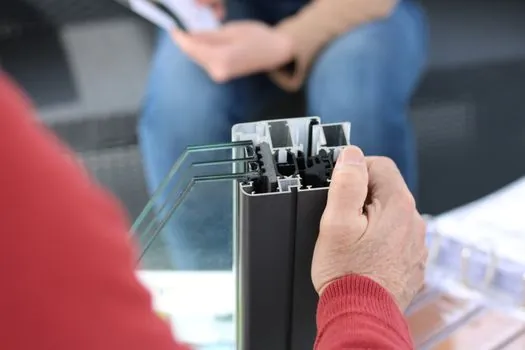
The frame Uf in EN ISO 10077-1 is determined by 2-D or 3-D numerical simulation of the frame profile per ISO 10077-2 and is not a single material constant; published ranges for an unbroken aluminum profile sit at roughly 1.6 to 2.0 W/m²K, while wood and PVC frames commonly reach 1.0 to 1.3 W/m²K [S2]. Aluminum's high thermal conductivity means a plain chambered profile cannot hit sub-1.3 W/m²K Uf, which is the reason thermally broken aluminum systems use polyamide strips, resin-filled chambers, or foamed insulation cores to push Uf down toward the 0.9 to 1.2 W/m²K range [S4].
The Neuffer tables illustrate the geometric arithmetic: an Energeto 5000 ED frame with Uf = 0.89 W/m²K paired with Ug = 0.6 and Swisspacer V (Ψg = 0.032) reaches Uw = 0.78 W/m²K, qualifying as a Passive House component, while the same glass and spacer with Uf = 1.2 W/m²K stops at 0.87 W/m²K and misses the 0.80 ceiling [S4]. For project specs, the Uf figure that matters is the value from the system manufacturer's EN ISO 10077-2 hotbox or numerical report, not the Uf printed on a generic product sheet, because the latter often refers to a different profile section, mullion, or sash [S6].
Worked Example: 1.23 × 1.48 m Aluminum Window, Ug 1.1, Uf 1.2, Ψg 0.04
Using Ag = 1.0 m², Af = 0.82 m², Aw = 1.82 m², and lg = 4.0 m, the EN ISO 10077-1 formula returns Uw = (1.0 × 1.1 + 0.82 × 1.2 + 4.0 × 0.04) / 1.82 = (1.10 + 0.984 + 0.16) / 1.82 = 2.244 / 1.82 = 1.23 W/m²K, a value that lines up with the Neuffer Ideal 5000S entry of 1.2 (1.23) W/m²K for Ug = 1.1, Uf = 1.2, and a 0.04 W/mK warm-edge spacer [S2][S4]. Swapping in Swisspacer V at Ψg = 0.032 W/mK drops the edge term to 0.128 W/K and the final Uw to 1.214, matching the 1.21 entry for the same product in the same table [S4].
The same calculation with an aluminum spacer at Ψg = 0.07 W/mK yields Uw = 1.30 W/m²K, which corresponds to the 1.3 (1.30) column of the Ideal 5000S table and illustrates how a single spacer swap moves the Uw result from a passive-house-eligible 1.21 to a code-compliant but not best-in-class 1.30 [S4]. For procurement, this means that an aluminum window specified only by Ug, Uf, and frame size can still miss a 0.80 W/m²K target by 0.4 W/m²K if the spacer is left to the glass supplier's default.
Comparison: Frame Material and Spacer on the Same Glazing
For a fixed Ug of 0.7 W/m²K and the same 1.23 × 1.48 m geometry, the table for an Energeto 5000 ED profile (Uf = 0.89 W/m²K) reports Uw of 0.93, 0.86, and 0.84 W/m²K for aluminum, PVC warm-edge, and Swisspacer V spacers respectively, while the same Ug with a higher-Uf PVC Ideal 5000S profile (Uf = 1.2 W/m²K) reports 1.03, 0.96, and 0.94 W/m²K [S4]. The 0.07 to 0.10 W/m²K improvement from warm-edge upgrades is consistent across both frame types, while the 0.10 W/m²K gap between the high-Uf PVC frame and the low-Uf thermally broken aluminum frame is independent of spacer choice, confirming that Uf and Ψg are independent levers in the ISO 10077-1 formula [S4][S6].
For a Passive House spec, the only combinations that break the 0.80 W/m²K ceiling in the Neuffer table are Ug = 0.6 W/m²K with Uf ≤ 0.89 W/m²K and Swisspacer V (Ψg = 0.032), reaching 0.78 W/m²K; the same Ug = 0.6 with an aluminum spacer stops at 0.83 W/m²K [S4]. Choosing the spacer that puts the unit under the spec line is typically less expensive than upgrading the frame profile by a full thermal-break generation, which is the practical reason Ψg is treated as a first-class variable in the standard rather than a minor correction term [S6].
Standards Boundary: EN ISO 10077-1 vs EN ISO 10077-2 vs NFRC
EN ISO 10077-1 is a calculation method that takes externally measured or simulated inputs (Ug from EN 673, Uf from EN ISO 10077-2, Ψg from EN ISO 10077-2 or product tables) and produces a single window-level Uw, and it is the method the European CE marking and the German GEG (Building Energy Act) refer to for Uw [S1][S2]. The North American NFRC/CSA rating system also reports a whole-product U-factor but does so by physical testing of a complete unit at a fixed standard size, with different boundary conditions and different surface film coefficients, so a single window will return a different U-factor under NFRC than under ISO 10077-1 even at the same geometry [S3].
The practical implication is that an aluminum window specified to a European Uw of 1.3 W/m²K is not directly equivalent to a North American U-factor of 1.3, and a U-factor-based energy model should be re-run under the NFRC/CSA framework before the same number is used for code compliance in a US or Canadian jurisdiction [S3]. Within Europe, EN ISO 10077-1 is also explicitly the basis for the psi-value-corrected Uw of glazing-bar windows, with subdivided-glass corrections handled by the Σ Afi form rather than the simplified two-area version [S1][S7].
Spec Pitfalls and Failure Modes
The most common error in aluminum window Uw calculations is using a Ug value measured for a vertical installation to size a horizontal or rooflight application, because EN 673 explicitly differentiates between vertical and horizontal glazing Ug and the LAMILUX worked example warns that ignoring the orientation term alone can shift Uw by more than 0.3 W/m²K [S1]. A second common error is using a default Ψg of 0.07 W/mK for a window that actually carries a warm-edge spacer, which overstates Uw by 0.05 to 0.15 W/m²K and can lead to a window being wrongly rejected in a Passive House review [S4][S6].
A third error is treating the rebate area as glazing area, so Ag is overstated, Af is understated, and the contribution of the frame (typically the worst-insulating part of an aluminum assembly) is mathematically diluted in the weighted average [S1][S2]. A fourth error is using the frame Uf of a thermally broken aluminum profile for a mullion or transom of a different cross-section, which is technically out of scope of EN ISO 10077-1 unless each section is documented separately and the Σ Afi form is used [S6][S7]. For rooflights and curtain walls, omitting the point-transmittance term χ for load-transfer brackets and flap frames is a fifth common error, and the LAMILUX example adds χ precisely to capture that geometry [S1].
What to Track Next
For aluminum window procurement, the next data point to lock in is the system-specific Uf hotbox report under EN ISO 10077-2 rather than a brochure value, because the latter is often a best-case figure and the first calculation that breaks is usually the Uf term. The second trackable signal is the spacer model, which should be called out by brand (Swisspacer V, TGI, Thermix) rather than by generic warm-edge description, so the Ψg value of 0.032 to 0.04 W/mK used in the Uw calculation can be matched in the supplied glass. The third is the orientation of the window, since a Ug value for vertical installation cannot be used for a rooflight without the LAMILUX-style horizontal correction. [S1]