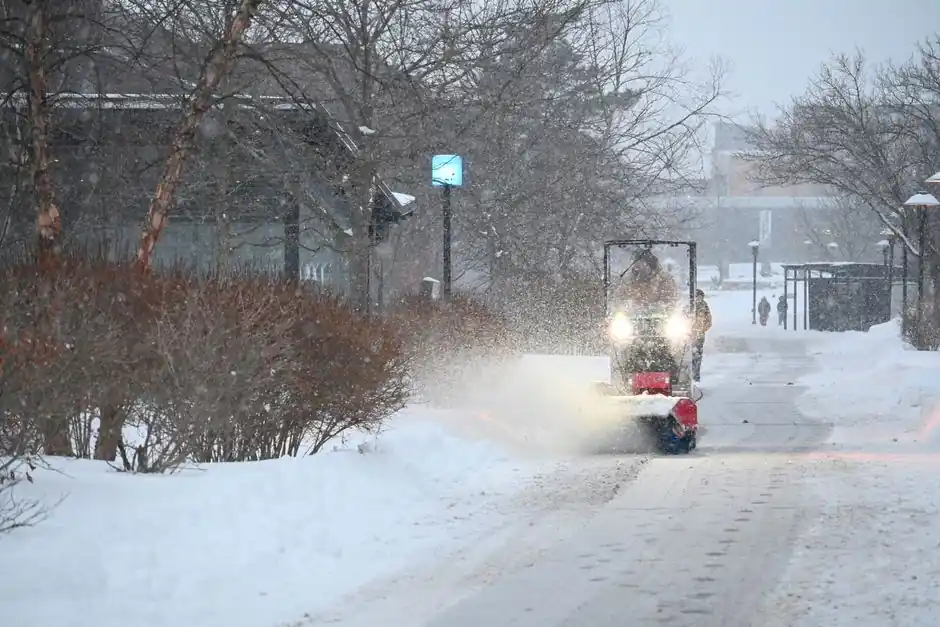
EPDM's outdoor weatherseal temperature range spans roughly -50°C to +150°C (-60°F to +300°F), with the -40°C to +120°C band treated as the dependable continuous-service window across most compounding sources [S2][S5].
Outside that band, behavior is a function of cure system, filler package, and section thickness, so the headline number must be cross-checked against the actual service envelope before specification [S5][S7].
Cold-side limits: -30°C to -50°C depending on grade
Low-temperature flexibility in EPDM is driven by diene choice and plasticizer loading, which is why published numbers diverge by 20°C across reputable sources. Elastoproxy lists -40°C as the standard low end for general-purpose EPDM compounds [S2]. Aquaseal narrows that to -30°C for its commercial grade [S4]. ERIKS and Delta Rubber both document a -50°C low-temperature limit using peroxide-cured or specialty low-temperature grades, with flexibility maintained to -50°C for cold-climate outdoor equipment [S5][S7]. Universal Polymer quotes -40°F (-40°C) as the practical floor where the material "stays flexible and maintains sealing force" for outdoor service [S1].
Hot-side limits: +120°C continuous, +150°C intermittent, peroxide-cured up to +300°F
The hot-side ceiling splits cleanly by curing system. Sulphur-cured EPDM caps at +120°C (+250°F) for continuous service and is positioned as an inexpensive general-purpose material [S5]. Peroxide-cured EPDM extends the continuous ceiling to +150°C (+300°F) and is the grade specified for hot water, steam, alcohols, ketones, engine coolants, and organic or inorganic acids and bases [S5]. Standard compounding sources converge on +150°C as the practical intermittent peak [S2][S4][S5].
Sealmaster lists -29°C to +150°C as the working span for EPDM in its temperature-range charts, which is the narrowest commercially defensible band for outdoor weatherseal work [S8]. Universal Polymer's +250°F (+121°C) continuous figure matches the sulphur-cured number from ERIKS, so the +120°C continuous / +150°C intermittent pair is the most defensible baseline for procurement documentation [S1][S5].
How EPDM compares to nitrile, silicone, and natural rubber outdoors

EPDM's value proposition outdoors is ozone, UV, and steam resistance combined with a wide temperature band, but the trade-off against alternative elastomers is sharp. Elastostar notes that nearly 60% of seal failures are linked to improper material selection, particularly in applications exposed to oil, temperature variations, or outdoor conditions, which is why the material choice must be driven by the exposure profile rather than unit cost [S3].
Against nitrile (NBR), EPDM wins on weather, UV, water, and steam resistance but loses decisively on oil and fuel compatibility, so any hydrocarbon exposure immediately disqualifies EPDM regardless of temperature [S3]. Against silicone, EPDM handles -40°F to +250°F (-40°C to +121°C) for many common automotive and construction applications, while silicone extends the hot ceiling further but at higher unit cost and lower tear strength [S9]. For deeper polymer-level comparison, the EPDM vs natural rubber backbone chemistry and selection rules reference lays out how saturated EPDM backbone resists ozone cracking where natural rubber's unsaturated backbone fails.
Decision matrix: continuous service temperature and exposure profile
Specifying EPDM for outdoor weatherseal service comes down to four criteria: continuous hot ceiling, cold flexibility, chemical exposure, and movement class. The peroxide-cured grade is the only option when the seal sees +120°C to +150°C continuous or any steam service [S5]. The low-temperature grade (-50°C capability) is mandatory for cold-storage doors, Arctic-rated HVAC cabinets, and similar applications; standard EPDM at -30°C will harden and lose sealing force [S4][S7].
For HVAC, roofing, and exterior door and window seals, the standard sulphur-cured EPDM at -40°C to +120°C continuous covers the majority of temperate-climate weatherseal work and is the lowest-cost qualified option [S1][S3]. When the seal sees petroleum oil, grease, gasoline, or aromatic hydrocarbons, EPDM is disqualified entirely and NBR or FKM should be substituted [S3][S5]. For a deeper dive into how an elastomer choice interacts with adjacent process instrumentation, the temperature sensor selection reference covers sensor-side cold-junction and immersion-length trade-offs that often drive the same enclosure sealing decisions.
Failure modes and limits engineers underestimate
Three failure modes dominate outdoor EPDM weatherseal service and each is tied to a specific spec oversight. Compression-set relaxation at sustained high temperature causes permanent deformation; specifying a low-compression-set compound (often a peroxide cure) is required above +100°C continuous [S5]. UV-driven surface cracking is rare on properly compounded EPDM but appears within 5 to 10 years on thin sections under high-ozone exposure such as coastal or urban industrial atmospheres, which is why section thickness and strain relief should be reviewed at the design stage [S1][S4].
Chemical incompatibility with hydrocarbon fluids is the single most common cause of EPDM weatherseal failure in field service, because the same door or cabinet that sees weather on the outside often has lubricated hinges, hydraulic lines, or grease contamination on the inside; Elastostar's caution on EPDM being incompatible with petroleum-based oils and fuels is the rule that drives most field returns [S3]. Aquaseal's 20-year typical service life figure applies to correctly specified compounds in clean outdoor exposure, not to misapplied seals [S4].
Standards, sourcing, and what to request on the data sheet
Outdoor EPDM weatherseal compounds are typically qualified against ASTM D2000 line-callout designations (e.g. "EPDM, M3BA510" for a basic peroxide-cured grade with specific hardness, tensile, and heat-aging requirements), with the diene type, cure system, and compression-set value called out in the line-callout suffix. For drinking-water and food-adjacent weatherseal service, request WRAS, NSF/ANSI 61, or W270 certification explicitly, because general-purpose EPDM compounds are not automatically certified for potable water contact [S5].
When qualifying a supplier, the minimum data-sheet checklist is: specific gravity, hardness (Shore A, ASTM D2240), tensile strength and elongation at break (ASTM D412), compression set after 22h at +100°C and after 70h at +150°C (ASTM D395B), TR-10 low-temperature retraction (ASTM D1329), and heat aging per ASTM D573. For the weatherseal application specifically, the seal's temperature measurement instrumentation on the enclosure should be verified against the same +120°C / -40°C envelope to avoid over-specifying the elastomer beyond what the actual service environment demands, and a baseline temperature monitoring trace during commissioning is the cheapest insurance against the "everything is EPDM" failure mode.
Track the next weather-season commissioning data on low-temperature-grade (-50°C) EPDM in cold-storage and Arctic HVAC applications, and watch for any 2026 supplier data-sheet updates that widen the published intermittent ceiling above +150°C, since that would shift the continuous-service band on the same compounds.