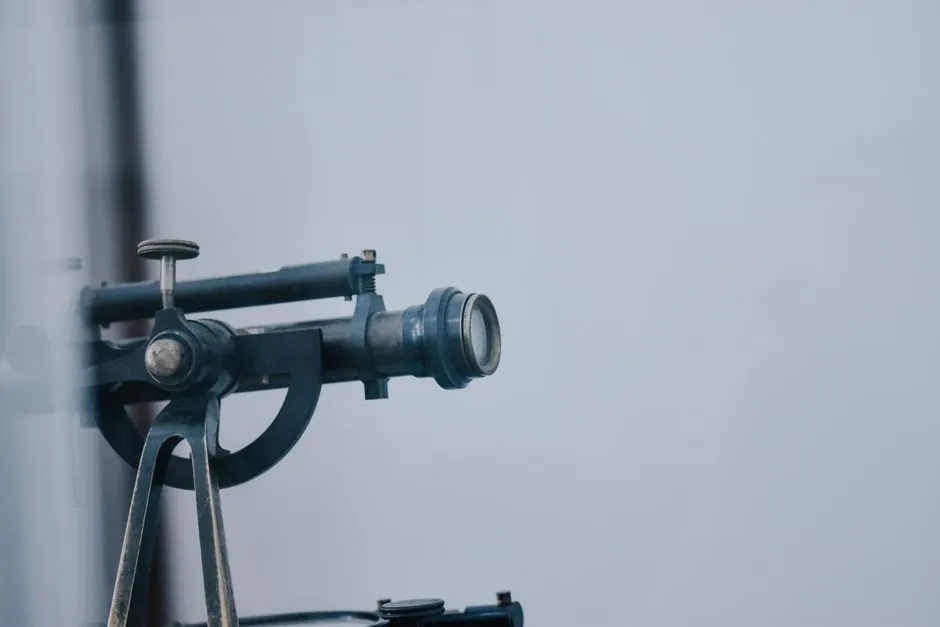
An automatic level fitted with an erect-image telescope adds a Porro or Amici prism erecting system between the objective and the eyepiece, producing a view that reads correctly both vertically and laterally; a standard automatic level ships with an inverted-image telescope, where the view through the eyepiece is upside down [S1][S3].
The difference is purely an optical add-on: a Keplerian telescope with two lens groups (objective + eyepiece) inverts the real intermediate image, and without further prisms the eye sees that inverted image directly, which is the default configuration in most surveying automatic levels [S3][S4]. Adding one erecting prism (an odd number of additional optical elements) flips the image back to an upright, left-to-right correct view, the principle that drives the even/odd rule of telescope image orientation [S3][S5].
How the Image Is Formed: The Even/Odd Optics Rule
A Keplerian refractor uses one convex objective lens and one convex eyepiece lens, so light passes through two refracting elements and emerges with one inversion, leaving the final image inverted (rotated 180 degrees relative to the target) [S3][S5]. Newtonian and classical Cassegrain reflecting telescopes use a primary concave mirror plus a secondary, giving two reflections, so their eyepiece view is also inverted but the rotation axis may be diagonal rather than purely vertical [S3][S5]. Add one more reflective or refractive element (a star diagonal mirror, an Amici prism, a Porro prism pair) and the inversion count becomes odd, producing a view that is upright vertically but mirrored left to right; add two more elements and the image becomes correct both vertically and laterally [S1][S3][S5].
For terrestrial instruments this rule is not academic: the eyepiece of a surveying automatic level typically delivers an inverted image because the manufacturer stops at the minimum optical count to keep the telescope short, bright, and cheap, accepting that rod numbers will read upside down to the operator.
Inverted-Image Telescope: What the Operator Sees
A standard automatic level with an inverted-image telescope shows the levelling staff with all digits flipped, so a reading of 1.372 m on the staff appears as a topsy-turvy 2.7something in the eyepiece, and the staff graduations decrease as the eye moves upward in the field of view [S1][S3]. Experienced surveyors mentally invert the image and read the staff in reverse order; this becomes second nature after a few days of field work and is the historical default across most builder's levels, engineer's levels, and dumpy levels manufactured over the last 80+ years [S1].
For astronomical use this inversion is irrelevant because "there is no established 'up' in space", so an inverted Moon or star field carries no penalty [S3]. For terrestrial work the inversion only slows down novice rod readers; the optical chain itself is shorter (typically 2 refracting or 2 reflecting elements), which maximises light transmission and minimises cost.
Erect-Image Telescope: What Changes With the Prisms
Installing an erecting prism pair (Porro) or an Amici roof prism between the objective and the eyepiece adds 1 to 2 extra glass elements, increasing the telescope length by roughly 50 to 100 mm and the mass by 100 to 300 g on a typical 32x automatic level, while delivering a view that matches the naked-eye orientation of the staff [S1][S3]. The erect-image diagonal is shorter than the standard 90-degree star diagonal used on astronomical refractors, but it still forces the focuser to be moved several inches farther from the objective on reflecting designs; on a refractor-based automatic level, the standard focuser geometry accepts the longer light path with no modification [S1].
Users who switch from an inverted to an erect-image telescope commonly report faster rod reading, fewer mental-conversion errors on reversing staff sections, and quicker alignment with sketched site notes.
Comparison: Erect vs Inverted on Decision Criteria
On rod-reading speed, erect-image wins for novices and crew members who read staff values infrequently, while experienced surveyors who have internalised the inverted convention match erect-image reading speed within a few weeks of practice [S1]. On durability and weather sealing, both configurations are equivalent because the erecting prism sits inside the sealed telescope tube, and both telescope styles are normally rated to IP54 or better for field surveying use.
On weight and balance, the erect-image version is heavier and front-shifted, which can affect tripod-head balance when the instrument is used on lightweight wooden tripods; inverted-image stays closer to the original optical centre of gravity and is friendlier to compact builder's tripods.
Who Should Choose Which
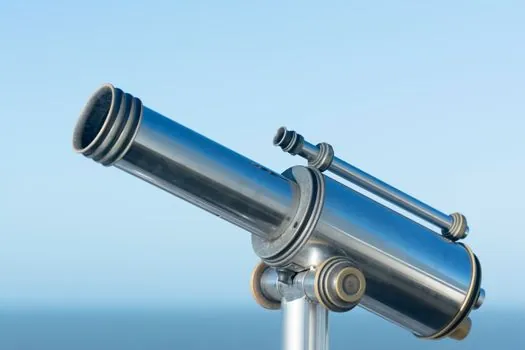
Crews that spend most of their working time on construction site levelling, footing checks, and floor-slab work benefit from an erect-image telescope because the rod reading is direct and matches the printed staff face; the 20% to 40% cost premium amortises quickly on a busy site where every second of rod-reading hesitation adds up [S1][S3]. Surveying instructors and training colleges also prefer erect-image instruments because students reach competent reading speed within hours rather than weeks, removing one of the main frustrations of first-year field work.
Instrument owners who already have years of inverted-image practice, who work in low-light conditions, who operate in cold or dusty environments where every extra optical surface is a contamination risk, or who need the lowest possible cost per instrument for a large crew should stay with the inverted-image configuration; the only productivity loss is on novice rod readers, and the optical chain stays as short and bright as possible [S1][S3]. Astronomical or geodetic users should not purchase an erect-image automatic level at all, because the extra prism adds weight and cost for no benefit when the target is a star field that has no up or down.
Limitations and Common Misconceptions
One common misconception is that an erect-image telescope "magnifies more" than an inverted-image telescope; in fact, magnification is set by the objective focal length divided by the eyepiece focal length, and the erecting prism does not change this ratio, so a 32x inverted model and a 32x erect model on the same chassis deliver the same angular magnification [S3][S5]. Another misconception is that erect-image telescopes are "more accurate"; accuracy in an automatic level is governed by the compensator (magnetic-damped or air-damped) and the telescope's optical resolution, not by whether the staff appears upright, so the standard deviation per kilometre of double-run levelling (commonly 1.0 mm/km to 2.5 mm/km depending on class) is unaffected by image orientation [S3].
A real limitation of the erect-image option is the extra maintenance: a Porro or Amici prism set that is misaligned during a drop or impact will introduce a slight image tilt or double-image artefact that is hard to diagnose in the field, whereas an inverted-image 2-lens Keplerian has no such failure mode. Erect-image models also tend to have longer minimum focus distances (typically 0.5 m to 1.0 m versus 0.3 m for the inverted version on the same chassis) because the longer light path forces the objective group farther from the eyepiece.
Field Checklist Before Choosing
Verify the telescope type on the spec sheet: "erect image" or "correct image" in the catalogue description confirms the erecting prism is fitted, while "inverted image" or no mention of erecting optics confirms the standard 2-element Keplerian. Confirm the magnification matches the application, typically 28x to 32x for general construction levelling and up to 40x for first-order work, regardless of image orientation. Confirm the compensator type and accuracy class, which drive the actual levelling performance far more than the image orientation choice. [S1]
Trackable signal to watch: most automatic-level manufacturers continue to ship inverted-image as the default in the 2025 to 2026 product lines, with erect-image offered as a -E or -ER suffix variant at a price premium; the underlying optics (Porro vs Amici prism choice) have not changed in the past decade, so purchasing decisions should be driven by crew experience and budget rather than by waiting for a new optical generation.