An exposure meter reading in EV and a handheld lux meter reading in lux are two encodings of the same incident illuminance on the subject, separated by a base-2 logarithm and a calibration constant of 250 at ISO 100 [S4].
Because the relationship is fixed, a 0.1 to 200,000 lux digital lux meter spans roughly -4 to 16 EV, which is the practical range from "half-moonlit subject away from city lights" through "bright sun on sand or snow" [S1].
Definition and Scope: What Each Unit Actually Measures
Lux is an SI photometric unit defined as one lumen per square meter, so it is an objective measurement of illuminance that does not depend on camera ISO, aperture, or shutter speed [S4]. A device that displays its output in lux is, by convention, called a "luxmeter" [S2].
Exposure Value (EV) is a photographic compound quantity that pairs a shutter speed and an f-number for a given ISO; at the baseline EV 0, the combination is f/1.0 at 1 second at ISO 100, and each step of +1 EV halves the light reaching the sensor [S4]. On most handheld exposure meters, the EV value is the underlying raw output from which the displayed f-stop and shutter combinations are derived once ISO is set [S3].
Conversion Formula, Calibration Constant, and Worked Examples
The exact relation at ISO 100 is EV = log2(Lux / 2.5), or equivalently Lux = 2.5 × 2^EV, which the 2020 hobbyist reference describes as "Lux is two to the power of EV times 2.5" [S1]. The general form with ISO factored in is EV = log2(Lux × ISO / 250), where 250 is the standard incident-meter calibration constant [S4].
Plugging in real numbers: EV 1 equals 5 lux, EV 13 equals 10,240 lux, and EV 15 (the "sunny 16" anchor) equals about 32,000 lux at ISO 100, which is why a meter with a 200,000 lux ceiling comfortably covers the full outdoor range [S1][S4]. At ISO 400 the same physical scene reads two stops higher on the EV dial, so the lux reading on the illuminometer does not change but the EV number shifts by exactly +2 [S4].
Decision Matrix: When to Use a Lux Meter vs an Exposure Meter
For a photographer who only needs an exposure answer in the field, a dedicated photographic exposure meter (incident or reflective) is the right tool because it already outputs f-stop and shutter combinations for the chosen ISO [S3]. A lux meter, in contrast, gives raw illuminance and requires either a printed conversion table, a circular dial calculator, or a software tool to translate the reading into EV [S1][S4].
For lighting designers, gaffers, scene-shop electricians, and plant-growers who need illuminance in objective SI units (lux or foot-candles) to verify architectural, horticultural, or cinematography lighting installations, a lux meter is the only correct instrument because EV depends on ISO and is therefore a photography-specific construct [S2][S4]. A cost-driven compromise that actually works in practice is to buy a sub-£10 digital lux meter, build a printed Lux to EV card at ISO 100, and use that pair to both cross-check old photographic meters and serve as a service-grade illuminance reference [S1].
Sensor Type, Range, and Accuracy Trade-offs
Sub-£10 handheld lux meters from the 2020 hobbyist review used a silicon photodiode behind a diffuser, autoranged across roughly 0.1 to 200,000 lux in switched decades, and gave stable enough readings that a Sekonic Twinmate L-208 and the cheap meter agreed on a sunny outdoor scene [S1]. The EV equivalent of that same hardware envelope, -4 to 16 EV, is wider than the EV 0 to 20 range most dedicated photographic exposure meters display and covers every lighting condition a still photographer is likely to encounter [S1].
Two practical limits are worth flagging. First, reflective in-camera meters report a luminance-based EV that includes subject reflectance, so it does not match an incident-lux conversion on backlit or unusually dark subjects [S4]. Second, foot-candle and lux conversions differ by a factor of 10.76, and any crew member copying a spec from a U.S. lighting designer must convert before applying a Lux to EV calculator or the result will be off by more than three stops; see the related foot-candles to lux note for the exact factor and where each unit belongs [S4].
Verified Field Use Cases from Working Photographers
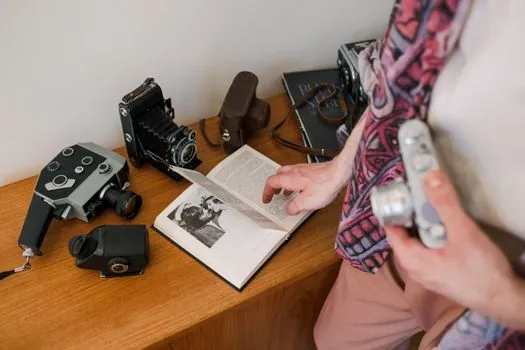
The 2020 case study paired a Chinese-made sub-£10 lux meter with a printed Lux to EV conversion card and used the combination to verify that a vintage Sekonic meter still read correctly on the same outdoor scene, then as a reference against which to recalibrate a collection of older Weston and Norwood meters [S1]. The same Lux to EV workflow is used on professional film sets when a lighting director specifies a key-light target in lux and the cinematographer needs the matching EV to set aperture and shutter angle on the camera [S4].
Outside photography, the same lux-meter reading is reused directly in architectural lighting verification and in indoor-plant light-level assessment, where the EV construct is meaningless and only the lux number matters [S2]. A useful sanity check is to remember that the same physical scene reads roughly 10,000 lux under open shade at noon and about 1 lux under a full moon, which corresponds to about EV 12 and EV -1.3 respectively at ISO 100 [S1].
Limitations, Common Errors, and How to Avoid Them
The single most common error is treating the EV shown on a reflective in-camera meter as interchangeable with an incident-lux conversion; reflective EV is subject-dependent, while the incident lux-to-EV formula assumes an 18% grey calibration on the meter dome [S4]. A second error is forgetting the ISO term: doubling the ISO adds +1 EV at the same physical lux level, so a reading taken at ISO 200 must have 1 EV subtracted before being compared to a chart built at ISO 100 [S1][S4].
A third limitation is dynamic range: a cheap lux meter autoranges in decade steps and may briefly stall or read zero between scales in very low light, while a dedicated photographic exposure meter down to EV -4 typically has a smoother low-light response but a lower maximum ceiling than a 200,000-lux illuminometer [S1]. For any safety-critical or contractual illuminance measurement (museum lighting, OSHA-style workplace checks, horticultural PPFD work), a calibrated lux meter with a current calibration certificate should be used instead of a converted photographic EV reading, and the resulting lux should be reported, not the EV [S2].
Trackable signals to watch: the next refresh of online Lux to EV calculators adding ISO 50 and ISO 800 presets, and more sub-£20 digital lux meters listing an explicit EV-overlay mode rather than a raw lux-only output, which would close the remaining workflow gap for hobbyist photographers [S1][S4].
