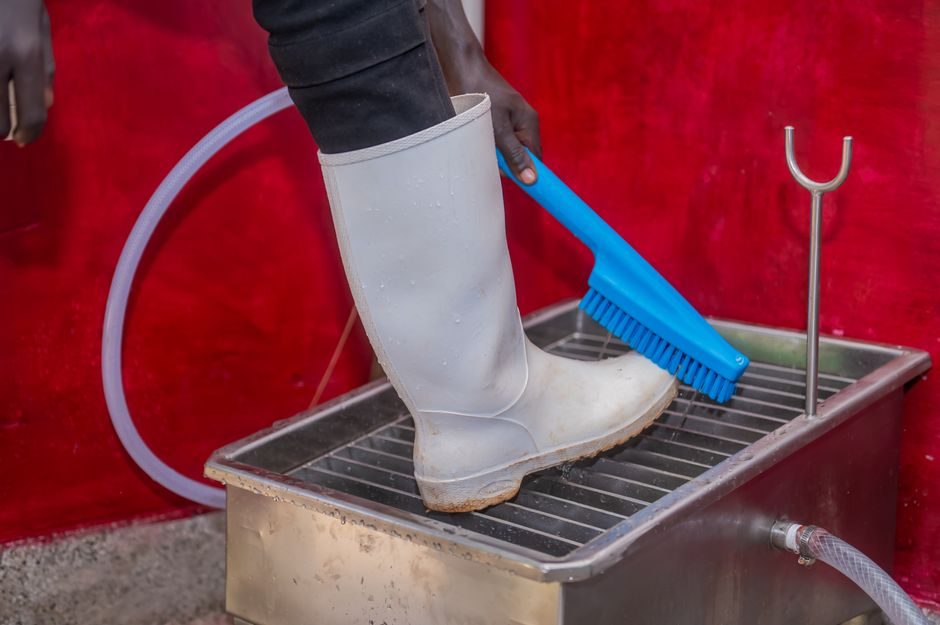
An eye wash station must sit on an unobstructed 10-second walk from the hazard, deliver at least 1.5 L/min per nozzle for 15 minutes, and feed tepid water between 15 °C and 38 °C — those three numbers govern every pipe-run, tank, and mounting decision on a chemical or battery plant floor.
Selection splits cleanly into plumbed wall-/floor-standing stainless assemblies and self-contained portable units, with current European catalogue data showing portable tanks in 50 L, 60 L, and 11.5 L/min wall-cart formats, all built to meet EN 15154 and ANSI Z358.1 [S1][S2][S3].
Plumbed vs Portable: Which Format Fits the Hazard Map
Plumbed wall-mounted units such as the SS304 trapezoidal models sold at US$23-26 per set with a 2.4 kg gross weight are the default for indoor fixed benches and carry an anti-splash geometry [S6]. Hughes Safety Showers' STD-68G is the portable-flagship benchmark: a 60 L high-density polyethylene body, bench or wall mounted, delivering 3 L/min for 15 minutes and accepting an optional heated cabinet for outdoor retrofit [S1].
Portable pressurized tanks trade continuous water supply for mobility. The EPITECNICA 6050R2D2 carries 50 L of useful potable water inside a stainless tank, charged with compressed air to 5-6 bar (72.5-87.0 psi), feeds a 1500 mm hose, and uses a manual lever plus automatic cutting gun for shower action [S2]. The 6100R2D2 keeps the same 5-6 bar envelope and 11.5 L/min flow but drops to 0 Pa minimum, simplifying the air-charge procedure on construction sites [S4]. The 6684 wall-cart converts any existing wall eyewash into a mobile unit on a stainless tube truck with 40 or 60 L collection buckets and a height-mounted regulatory sign [S3].
Placement Geometry: Distance, Height, and Obstruction-Free Path
Both ANSI Z358.1 and EN 15154 require the eye wash station to be on the same level as the hazard, reachable within 10 seconds, and mounted with the nozzles 838-1143 mm above the floor and at least 153 mm from any wall or obstacle [S1][S6]. A 6684 mobile cart is rated for door-passable geometry and ships with a height signal that satisfies the visibility clause on a multi-room site [S3].
Plumbed eyewash must be tagged on a highly visible sign, lit if the work area is dim, and kept clear of locked doors; the 6684's height-mounted signal panel is the portable equivalent and the only mobile unit in the catalogue group that ships with regulatory signage factory-fitted [S3]. For outdoor hazmat yards, plumbed lines must be heat-traced or drained, otherwise a portable 50 L pressurized tank sidesteps the freeze risk entirely [S2].
Water Quality, Flow, and Tepid-Limit Verification
Acceptance test: 1.5 L/min minimum per eye wash nozzle (3 L/min combined is typical for face/eye dual heads), sustained for a full 15 minutes, with delivery temperature held between 15 °C and 38 °C [S1][S6]. The Hughes STD-68G ships rated at 1.5 L/min (0.4 US gal/min) flow and a 60 L tank sized for the 15-minute window, and its HDPE body will not skew the water chemistry the way unprotected carbon-steel bowls do [S1].
For portable tanks, an innocuous bactericidal additive (article 6800) is included with the 6050R2D2 to keep stored potable water usable for extended periods, removing the weekly flush burden that a stagnant plumbed dead-leg would otherwise impose [S2]. Annual flow verification is done by capturing nozzle discharge into a calibrated jug over 60 s; any reading below 1.5 L/min per nozzle triggers a strainer clean or a full replacement of the flow-control internals [S1].
Mounting Hardware, Materials, and Field Acceptance
SS304 stainless is the de-facto material spec across both Chinese OEM and European catalogues; the MAGY 7000 lab sink variant from MedicalExpo builds the entire bowl and pedestal in 304 stainless for full-sterilization rooms and ships with both wall-mount and footed-mount hardware kits [S9]. Wall-mounted trapezoidal units from Chinese OEM runs ship at 2.4 kg gross weight with anti-splash design and the SS304 body comes welded, no on-site cutting needed [S6].
Floor- and bench-mounted plastics stay inside the HDPE / polyethylene family to avoid chemical attack; the Hughes STD-45G, STD-75G, and EXP-AH-45G/P heated variants extend that body chemistry to hazardous indoor zones and frosty outdoor cabinets [S1]. For construction sites and outdoor hazardous work, only the frostproof portable 6050R2D2 and 6100R2D2 are listed as suitable, with EPITECNICA explicitly excluding the plastic-only 6684 from outdoor / construction use [S2][S3][S4].
Failure Modes: When to Repair, When to Replace
Symptom → low flow at the nozzle. Root cause → blocked inline strainer or fouled flow controller. Action → isolate the supply, unscrew the nozzle insert, back-flush the strainer, and re-test to 1.5 L/min; if the controller itself is scored or the HDPE body shows chemical attack, replace the whole sub-assembly rather than patching [S1]. Symptom → tepid water outside 15-38 °C at the nozzle. Root cause → undersized or uninsulated trace-heating on a long pipe run, or a sun-exposed black HDPE body on a 6050R2D2. Action → re-route the line, add a blended thermostatic mixing valve, or fit the Hughes heated-cabinet option [S1][S2].
Symptom → tank pressure decay on a portable unit. Root cause → automotive pneumatic valve seal failure on the 6050R2D2/6100R2D2 air-charge fitting, since both are pressurized with standard car-type compressed-air valves [S2][S4]. Action → replace the valve core (an off-the-shelf automotive part), then re-pressure to 5-6 bar; if the stainless tank itself shows pitting, the unit is scrap. When the eyewash is more than 10 seconds' walk from a new hazard, escalation is correct: do not relocate the existing unit, add a second one — a single 11.5 L/min wall-cart cannot cover two separate rooms [S3].
Standards and Sourcing Signals
Specifying language should reference ANSI Z358.1-2004 (or its current revision) for US sites, EN 15154-1/-2 for European sites, and a flow rate of 1.5 L/min minimum per nozzle for 15 minutes, with tepid water defined as 15-38 °C [S1][S6]. The Hughes STD-68G datasheet explicitly states "conforming to European and International standards" alongside an EN/ANSI dual mark, and the EPITECNICA portable line is described as "frostproof" for outdoor construction use [S1][S2].
Sourcing signals worth tracking: portable 50 L tank units cluster at US$200-400 per set in EU catalogues versus US$10-50 entry-level plastic wall units in Chinese OEM listings and US$23-26 for SS304 wall-mounted trapezoidal models with 2.4 kg gross weight [S6][S8]. For projects that mix a fixed plumbed line with a mobile backup — typical in pharma, battery R&D, and lab builds — the eye wash station shortlist should pair a 304 stainless wall unit with a 6684 mobile cart on the same site, and document both in the EHS register against the same ANSI/EN acceptance numbers [S3][S6][S9]. Cross-check adjacent process-equipment specs such as vibration meter calibration when auditing mechanical-vibration hazards that share the same ANSI Z358.1 placement logic, and revisit the waterstop splicing and acceptance workflow where plumbed water lines cross expansion joints near the eyewash.
Spec-level background on the components involved: linear guide, and crossed roller guide.