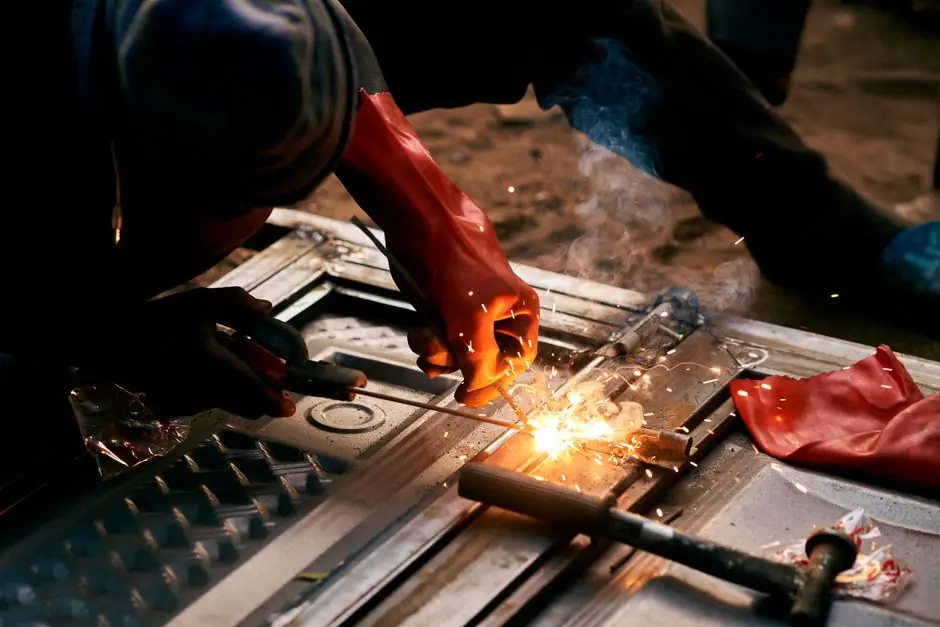
A welding-rated fall-arrest harness must combine full-body load distribution with flame-resistant (FR) webbing, aramid fibers, and PVC-coated hardware to survive spatter, slag, and radiant heat that destroy standard nylon gear.
This guide covers the spec criteria, the dorsal vs sternal vs lateral D-ring trade-offs, the 29 CFR 1926 Subpart M test loads an OSHA inspector will check, and the failure modes welders actually see on tank, pipeline, and structural jobs.
Welding Harnesses Differ from General-Purpose Harnesses in Three Specific Ways
Standard polyester or nylon web loses strength rapidly when exposed to welding spatter and contact heat above roughly 200 deg C, so welding harnesses use aramid fibers (Kevlar) in the load-bearing web and FR-treated cotton for reflective trim [S1]. MSA's Gravity Utility Harness (Arc Flash variant) is a published example: nylon web still meets the 7,000 lbf minimum static strength, but the FR fabrics, aramid padding, and PVC-coated buckles and D-rings are the specifiers that mark it as welding-rated [S1]. A second MSA variant, the Gravity Coated Harness, adds a urethane web coating for stain and abrasion resistance in dirty fabrication environments [S1].
Hardware choice matters as much as the web: bare aluminum or steel D-rings conduct heat and weld current, while PVC-coated and bayonet-style locking buckles confirm engagement at a glance and do not slip under load [S1]. Worker capacity is typically rated to 400 lbs (181 kg), the same envelope used in 29 CFR 1926 Subpart M strength tests where a 300 lb plus or minus 5 lb rigid test weight is dropped once onto an unused system [S1][S4].
Dorsal, Sternal, and Lateral D-Rings: Pick by Welding Task, Not by Catalog Default
D-ring position is dictated by how the welder is tied off, not by what the supplier stocks. Dorsal (back) D-rings are the default for fall arrest and are the most common welding configuration, and the MSA Gravity series is a dorsal-fixation full-body harness with optional ventral, sternal, hip, and back D-rings for suspension work [S1].
Lateral D-rings, as in TRACTEL's wind-industry harness range, are for positioning and work positioning, not primary fall arrest, and are paired with a separate fall-arrest anchor point [S2]. Sternal D-rings are used for vertical climb and confined-space welding where a dorsal-only attachment would invert the worker; the Gravity Suspension Harness explicitly lists sternal and back D-rings as fall-arrest rated, with a 3,600 lb (16 kN) carabiner gate strength [S1]. For most overhead structural and pipe welding the dorsal D-ring alone is correct; for tank and vessel welding inside a basket, add a sternal or ventral D-ring so the arrest load does not snap the worker face-down.
29 CFR 1926 Subpart M Test Loads Every Welding Harness Must Survive
OSHA's non-mandatory Appendix C to Subpart M (29 CFR 1926) is the de facto test protocol U.S. inspectors reference, and it is worth reading the numbers before you sign a PO [S4]. A rigid metal test weight of 300 lb plus or minus 5 lb (135 plus or minus 2.5 kg) with a 38 in plus or minus 4 in girth is dropped once per unused system, with lanyard length 6 ft plus or minus 2 in from the fixed anchorage to the body harness [S4].
For systems without automatic free-fall limiting, the test weight free-falls 7.5 ft (2.3 m) from 1.5 ft (.46 m) above the anchorage, simulating a worst-case arrest [S4]. The anchorage itself must not deflect more than 0.04 in (1 mm) under a 2,250 lb (10 kN) static load, and load-measuring instrumentation is specified at 500 Hz frequency response [S4]. On the supplier side, ASTM F887 is the relevant U.S. arc-flash and welding harness standard and its 7,000 lbf minimum web static strength is the number to put on the datasheet checklist [S1].
Comparison: Welding-Rated vs General-Purpose vs Positioning Harnesses
Line the three common harness classes up against the four criteria that drive a welding-job decision: [S1]
Flame/spatter resistance: Welding-rated harnesses use aramid web, FR-treated reflective tape, and PVC-coated hardware [S1]. General-purpose harnesses use nylon or polyester web and bare metal D-rings, which fail after spatter exposure. Positioning harnesses (lateral D-ring) are rarely FR-rated; TRACTEL's lateral-fixation line is targeted at wind-turbine access, not welding [S2].
Primary attachment point: Welding-rated = dorsal (back) D-ring, often with optional sternal and ventral for suspension [S1]. General-purpose = dorsal. Positioning = lateral D-ring only, for work positioning, not fall arrest [S2].
Test load: Welding-rated and general-purpose both target 3,000 lb (5,000 lb ultimate) arrest load per 29 CFR 1926.502, validated by the 300 lb / 7.5 ft drop test in Appendix C [S4]. Positioning harnesses are limited to 1,000 lb arrest per positioning-device rules [S4].
Typical capacity: Welding-rated and general-purpose = 400 lbs worker capacity per MSA Gravity spec [S1]. Positioning harnesses are usually 310 lb (140 kg) per EN 813-style positioning standards. A spec-only signal worth tracking: MSA lists built-in load indicators and RFID tagging on Gravity harnesses, which lets a safety manager pull inspection history without paperwork [S1].
Failure Modes Welders Actually See on the Job
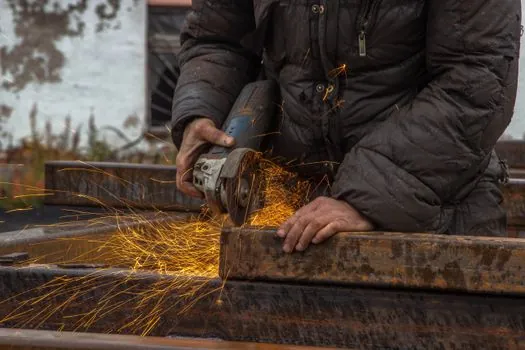
Three failure modes drive harness replacement on welding sites, and all three are visible without destructive testing. Spatter burn-through of nylon web is the first, and any char beyond a small surface mark means the harness is out of service; aramid web resists this but is not immune. Heat-degraded D-rings and buckles are the second, and PVC coatings will discolour and stiffen well before the underlying steel loses strength, which is why a visual-inspection program matters. [S1]
Slag cut on load-bearing stitching is the third, and side-loaded cuts across a stitch line reduce the 7,000 lbf rating faster than axial cuts. Welders should also check that any lanyard or self-retracting lifeline (SRL) feeding into the dorsal D-ring is itself FR-rated, since a non-FR lanyard fails first in a real arrest. For overhead work where a hard catch is possible, an SRL limits free fall to 2 ft (0.61 m) automatically and drops the test weight only 4 ft (1.22 m) per Appendix C paragraph (c)(6), which lowers the arrest force on the welder's body [S4]. See fall arrest harness selection for electrical work for the arc-flash-rated variant and FR-clothing layering that often goes with it.
Standards, Sourcing, and What to Verify on the Datasheet
The specifier's checklist for a welding job is short but unforgiving. ASTM F887 compliance with documented 7,000 lbf minimum static web strength is non-negotiable for U.S. welding work [S1]. ANSI Z359.11 covers full-body harness performance in the same market. 29 CFR 1926.502(d) and Appendix C govern how the system is tested and anchored, with a 5,000 lb (22.2 kN) minimum anchor or a 2,250 lb (10 kN) engineered anchor as the typical specification [S4]. EN 361 is the European full-body-harness standard if the work is in the EU.
On the supplier datasheet, require: FR/aramid web with stated minimum static strength, PVC-coated D-rings and buckles, dorsal D-ring as primary fall-arrest attachment, locking bayonet buckles, 400 lb worker capacity, built-in load indicator, and RFID or serial-traceability for inspection records [S1]. Reject any harness with bare aluminum hardware, polyester-only web, or a working-height rating above the anchorage capacity. A welding-rated harness costs roughly 1.5x to 2x a general-purpose harness, but the replacement cycle on a dirty structural job is the same, so the lifetime cost converges.
Track two signals through 2026: (1) whether MSA, 3M, Petzl, and Tractel publish revised F887/EN 407 test data after the 2026 arc-flash PPE refresh, and (2) whether the Fall-Pac air-pocket and polystyrene cushion systems referenced for transport and aerospace rigging begin to appear on welding-cell fall-arrest tenders as a substitute for personnel SRLs in low-frequency tasks [S5]. For adjacent PPE context, see the welding and cutting tool encyclopedia entry on spatter-rated gloves and sleeves that pair with welding harnesses.
For the relevant spec sheets and selection criteria, see fall arrest harness, and pressure transmitter.