
Firefighter hearing loss is driven by a 1 kHz to 4 kHz band where pump panels, chainsaws, SCBA alarms and hydraulic rescue tools routinely push 100 dB to 120 dB SPL, so 2026 procurement is spec'ing dual protection (earplugs plus earmuffs) targeting an effective protected exposure of 80 dB(A) over an 8 h shift [S3].
The class covers four product families: foam disposable plugs, pre-moulded reusable plugs, custom-moulded musician-style plugs, and helmet- or hardhat-mounted active/passive earmuffs. Selection is governed by the working environment (structural, wildland, airport Rescue and Firefighting, shipboard, industrial brigade), the PPE stack the wearer already carries, and the radio or RHA (Rescue Hearing Augmentation) interface built into the helmet [S1][S2].
Attenuation classes and the SNR / NRR / SLC80 decision
European brigades reference SNR (Single Number Rating) per EN ISO 4869, while North American fire services still apply NRR (Noise Reduction Rating) under EPA TSG and ANSI S3.19, and Australia/New Zealand use SLC80 (Level Conversion, 80th percentile). For structural firefighting, the 2026 baseline is an SNR ≥ 30 dB passive cup combined with a low-profile foam plug rated SNR 27 dB to 35 dB inside the SCBA facepiece seal [S1].
Over-protection backfires in low-noise phases (overhaul, victim extraction): specifying an active, level-dependent muff with an ambient-through gain of roughly +8 dB to +12 dB, and a limiter that clamps the cup response at about 82 dB(A) at the ear, preserves voice intelligibility on the incident ground. Wildland and airport RFF crews exposed to APU and turbine run-up noise lean on passive muffs with SLC80 ≥ 30 dB because electronic clipping inside a level-dependent circuit can introduce harmonic distortion that masks radio syllables [S1][S2].
Helmet, SCBA facepiece and radio stack integration
The dominant 2026 fail-mode is bracket interference: a clip-on earmuff that does not match the helmet's 30 mm or 35 mm side-slot pattern blocks the SCBA facepiece neck strap and forces a leak path. EN 352-3 compliant helmet-mounted muffs with a fixed or universal adapter are the only devices that survive an EN 443 / NFPA 1971 helmet shell audit [S1].
Body-worn radios, bone-mic or lapel-mic comms, and RHA (situational-awareness) modules are usually wired through the muff's boom-mic port or a 3.5 mm jack; specifiers should require an IP54 or higher rating on the muff electronics, a Kevlar-reinforced coiled cable, and a quick-disconnect that releases cleanly under a 50 N load to prevent snag hazards during bailouts [S2]. For structural attack, in-ear earpieces that sit under the SCBA facepiece seal (comms-only foam tips) trade attenuation for radio clarity and are paired with an over-the-ear cup when crews transition from interior attack to overhaul.
Materials, hygiene and the decon cycle
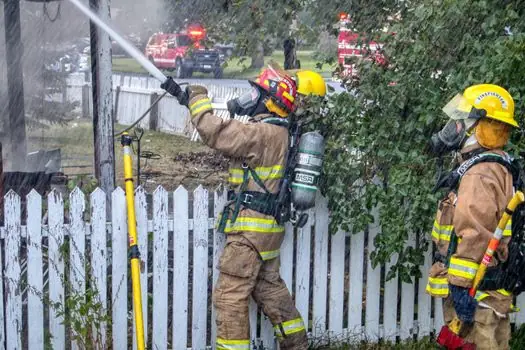
Cup shells are thermoplastic ABS or polyamide (PA66) with a PVC/PUR headband, and the sealing cushions are PVC film over PUR foam. The 2026 spec map flags PVC-free PUR cushion assemblies for stations that launder muffs in industrial washing cycles above 60 °C, since PVC plasticiser migration cracks the film after 50 to 80 wash cycles [S1].
For reusable plugs, silicone flanged tips tolerate routine surface-wipe decon with isopropyl alcohol or chlorine dioxide wipes, while PU foam tips are single-shift disposables by hygiene convention. Wildland and airport-RFF caches typically stock silicone plugs because sand, soot and jet-fuel residue clog open-cell foam; foam tips remain the choice for first-on-scene structural attack where the SNR 35 dB to 37 dB peak attenuation is worth the consumable cost [S2][S3].
Active electronics, Bluetooth and situational awareness
Active muffs in the 2026 catalogue run from 9 dB to 30 dB of amplification in the ambient-through channel, with two or three directional microphones feeding a DSP limiter that prevents the speaker from re-injecting the very noise it should be blocking. Bluetooth 5.2 or 5.3 multipoint pairing is now standard on most mid- and high-tier fire-grade muffs, but the radio-side priority must be hardwired: a helmet-mounted PTT (push-to-talk) that mutes the Bluetooth stream on transmit avoids the half-second latency that drops syllables during a mayday call [S1][S2].
For a wider B2B view of how attenuation and comfort trade off across industrial PPE, the hearing protector reference page summarises SNR, NRR and SLC80 conversion math, and the mining hearing-protector spec map covers a closely related high-noise, helmet-and-radio stack. Where the incident requires long shifts on rotating pumps, the same cradle selection logic reappears in tower crane selection for agricultural builds, which treats helmet-PPE compatibility the same way a fire-muff treats the SCBA seal.
Standards, certification and what a 2026 datasheet must show

Fire-grade hearing protectors are expected to ship with EN 352-1 / EN 352-3, ANSI S3.19, AS/NZS 1270, plus a hazard-specific attestation: EN 443 for structural fire helmets, NFPA 1971 for US wildland/structural, and EN 136 for SCBA facepiece coupling. ATEX / IECEx marks are required wherever the muff electronics are powered (Zone 1 / Zone 21 typical), and a CE / UKCA declaration under PPE Regulation (EU) 2016/425 module C2 or module D is the minimum for European tenders [S1][S2].
The datasheet must list SNR, H, M and L values (not just a single rating), the SLC80 or NRR if sold in those markets, the head-strap or helmet-slot fitment code, the IP rating on the electronics enclosure, the battery type (typically 2 × AAA alkaline, 200 to 350 h runtime), the operating-temperature window (commonly -20 °C to +55 °C for structural attack), and a declared shelf life of the foam cushion (usually 3 to 5 years) [S2]. Without those numbers, a 2026 procurement officer has no way to compare two apparently identical muffs and should reject the bid.
Limitations, contraindications and what hearing PPE cannot fix
Attenuation caps at roughly SNR 40 dB even for over-ear cups; beyond that, bone-conduction and the skull's own sound-path dominate, so doubling up an over-ear muff with another over-ear muff does not add 30 dB more protection and frequently produces a 1 kHz to 2 kHz occlusion peak that interferes with radio audio [S1].
Active muffs lose their level-dependent gain once the battery drops below roughly 20 % state-of-charge, and most fail silently to passive mode without a low-battery cue; this is a known contributor to NIHL (noise-induced hearing loss) in long-duration industrial fire watches, where crews trust the limiter long after the limiter has stopped working [S2]. Hearing PPE also does not protect against ototoxic atmospheres (CO, HCN) that are common in structure fires; it is one layer in a PPE stack, not a substitute for SCBA or for atmospheric monitoring, and procurement should be reviewed against the station's SCBA facepiece and helmet inventory before any muff brand is approved. A trackable signal through 2026 will be how many brigades move from PVC to PUR cushions, and whether level-dependent muffs ship with a hard low-battery alarm rather than a soft LED.
Component reference pages worth checking: motor protector, and surge protector.