
For pulp and paper mills, fiber optic sensors are specified for three jobs where conventional gauges fail: distributed strain on dryer fabrics, near-infrared moisture on the reel, and optical consistency measurement in the wet end [S1][S5].
Fiber Bragg grating (FBG) systems read strain, temperature, and pressure at 100 Hz with thousands of gratings on a single fiber at quarter-inch spacing, while immunity to electromagnetic interference lets them sit next to VFD-driven calender drives without shielding rework [S2]. Wet-end optical consistency sensors such as the ABB KPM KC9 cover 0–14% fibre consistency in single-component liquids, giving paper-machine operators a closed loop on stock prep [S10].
Where fiber optics actually displace conventional sensors
Fiber optic sensing outperforms piezoresistive, piezoelectric, and capacitive transducers in three pulp-mill pain points: high-EMI zones, distributed strain mapping, and chemically aggressive wet ends [S1]. Piezoresistive cells drift with temperature and pose ignition risk in flammable liquor areas; piezoelectric units cannot hold static load on press rolls; capacitive probes fail in conductive white water [S1][S5].
FBG-based distributed strain arrays replace dozens of point load cells on suction press rolls and dryer sections, returning a continuous profile of web tension rather than spot readings at idler roll bearings [S2][S4]. For high-speed web tension control, Interface-style load cells still dominate the calender and coater nips, but fiber arrays add spatial resolution that discrete strain gauges cannot match, with thousands of sensors installable in less time than conventional foil gauges [S2][S4].
Selection criteria: matching sensor class to stock prep, press, and reel
Mill engineers should match sensor class to four process variables: target parameter (moisture, consistency, basis weight, tension), ambient chemistry, refresh rate, and whether the measurement must be scanned or single-point [S5][S6]. Near-infrared (NIR) moisture sensors such as the OMNIR On-Line series deliver non-destructive reel-side readings and self-monitor their own health, eliminating manual calibration drift [S8]. Optical consistency transmitters cover 0–14% range for fibre stock; ultrasonic sensors add lab-to-machine correlation for refining energy and pulp quality [S7][S10].
For smart pulp-and-paper retrofits, Althen-style load cells and force sensors remain the workhorse for nip pressure and web tension, while fiber optics are layered on top for distributed strain, leak detection, and temperature profiling inside digesters [S5]. On-machine fiber orientation sensors (ABB) scan both sides of the sheet continuously, giving the best runnability insight on cross-directional profiles that no single-point gauge can replicate [S3].
Comparison of the main fiber optic sensor types for paper machines
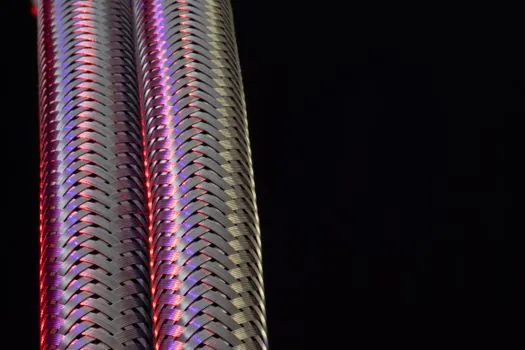
Four fiber optic and adjacent optical technologies compete on a paper machine: FBG strain arrays, NIR moisture probes, optical consistency sensors, and fiber orientation scanners [S1][S3][S8][S10]. Against four decision criteria:
1. Measurement target: FBG covers strain, temperature, pressure on a single fiber; NIR covers moisture 0–15% in dried sheet; optical consistency covers 0–14% in liquid stock; fiber orientation covers MD/CD fibre angle [S2][S8][S10][S3].<br/>2. Wet-end compatibility: FBG (with stainless or polyimide jacket) and inline optical consistency sensors tolerate pH 1–14 stock; NIR probes mount dry-side, 0.5–1 m stand-off; fiber orientation scanners need clear optical windows on both sheet faces [S5][S10].<br/>3. Refresh rate and resolution: FBG arrays sample at 100 Hz with quarter-inch gauge spacing; NIR scans at 10–100 Hz across the web; consistency sensors return 1 Hz average; orientation sensors run continuously across the full sheet width [S2][S3][S8].<br/>4. Installation cost: FBG multiplexes hundreds of points on one fiber, lowering per-point cost below discrete load cells; NIR and orientation scanners are higher capital but replace lab hand-sheet moisture checks [S1][S2][S4].
Engineers building new mills typically combine FBG for structural health monitoring on digesters and dryer cans, NIR for reel moisture, optical consistency for wet-end stock prep, and fiber orientation for cross-directional control [S1][S3][S8][S10]. For a deeper dive on tension transducers used in nip control, see this load cell and force-measurement overview and the broader industrial sensor equipment reference.
Who fiber optic sensors are for, and where they are overkill
Fiber optic sensing pays off for integrated mills running 1,500+ m/min machines where a single web break costs six figures per hour, and for digester and chemical-recovery areas where intrinsic safety rules out copper wiring [S1][S5]. Mills with legacy 4–20 mA DCS and slow basis-weight scanners gain little by adding FBG unless they also upgrade their MD/CD control loops to handle 100 Hz strain data [S2][S6].
Small non-integrated recycled-fiber mills running under 500 m/min get a better return from off-line lab moisture ovens and simple pneumatic load cells than from distributed FBG, because the failure-mode cost does not justify the multiplexing hardware [S4][S5]. Likewise, packaging converters cutting pre-made board do not need optical consistency sensors, since their furnish arrives already refined.
Failure modes and constraints on a paper machine

Three failure modes dominate field returns: fiber coating attack from bleach plant chemistry, mechanical fatigue at felt-roll transition points, and signal loss in long cable runs past 10 km without repeaters [S1][S5]. Polyimide or Ormocer-coated fibers survive pH 1–14 and 80–120 °C digester conditions; standard acrylate coatings fail in under six months in the same service [S1].
Cross-sensitivity between temperature and strain is the main measurement pitfall: a 1 °C shift can read as 10 µɛ on an FBG unless a reference (loose) grating is run on the same fiber for compensation [S1][S2]. Wet-end optical consistency sensors also need regular window cleaning, as pitch and stickies build up on the sapphire face; ABB recommends a weekly air-blow purge in brown stock and a chemical wash in bleached stock [S10]. For a related process-engineering reference on mechanical retrofits that affect tension control, see this packaging-line universal joint selection guide.
Standards, sourcing, and integration anchors
Paper-machine sensor installations follow IEC 60584 for thermocouple-grade fiber terminations and ISO 5167 flow classes where mass-balance is computed from sensor inputs, while EMC compliance defaults to IEC 61000-6-2 for industrial immunity in VFD-rich areas [S1][S2]. ATEX-rated fiber optic variants (no copper, low loop energy) are specified for black-liquor and chlorine-dioxide zones without separate intrinsic-safety barriers [S1].
On the supplier side, ABB, Honeywell (formerly Measurex), Voith, and Valmet hold the installed base on scanning measurements; FBG hardware is sourced from Luna Innovations, FBGS Technologies, and Smart Fibres for OEM integration [S3][S5][S6]. For end-to-end mill retrofits, see how permanent magnet materials drive VFD efficiency in calender drives and how RV reducers index calender and reel drums.
Trackable next signals for specifiers
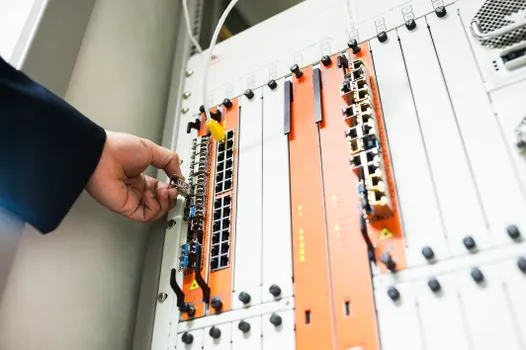
Watch for two signals in the coming 12 months: IECEx-certified FBG arrays released specifically for digester-vessel mounting, and optical consistency sensors that combine NIR moisture with consistency in a single wet-end probe, eliminating one stand-off and one calibration cycle [S1][S5][S8]. Mills evaluating tenders should request the 100 Hz FBG refresh spec and the 0–14% consistency range explicitly, since generic "fiber optic sensor" bids without those numbers usually arrive from resellers without pulp-mill references [S2][S10].
Spec-level background on the components involved: fiber optic sensor.