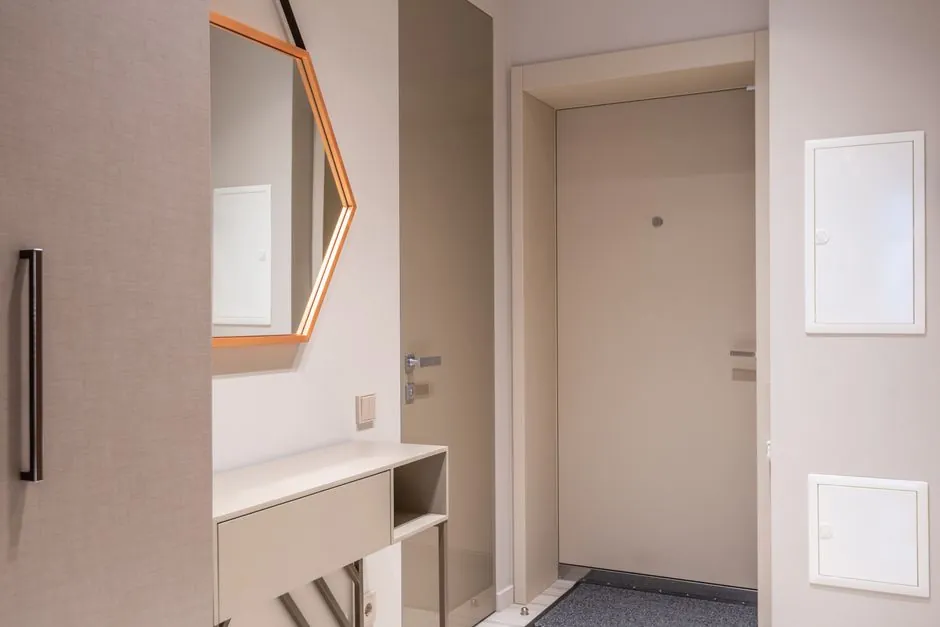
An installed fire door in the United States runs $400 to $900 per opening in 2026, with a national midpoint of about $650 according to Angi (Jul 9, 2026) and HomeAdvisor (Jun 19, 2026) [S1][S4]. That total bundles three line items: the door slab or prehung leaf ($300 to $600), labor at $40 to $90 per hour for 2 to 3 hours ($200 to $500), plus a fire-rated frame, closer, intumescent seals, and a lockset that frequently get under-quoted.
For a typical US single-leaf project, Homewyse's September 2026 calculator puts materials at $476 to $727, labor at $261 to $425 over 2.8 hours, and supplies at $108 to $152, yielding an $845 to $1,304 installed range before permits [S2]. A prehung package in New York breaks down to $350 to $700 for the door, $120 to $250 for the fire-rated frame, $33.86 for a 3-pack of 4-1/2-in square hinges, $84.98 for a Grade-1 aluminum surface closer, $60 to $150 for a fire-rated lockset, $25 to $60 for an intumescent seal kit, and $35 to $80 for a threshold/sweep, all per opening, with 5 hours of labor at $68.31/hr adding roughly $341.57 in fully loaded labor, hitting $1,810.78 in NYC average pricing on September 24, 2026 [S3].
Cost drivers ranked by price impact
Fire rating in minutes (20, 45, 60, 90, 120) is the single largest cost lever because thicker cores need more intumescent material and heavier hardware; a 60-minute door can be limited to 3 ft 6 in width by 8 ft 0 in height, so any oversized opening forces a custom build that adds materially to the line item [S4]. Hollow metal 20 to 120-minute units run $450 to $1,100 installed, solid-core wood 20 to 90-minute units $500 to $2,500, composite $400 to $1,100, glass 20 to 90-minute units $1,000 to $5,000, prehung $600 to $1,800, and slab-only $400 to $1,700, with hollow metal the budget pick and glass the ceiling for any single opening [S1].
Material grade and configuration matter as much as rating. The Hollow metal fire door is the workhorse of garage and utility enclosures because galvanized steel cores keep replacement cost low; solid-core wood is preferred where appearance drives spec, but it carries the highest installed ceiling because of veneer, weight, and closer sizing. Door size is the second-biggest lever: standard 30, 32, or 36 in widths at 80 in height keep pricing on the low end of any range, while custom heights of 84 in or 96 in push material and labor up together [S1][S2]. Frame and architectural hardware selection is the third lever, and the one most often missed on a quote.
Frame, hardware, and seals line by line
For an FD30 (30-minute) UK timber spec, the comparable line items run £65 to £80 supply-only for a ply-veneer leaf, £175 to £200 for an oak-veneer leaf, £30 to £50 to fit, £40 to £100 for a wooden lining, £10 to £30 for intumescent strips, £1 to £5 for the mandatory signage, £50 to £200 for hinges/handle/lock/bolt/overhead closer, and £50 to £80 per leaf for a kick plate, all per the June 2026 Checkatrade cost guide [S5]. A glazed FD30 ply-veneer leaf is £200 to £250 supply-only, and an oak-veneer glazed FD30 is £235 to £600, with the glazing being the cost swing versus an unglazed equivalent [S5].
Per the Homewyse 2026 estimate [S2], supplies alone account for $108 to $152 of a $845 to $1,304 total for a fire-rated door. For a fire rated door installed into existing framing with no structural work, budget roughly one-quarter of the invoice for hardware, seals, and frame, and three-quarters for the leaf and labor.
Where the project sits on the cost curve: low, mid, premium
Three reference points anchor the US market in 2026. A budget hollow-metal 20-minute install in an existing frame is $300 to $650, materials-heavy, labor-light, with a $400 slab-style cut-in. The mid-tier solid-core or composite 45 to 60-minute prehung in a finished opening sits at the $650 to $1,100 zone, matching both Angi and HomeAdvisor midpoints [S1][S4]. Premium 90 to 120-minute commercial hollow metal with a Grade-1 closer, listed fire-rated lockset, full intumescent kit, and welded frame lands at $1,200 to $1,800 per opening, with NYC commercial hollow metal reaching $1,800 to $2,500 once prevailing-wage labor is layered in [S3][S8].
Region is the multiplier on top of those tiers. New York City ranges are $1,201.79 to $2,403.59 for a single prehung install, well above the $845 to $1,304 national Homewyse baseline, and the Metro Cellar Door NYC pricing puts a basic 60-minute residential steel door at $900 to $1,400, a solid-core wood with fire-rated hardware at $1,200 to $1,800, and a commercial hollow metal single at the top of that band [S3][S8]. Permit fees, old-door removal, and post-installation inspection are typically excluded from those line items and should be added separately, with permit and inspection often adding 5 to 10% to the project total [S1][S4].
Who this cost applies to, and who it does not
The $400 to $900 range covers a single residential or light-commercial opening, retrofit into an existing frame, with standard 30 to 60-minute rating, on readily accessible conditions, using in-stock products [S1][S2][S4]. It does not apply to multi-story stairwell enclosures in high-rise construction, where 90 to 120-minute ratings, UL-listed fire rated door assemblies, and welded steel frames are mandatory, and where the project shifts to commercial-spec pricing above $1,800 per leaf. It also does not cover jobs that require modifying existing framing, replacing non-fire-rated structural framing, or adding masonry surrounds, all of which are explicit exclusions in the Homewyse estimate model [S2].
Owners doing a single garage-to-house 20-minute retrofit with a slab door into an existing frame should anchor to the $300 to $600 range; small commercial tenant fit-outs with prehung 60-minute hollow metal into existing drywall framing should budget $850 to $1,300 per opening. Buyers who need a glazed 60 to 90-minute architectural assembly, or a 120-minute stairwell door on a rated frame, should not anchor to the residential midpoint at all and should price from the premium tier instead. For deeper guidance on relabeling legacy doors that arrived without a certification sticker, see the field relabeling of fire doors with missing labels reference, which covers who is authorized to issue a retroactive rating and what documentation follows.
Total cost of ownership beyond the invoice

Purchase price is the smallest line over the door's life. Annual inspection is mandatory for most commercial fire-rated assemblies, and a certified inspection typically runs $50 to $150 per door depending on region and report depth, with drop-test verification for closers and seal integrity checks. Energy impact is small for a single residential opening but material for a commercial stairwell: a properly sealed and gasketed fire-rated assembly reduces stack-effect air leakage, which on a 10-story stairwell can be a measurable HVAC load over the heating season. [S5]
Insurance and code-compliance exposure is the unpriced line. A non-certified or unlisted door assembly, or one with a missing certification label, will not be accepted by most US AHJs on a final inspection, and removal-and-replace costs are the same as a new install, with no salvage value on a non-compliant leaf. For a clear-eyed quote, ask the installer to break out the door, the frame, the closer, the lockset, the intumescent kit, the threshold/sweep, and labor as separate lines, then verify the certification label is present on the door edge and frame before signing off. Two trackable signals for 2027 budgets: first, watch whether regional cost guides continue to widen the NYC-to-national gap above 2x, and second, whether 90-minute residential ratings displace 60-minute as the new default for garage-to-house transitions under updated IRC interpretations.