
NFPA 80 recognizes five fire protection rating levels for fire door assemblies, with the required rating tied directly to the fire-resistance rating of the wall the door protects; common pairings run from 45-minute doors on 45-minute walls up to 180-minute doors on 4-hour separations [S7][S5].
Every listed fire door must carry a permanent, legible label showing the manufacturer, third-party certification mark, fire test standard designation, the component's fire-protection rating, and a 30-minute temperature-rise reading if it is below 650°F (361°C), so an AHJ can verify the assembly on site [S1][S4].
What the Five Rating Levels Actually Cover
Fire-protection rating is defined as the time in minutes or hours that a closure withstands the passage of flame when exposed to fire under specified test conditions; the same definition is used by NBC(AE) 2019 when adopting NFPA 80 test methods [S5]. Wall-to-door rating pairings in NBC(AE) range from a 45-minute door on a 45-minute separation, up through 1 h on 1.5 h, 1.5 h on 2 h, 2 h on 3 h, and 3 h on 4 h assemblies [S5].
NFPA 80 itself organizes the five accepted rating levels as 20-minute, 45-minute, 60-minute, 90-minute, and 180-minute (3-hour) door assemblies, with the required level selected by the wall type and its hourly fire-resistance rating [S7]. The shorter 20-minute and 45-minute ratings are typically used where the wall itself carries a 1-hour or lower fire-resistance rating, while 90-minute and 3-hour assemblies are reserved for high-hazard walls such as 2-hour and 4-hour enclosures [S7][S5].
Self-Closing Hardware: Function, Types, and Where It Is Mandatory
With a few exceptions, every fire door must be equipped with a self-closing device designed to return the door to the closed position after each use, and swing-type fire doors must carry a positive-latching mechanism designed to hold the door closed after each cycle [S5]. A self-closing door is defined as one that remains closed and automatically returns to the fully closed position when opened, which is the baseline operational requirement under NFPA 80 [S4].
NFPA 80 also recognizes automatic-closing doors and power-operated fire doors as separate categories, all of which must still close and latch under fire conditions; blocking or wedging a fire door in the open position is prohibited because it defeats the required closing feature [S1][S4]. A self-closing mechanism is what allows the fire door assembly to return to the frame and latch correctly, which is the core of how the assembly performs under fire conditions [S9].
Hold-open devices are permitted only in limited situations, and are explicitly prohibited on exit stair doors in buildings more than 3 storeys in height and on vestibule doors between a storage garage and an assembly, care, or residential occupancy; permitted hold-opens must release on a signal from an automatic sprinkler system, a heat-actuated device, or a smoke detector per CAN/ULC-S524 [S5].
Inspection Frequency and the 13-Point Annual Check
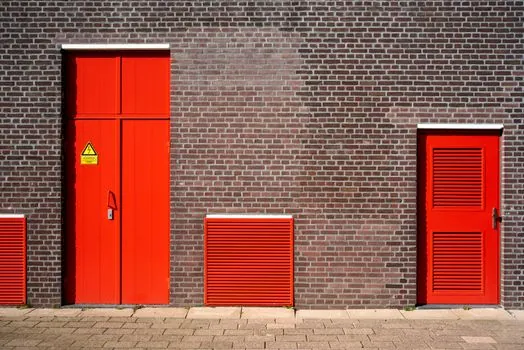
NFPA 80 requires fire doors to be inspected and tested immediately after initial installation and then at minimum annually thereafter, with the work performed by a qualified person whose credentials are acceptable to the AHJ [S1]. Section 5.2.4 of the 2025 edition of NFPA 80 codifies that annual cadence inside NFPA LiNK [S1].
Each annual inspection must verify 13 specific items, ranging from confirming that labels are visible and legible, checking for damage, broken or missing components, and clearance around the door, to validating signage compliance and running an operational test to confirm the assembly will close and latch under fire conditions [S1]. Door and frame must be securely attached, aligned, and in good order with no damage, and self-closing hardware must function so the door moves through the full closing cycle every time [S6].
How Door Type, Frame, and Wall Combine into a Compliant Opening
A fire door is a closure, meaning the device or assembly used to close an opening in a fire separation or exterior wall, and it includes the door, shutter, wired glass or glass block, and all components such as hardware, closing devices, frames, and anchors; every component in that assembly must carry a fire-protection rating [S5]. Because of that, a fire door should never be installed as a separate entity outside of its tested assembly [S5].
Opening protectives recognized by NFPA 80 and CCPIA include swinging doors with builders hardware, swinging doors with fire door hardware, horizontally sliding fire doors, special-purpose accordion or folding fire doors, vertically sliding fire doors, rolling steel fire doors, service counter fire doors, fire shutters, hoistway doors, chute doors, access doors, and fire windows, each with its own listed closing method [S4]. The closing method must match the tested assembly, and any change in closer, hinge, or latch brand without a listing undermines the fire-rated door certification [S4][S6].
Codes and Label Information That Make a Door Acceptable
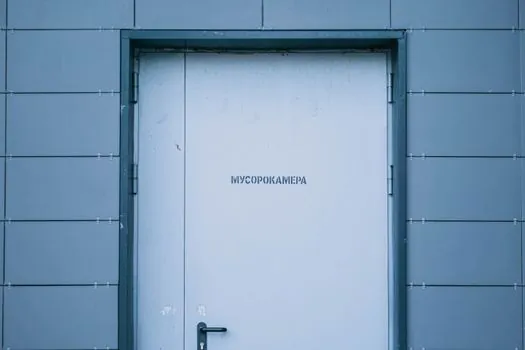
NFPA 1 (Fire Code), NFPA 101 (Life Safety Code), and NFPA 80 (Standard for Fire Doors and Other Opening Protectives) jointly govern installation, inspection, testing, and maintenance of fire doors in U.S. jurisdictions, while NSPIRE mirrors that approach for HUD-inspected residential properties [S1][S8]. Fire door frames are required to have an embossed label listing the fire-resistance rating, so the rating is traceable on the frame as well as on the door leaf [S2].
The label must also identify the fire test standard designation used, which lets an AHJ tie the assembly back to its listing; temperature-rise information is included only when the 30-minute reading is below 650°F (361°C), which signals a controlled-rise door for stairs and high-occupancy paths [S1]. Operability of these systems includes opening, closing, and latching, and the door must be kept closed and latched or arranged to be automatic closing during the time of a fire [S1].
Comparison of the Three Main Closing Methods
Three closing approaches are accepted under NFPA 80, and the choice changes hardware, power, and fail-safe behavior. A self-closing door uses a mechanical closer (spring, hydraulic, or concealed cam) to return to the fully closed position after each manual open, which is the default for most swing-type fire doors [S4][S5]. An automatic-closing door is held open by a releasing device tied to a detector, sprinkler, or fire alarm signal, and must release and self-close on activation, which is common in corridors and high-traffic openings [S4]. A power-operated fire door uses a motorized operator for daily use but must still close and latch under fire conditions when power is lost or the release signal fires [S4].
On decision criteria, self-closing is lowest cost, lowest complexity, and the only option allowed on most exit stair and vestibule doors where hold-opens are explicitly prohibited; automatic-closing adds daily-use convenience and traffic flow at the cost of detector and release-device maintenance; power-operated fits large or heavy leaves (rolling steel, oversized sliding) but requires a UL-listed operator and a fail-safe closing mode. For a side-by-side cost view across 20-, 60-, and 90-minute ratings, see the fire door cost per opening comparison.
Common Failure Modes and What Inspectors Flag
Annual inspections most often fail on three items: missing or painted-over labels, excessive clearance around the door edge, and a closer that does not pull the door into full latching from any open angle [S1][S6]. A painted-over label is non-compliant because the listing information (manufacturer, certification mark, fire test standard, rating, and any 30-minute temperature-rise below 650°F / 361°C) must remain visible and legible to the AHJ [S1][S4].
NFPA 80's 13-item checklist explicitly covers label legibility, component damage, broken or missing parts, door clearance, signage, and the operational close-and-latch test, so any closer that hesitates, any latch that does not engage, or any wedge holding the door open is a written deficiency [S1][S6]. Because the door is a system, a swapped closer or non-listed hinge can void the entire self-closing function even if every other part is intact [S6][S9].
Trackable signals for the next review cycle: monitor the 2026 adoption of NFPA 80 (2025 edition) in state fire codes, and watch for AHJ guidance on detector-linked hold-opens in stair and vestibule assemblies, where NBC(AE)-style restrictions are still tightening in some jurisdictions [S1][S5].
For component-level specifications, see function generator.