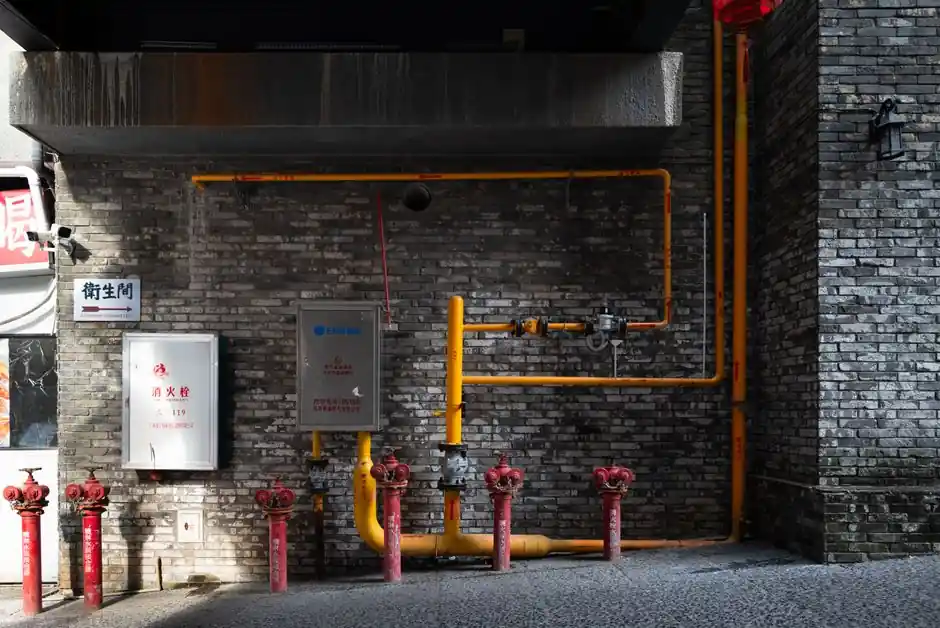
Choose gas suppression for a contained electronics room when asset protection outweighs sprinkler water exposure, and retain sprinklers for required building-level coverage.
A gas fire suppression system targets one enclosed hazard area, while a sprinkler system uses water to control fire across a much broader building footprint.
Decision Criteria for Electronics-Room Fire Protection
Gas suppression and sprinklers differ in the agent, protection boundary, activation logic, collateral-damage risk, and integration effort. A sprinkler is one specific form of suppression that uses water; engineered suppression is the broader category and may use water, gas, foam, or another agent [S2].
For an electronics room, compare the options against four criteria: water exposure to equipment, area covered, response method, and relationship to the building fire-safety strategy. Gas systems are engineered around a defined enclosure, while sprinklers protect buildings or larger hazards [S1][S2].
Neither system automatically replaces the other. Commercial sprinkler and fire suppression systems are commonly used together in different areas of a building, depending on contents and hazards [S5]. The selected arrangement must account for occupant evacuation, building code, insurer requirements, equipment availability, and the consequences of a false discharge.
Water Exposure, Coverage, and Equipment Impact
Sprinklers use water to control and extinguish fire, making them effective for many ordinary fire classes but unsuitable where water can cause major loss to switchgear, computers, archives, or other water-sensitive property [S1][S5].
Gas systems are preferred for sensitive electronics because the clean agent leaves no residue and limits secondary damage [S6]. Inert gas is also used where electronic equipment or records must be protected [S7]. This asset-protection advantage is conditional: the enclosure must limit agent loss, and discharge must include appropriate ventilation and safety controls.
Sprinklers provide broad coverage and remain a core building-level layer for life safety and fire spread control [S4]. In data-center practice, building-level protection commonly combines sprinklers, extinguishers, compartmentation, and fire floors, while room-level protection addresses the specific hazards of the protected space [S4].
Detection and Response Behavior

A suppression system can use smoke, heat, flame, or combined signals and can discharge before a fire becomes fully developed. Aspirating smoke detection continuously draws air samples through a pipe network and can identify smoke particles before visible flames develop [S2].
A sprinkler head opens through a heat-sensitive element at its specified temperature, so response is thermally initiated and generally corresponds to heads near the fire [S2]. Wet-pipe systems remain charged with water, while dry-pipe systems contain pressurized air or nitrogen until a head activates [S4][S8].
For data centers, very early smoke detection can identify microscopic combustion particles, after which operators may confirm the alarm, shut down power, and allow suppression to deploy if the fire expands [S4]. An aspirating smoke detector is therefore a detection-layer decision, not a substitute for either suppression method.
Where Each System Fits
Gas suppression fits server rooms, electrical switchgear rooms, control cabinets, and other contained spaces where water may damage assets or create secondary loss [S2]. It is also a common choice for server rooms and data centers where fast response and clean discharge support equipment continuity [S3][S4].
Sprinklers fit warehouses, retail buildings, distribution centers, restaurants, and other broad commercial properties where water is an effective agent and building-wide coverage is required [S5]. They also remain applicable where building requirements or risk ownership call for an installed water-based layer despite equipment sensitivity [S4].
Gas suppression is not the preferred primary answer for every electronics room. A small enclosure with high-value equipment, an occupied room requiring evacuation provisions, an unsealed space with excessive leakage, or a site unable to service the agent system can favor sprinklers or another engineered arrangement. Foam and water mist are distinct alternatives rather than interchangeable descriptions for gas or sprinkler protection [S2].
Implementation, Maintenance, and Failure Modes
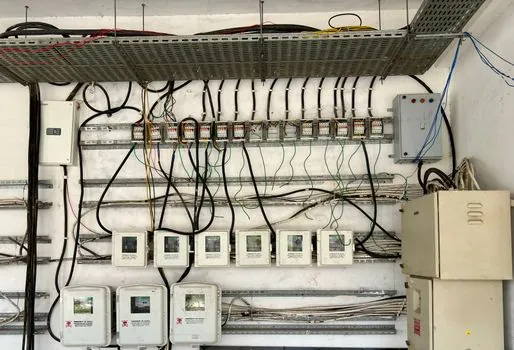
A gas system concentrates protection inside a contained enclosure, while a sprinkler network distributes water through a building-scale pipe network. A sprinkler system is a specific type of fire protection that uses water, while a fire suppression system is a broader category that uses water, gas, foam, or other agents to control or extinguish fire [S2].
Sprinkler leakage or accidental discharge remains a credible electronics risk because charged systems contain water before a fire occurs [S4]. Gas systems reduce residue but introduce different failure modes, including insufficient agent concentration, leakage from the enclosure, blocked discharge paths, ventilation interlocks, and service or testing deficiencies. The agent-retention verification process is covered in room integrity testing for gas suppression.
Total-flooding and local application are distinct gas-system architectures, so room volume, enclosure geometry, hazard location, and agent distribution must be evaluated rather than selecting a system by agent name alone. Maintenance plans should include detection verification, discharge-path inspection, notification checks, agent inventory, and any required room-integrity testing.
Standards, Detection, and Sourcing
NFPA 75 addresses fire protection of information technology equipment, while NFPA 76 addresses telecommunications facilities; NFPA 75 is the room-level reference cited for data-center protection in the research [S3][S4]. The applicable edition and system design must be confirmed by the authority having jurisdiction for the specific project.
The research identifies NFPA 72 for fire detection and clean-agent suppression methods under NFPA 75, and cites ANSI/UL 60950-1 for IT-equipment safety [S3]. These references support the source specification, but they do not justify selecting gas suppression without a room-specific risk assessment and authority approval.
Specify the project through coordinated detection, alarm, suppression, structural penetration, ventilation, electrical shutdown, and emergency-response documents. Candidate equipment can be evaluated through the fire alarm control panel, gas detector, and heat detector documentation, with agent quantity, concentration, discharge time, hold time, and compatibility derived from the approved system design rather than copied from another room.
The defensible choice is gas suppression for targeted electronics protection, sprinklers for broad building control, or a layered arrangement where both objectives apply. Confirm the final decision through the project hazard analysis, code review, insurer consultation, and room-integrity and maintenance plan.