Total flooding protects an enclosed space, while local application concentrates agent around a specific hazard; NFPA 2001 Section 3.3 is the governing US reference for clean-agent system definitions [S4].
The choice depends on enclosure integrity, hazard geometry, agent concentration, nozzle coverage, discharge sequence, and the consequences of agent release to occupants.
Core Difference: Enclosure and Hazard Coverage
NFPA 2001 Section 3.3 distinguishes total flooding, which fills an enclosed hazard area to protect the whole space, from local application, which targets a specific fire risk directly.
Total flooding fills an enclosed hazard area to protect the whole space, whereas local application targets a specific fire risk directly.
This makes total flooding a room or compartment strategy, while local application is a hazard-targeting strategy. A paint mixing station can be a local-application case, whereas an electrical switchgear room can justify total flooding because fire can spread among multiple cabinets and connected equipment [S3][S8].
Decision Matrix: Four Engineering Criteria
Enclosure integrity: total flooding requires a controlled enclosure capable of retaining the agent for the specified minimum hold time. Local application can suit an unenclosed or poorly sealed space because it does not require physical barriers around the entire fire space [S1][S5].
Total flooding protects the whole space, while local application targets a specific fire risk directly.
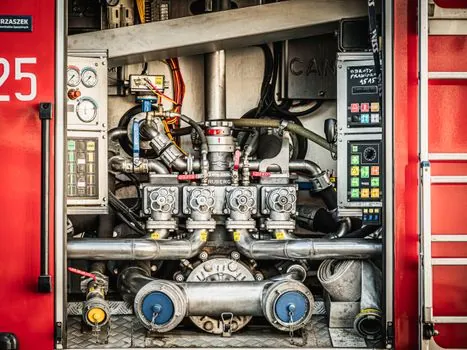
Agent and installation: total flooding requires room-level agent volume, concentration control, mixing provisions, and enclosure retention. Local application requires discharge calculation, nozzle placement, and coverage engineered for the protected equipment. Both approaches require storage cylinders, release valves, detectors, actuation controls, delivery piping, and dispersion nozzles [S5].
People and operations: total flooding requires an assessment of the agent concentration reached in occupied rooms and the consequences of discharge. Carbon dioxide systems are commonly applied in total-flooding arrangements in uninhabited spaces because of their hazard, whereas clean-agent systems are used where sensitive equipment requires suppression without the residue associated with conventional systems [S1][S3].
When Total Flooding Is the Better Fit
Total flooding is the stronger choice where the protected risk envelope includes several pieces of equipment or a complete room. Examples include server rooms, electrical switchgear rooms, control rooms, archives, and other critical areas where the fire may spread beyond the first visible flame [S4][S8].
The enclosure must retain the agent long enough to suppress the fire and prevent reignition. If the agent disperses before the burning items cool below their autoignition temperature, the fire can re-ignite [S1]. This makes enclosure design, leakage control, and agent concentration directly connected to suppression performance.
Total flooding is also suitable when residue-sensitive equipment must be protected, because clean agents are electrically nonconducting and leave no residue after evaporation [S1]. A 2025 review of IG-541 total-flooding systems describes the approach as an engineered arrangement of components that detects, alerts, and extinguishes a fire quickly [S7].
If an automatic sprinkler system is required by code, a fire suppression system may substitute for it only with prior approval from the fire code official, and code credits generated by the substitution may not be taken.
When Local Application Is the Better Fit
Local application is suitable for a specific fire risk, with the choice between it and total flooding depending on the hazard, enclosure, airflow, and business needs.
The critical design question is whether the nozzles can envelop the hazard with the required agent concentration. Since the protected object is not enclosed, the discharge nozzles and application rate must be capable of surrounding it [S1]. Precise aim therefore matters more than maintaining a uniform room concentration.
Local application is not a lesser form merely because it does not flood a room. It is the correct architecture when the hazard is bounded and direct delivery can provide effective coverage with less agent.
Agent, Detection, and Release Constraints
Gaseous suppression agents extinguish fire through multiple means, including reduction of heat and reduction or isolation of oxygen.
Total-flooding discharge is commonly arranged for automatic operation on a double-knock basis following activation by conventional smoke detection. This staged release supports warning and operational shutdown before agent discharge [S9]. The detailed sequence remains an engineered design requirement rather than a universal rule for every installation.
Agent selection must be tied to the protected fuel class and the required design concentration. Carbon dioxide is often classified separately from clean agents because of its personnel hazard, while halocarbon and inert-gas agents fall within the clean-agent category described by NFPA material [S1]. In the United States, clean-agent system design and installation are governed by NFPA 2001 [S3][S5].
Common Failure Modes and Design Errors
The dominant total-flooding failure mode is inadequate agent retention. A room that cannot maintain the required concentration for the minimum hold time may fail to suppress the fire or permit reignition after the initial discharge [S1]. Leakage paths, open doors, ventilation shutdown, and pressure effects during discharge must be addressed as part of the enclosure design.
The dominant local-application failure mode is incorrect nozzle coverage. If the discharge does not envelop the hazard at the required concentration, direct application may not control the fire. Equipment relocation, added guards, or changed product handling can invalidate the original arrangement and require field verification [S1][S4].
A room-integrity test checks whether the enclosure can contain the agent sufficiently for effective suppression. This verification is especially important where total flooding has been selected because enclosure performance is part of the suppression strategy rather than an optional architectural feature [S5].
For the detailed discharge and hold-time calculation, use the applicable clean-agent design procedure and verify the sequence against the gas fire suppression discharge and hold times workflow. For enclosure performance, verify agent retention with a room integrity test.
Application-Specific Recommendations
For an electrical switchgear room with multiple cabinets and shared room-level fire spread, specify total flooding if the room can be made sufficiently tight and the selected agent concentration is acceptable for the occupancy. This arrangement protects more than the initiating cabinet, including hidden and connected spaces [S8].
For a single paint mixing station inside an open production area, specify local application if engineered nozzle coverage can envelop the mixing hazard. This avoids sizing a system to flood the entire production area while concentrating agent where the fire is expected [S3].
For a single electrical cabinet in an occupied workshop, compare both options on measured cabinet volume, leakage, nozzle access, and downstream fire spread. Local application is usually the simpler engineering case when the cabinet itself defines the risk and direct discharge coverage is achievable; total flooding becomes necessary when the fire can escape the cabinet or affect multiple adjacent assets [S8].
Track two verification signals before approving the design: the calculated design concentration and minimum hold time for the selected agent and fuel class, plus documented enclosure leakage results for a total-flooding installation. Either result can invalidate an otherwise plausible nozzle and cylinder arrangement.