Commercial fire alarm installation costs range from $1.25 to $12 per square foot [S2].
Installed cost range and detector quantity
The detector count is only one line in that estimate. A fire alarm control panel, notification appliances, wiring pathways, programming, documentation, permits, acceptance testing, and labor can all exceed the detector purchase price [S4].
A practical bulk estimate starts with the number of heat detectors required by the approved device layout. At $20–$160 each, 100 units represent $2,000–$16,000 in equipment before freight, tax, accessories, and installation. A 500-unit order spans $10,000–$80,000. Those figures exclude the panel, wiring, notification devices, and field labor, so multiplying detector price by unit count produces an equipment budget rather than an installed cost.
Conventional, addressable, wireless, and hybrid systems
Addressable systems carry an initial premium of 30–50% over conventional systems, but they identify individual devices and support precise fault location [S2][S4].
Wireless systems reduce trenching and conduit work but require battery maintenance [S5]. Hybrid systems can lower installation effort in selected zones, but the need to coordinate two communications methods adds design complexity [S2][S5].
Where heat detection fits in a distribution center
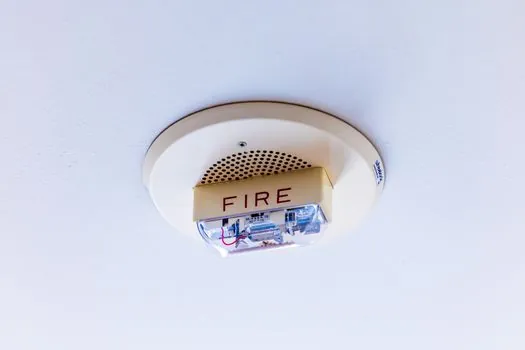
Heat detectors are better suited than smoke detectors to loading docks and areas containing dust or fumes [S1]. They are also appropriate where air movement, ambient temperature variation, or airborne particulates can impair smoke detection. Device selection still depends on the protected hazard, ceiling geometry, temperature range, and Authority Having Jurisdiction requirements.
A smoke detector normally costs $15–$90 per unit, compared with $20–$160 for a heat detector [S2][S8]. Heat detectors are therefore not a lower-cost substitute for every smoke detector. They are area-specific devices selected for the environmental conditions and fire strategy, not a blanket replacement across the building.
If tenant spaces, offices, mezzanines, or storage racks require separate coverage areas, the number of circuits, devices, and labor hours rises with the layout rather than square footage alone [S4].
Bulk procurement and installation cost drivers
Detector unit price is driven by model technology, temperature rating, environmental suitability, and addressability [S2]. A high-temperature or specialty detector can cost as much as $160, while a $20 unit sits at the lower end of the market [S1][S2]. Volume reduces the impact of per-unit price only when the seller passes procurement savings through and the specification remains unchanged.
The larger cost drivers are device quantity, control equipment, wiring pathways, programming, documentation, labor, permits, and acceptance testing [S4]. New construction generally provides easier access to conduit, ceilings, walls, and power.
Ceiling height and the stored product mix also affect the estimate because they influence the number of detection points, notification appliances, circuits, and installation hours [S1][S4]. Compatibility must be checked before reusing an existing panel or circuits, because unsupported equipment can force partial or complete replacement [S4].
Retrofit versus new construction
The spread reflects system architecture and site access rather than detector price alone.
For an occupied distribution center, allocate separate contingencies for cable tracing, fire-rated pathway restoration, equipment removal, asbestos or hazardous-material review where applicable, and night or limited-access work. These activities affect labor even if the detector count remains unchanged. Surface routing may be necessary where concealed pathway access is unavailable [S2][S4].
New construction reduces retrofit premiums by reserving pathways, power, panel locations, and device mounting positions before finishes are installed. Any budget based only on detector quantity and square footage will understate that benefit because it ignores access and coordination.
Operating cost and total ownership
Monitoring, inspection, and maintenance add $600–$2,000 or more per year [S2]. Other commercial guidance places professional design and installation work between $1,000 and $50,000 or more, depending on system complexity [S6]. Commercial building installations can range from $15,000 to $200,000, while residential installations are much smaller at $2,000–$5,000 [S7].
Total ownership should therefore include detector and panel replacement risk, annual monitoring, inspection, service visits, battery work for wireless devices, and any system-wide maintenance contract. The annual service-contract exposure for a fire alarm control panel should be tracked separately from detector operating costs, because panel support can continue even when no individual detector is replaced.
Wireless architecture lowers installation labor but shifts part of the lifecycle burden to batteries. Addressable equipment costs more at the outset, yet its device-level fault information can reduce diagnostic time and improve maintenance targeting [S2][S5]. The correct comparison is installed first cost plus expected maintenance and operating burden, not detector price alone.
Design, code compliance, and procurement criteria

NFPA 72 addresses fire alarm and signaling system design, installation, testing, and maintenance, while electrical, building, accessibility, and locally adopted requirements may also apply [S4]. The project still requires review by the local Authority Having Jurisdiction and should not be priced from a generic warehouse square-foot multiplier alone.
The procurement specification should fix detector type, approved temperature rating, addressable or conventional format, mounting method, environmental rating, and compatibility with the selected control equipment. A bid should separate the detector price from panels, devices, pathway construction, engineering, programming, permits, inspection, testing, training, and recurring service. That separation exposes substitutions that can shift a low equipment bid into a higher installed cost.
Before ordering bulk quantities, freeze the device layout and verify each part number against the panel compatibility list. The explosion-proof versus intrinsically safe heat detector comparison becomes relevant only where the hazard assessment identifies a classified area; ordinary distribution-center spaces should not pay for specialized equipment without an engineering basis.
Track three budget signals before approval: the approved detector count, the installed per-square-foot rate after design development, and the annual monitoring and maintenance allowance.