
One cubic yard of finished concrete equals 27 cubic feet, and a standard 80 lb bag of concrete mix yields roughly 0.60 ft³ when mixed, so 45 of those 80 lb bags make one cubic yard [S1][S5][S6].
The same 27 ft³ yard works out to 60 bags at 60 lb and 90 bags at 40 lb, because bag yield scales linearly with sack weight on a roughly 0.30 ft³ per 40 lb basis [S5][S4].
Per-Bag Yield and the 27 ft³/yd³ Anchor
Every figure in this article starts from one fixed conversion: 1 cubic yard = 27 cubic feet. Concrete Network, Cemex, and QUIKRETE all anchor their calculators to that constant, and the per-bag yield is then published as roughly 0.60 ft³ for an 80 lb sack, 0.45 ft³ for a 60 lb sack, and 0.30 ft³ for a 40 lb sack [S4][S5]. The inverse of those numbers gives 45, 60, and 90 bags per yard respectively, which lines up with Sakrete's "45 bags of 80-pound mix to hit a cubic yard dead on" rule of thumb [S1][S6]. QUIKRETE and Cemex both publish a calculator entry that resolves to the same 45-bag figure for the 80 lb path, so the cross-vendor agreement is unusually tight for a consumer-grade number [S2][S5].
One caveat: bag yield assumes the powder is pre-blended sand, gravel, and Portland cement, not straight cement. A 94 lb sack of Portland cement by itself only contributes about 1 ft³ of binder to the mix, so a true 3,000 psi yard needs six to seven of those sacks, with the rest of the volume made up by aggregate, water, and air. For most DIY and small-contractor planning, the pre-mixed bag count above is the operational answer, and it is the one embedded in our cement and concrete reference.
Bag Size Comparison: 40, 50, 60, and 80 lb Sacks
Bag size selection is mostly a logistics decision, not a chemistry decision, because the cement-aggregate ratio is locked into the bag at the plant. The table below lines the four common consumer sizes against the same one-yard target so a buyer can pick by handle weight and trip count. [S3]
Bag size, typical mixed yield, bags per cubic yard, and trips for one yard: 40 lb at 0.30 ft³, 90 bags, 90 trips; 50 lb at 0.375 ft³, ~72 bags, 72 trips; 60 lb at 0.45 ft³, 60 bags, 60 trips; 80 lb at 0.60 ft³, 45 bags, 45 trips. The 50 lb row is drawn from Concrete Network's stated 0.375 ft³ yield, the 40/60/80 lb rows from Cemex and myconcretecalc.com [S4][S5][S6]. QUIKRETE and Sakrete both publish 80 lb as their flagship for slab work because the 45-trip count is the practical minimum for a one-yard pour done by hand [S1][S2]. For crew ergonomics and bag-handling tools, see the concrete tool reference, which covers mixer capacity, wheelbarrow volume, and hoe weight thresholds.
From Bags to a Slab: 4-inch Thick, 100 ft² Reference Job
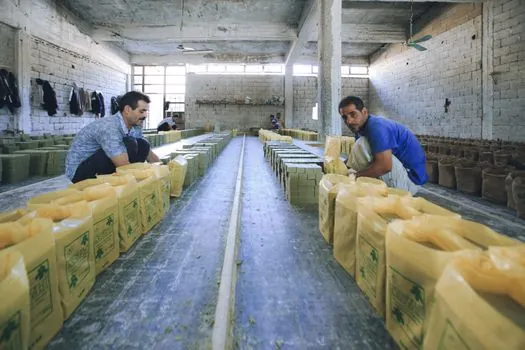
A 10 ft × 10 ft slab at 4 inches thick is the reference pour that every calculator reproduces, and it lands at 1.24 cubic yards, or 56 of the 80 lb bags with no waste factor [S4]. Concrete Network's "magic number" shortcut, 81, comes from the same geometry: square footage of a 4-inch slab divided by 81 equals cubic yards, so 100 ft² ÷ 81 ≈ 1.23 yd³, which rounds to the 1.24 figure and the 56-bag count above [S4]. Cemex's ready-mix calculator resolves the same slab to 1.23 yd³ as well, a cross-check within 1% of Concrete Network's number [S5].
Two adjustments always need to be on the worksheet. First, add an overage allowance for spillage and slab-edge variation; Volume Concrete's flagship calculator published a 1.23 yd³ neat result that grew to 1.36 yd³ with overage, which on the 80 lb bag size comes to 62 bags [S3]. Second, thickness drives volume linearly: a 6-inch slab of the same 10 × 10 footprint needs 1.85 yd³, or 84 of the 80 lb bags, because volume doubles from 4 to 6 inches at 1.5× the linear thickness [S4].
When Bags Stop Making Sense: the 1-Yard Inflection
All four reference calculators converge on a recommendation: jobs over roughly 1 cubic yard are usually cheaper and cleaner as ready-mix truck delivery. Volume Concrete's bag calculator explicitly routes a 1.36 yd³ result to its dispatch line with the note "ready-mix will beat bags on this pour" [S3]. Concrete Network quotes Jeff Hershberger of Deco-Crete Supply to the same effect, telling homeowners to "call your local Ready-Mix plant, give them your square footage and thickness, and they'll figure it up for you" for any larger pour [S4].
The break-even is a function of bag cost versus short-load fees, not just trip count. A typical short-load fee for under 3–4 yd³ in many US metros adds $40–$80 per yard, which can push bag-and-mixer pricing back into the running for very small pours in the 1.0–1.5 yd³ range; above that, ready-mix almost always wins on labor even after the short-load surcharge. The bagged path is still the right call for post-hole footings, fence post bases, and small walkways, where a single 60 or 80 lb bag covers the pour and there is no delivery window to coordinate. For pump and boom-truck options on larger pours, the concrete vehicle reference covers chassis class, reach, and short-load economics.
Mix Strength, Water Ratio, and What the Bag Count Does Not Tell You

Bag count is a volume question, but the strength stamp on the bag is a separate decision. A standard QUIKRETE or Sakrete 80 lb concrete mix is rated at about 4,000 psi at 28 days when mixed at roughly 0.5 gallons of water per 80 lb bag, which is the dosage that gives the 0.60 ft³ published yield [S1][S2]. This is why the calculators publish yield at the on-bag water dose, not at field-realistic slump.
Air-entrained mixes for freeze-thaw climates, high-early mixes for cold-weather pours, and fiber-reinforced mixes for slab crack control are all sold in the same 40/60/80 lb bag formats, so the bag count per yard stays fixed while the in-bag chemistry changes. Volume Concrete's calculator, for example, suggests a TG4000 packet (4,000 psi) for a typical bag-count result, which lines up with the standard 80 lb 4,000 psi consumer mix on the shelf [S3]. For fiber-reinforced options that hold the same bag count, see the concrete fiber reference. Admixtures for set retardation, acceleration, or water reduction sit on top of the bag count without changing it, and the concrete admixture reference covers dosage, compatibility, and slump targets.
Closing Reference Numbers and a Trackable Signal
For any one-yard estimate, lock these anchor numbers: 27 ft³ per yard [S4][S6], 0.60 ft³ per 80 lb bag, and 45 bags of 80 lb mix to hit a cubic yard [S1][S6]. A 10 × 10 ft slab at 4 inches is the standard reference pour, resolving to 1.24 yd³ or 56 of the 80 lb bags before overage [S4]. Trackable signals for the next planning cycle: 2026 retail bag prices from the three majors (Sakrete, QUIKRETE, Cemex) and any change to short-load ready-mix fees, both of which shift the bag-vs-truck break-even that Volume Concrete currently draws at about 1 yd³ [S3].
See also our earlier report, EN 388 Coup Number vs ISO 13997 TDM Letter: How to Read Both Cut Ratings.