
Hydraulic accumulator selection starts with the job the vessel has to do, not with brand or catalogue page. HYDAC's Accu-FIND tool asks the buyer to pick one of five functions (energy storage, shock absorption, media separation, pulsation damping, volume compensation) and then enter installation position, flow rate, nominal volume, diameter and pressure ratio [S1]. The same five-function frame appears across the supplier's product family, confirming that duty drives type, and type drives size.
Inside an accumulator a compressible gas charge (usually nitrogen) and a hydraulic fluid volume share a vessel separated by a bladder, a piston or a diaphragm [S2][S6]. The separation element is the single biggest design decision the buyer makes, because it sets the cycle rate, the maximum pressure, the contamination tolerance and the allowable gas permeation.
The Three Separation Types and Where Each One Wins
Bladder, piston and diaphragm accumulators cover roughly the full industrial envelope, but they do not overlap evenly. Bladder units dominate high-cycle energy-storage and pulse-damping work because the elastomer bladder is light, responds in milliseconds, and tolerates rapid charge/discharge switching; piston units win on high-pressure (typically 350 bar and above) and high-capacity duties where metal-to-metal sealing and long service life matter more than response speed; diaphragm units are the compact, low-cost choice for smaller volumes and lower cycle rates [S2]. The same MDPI review states that bladder, diaphragm and piston are the three most widely used families in industry, with the bladder type as the most common general-purpose pick [S2].
Type-to-duty mapping, drawn from the supplier's five-function frame and the MDPI review: energy storage at moderate pressure and high cycle rate maps to bladder; shock absorption with very fast response also maps to bladder; pulsation damping in pump discharge lines typically maps to bladder or diaphragm; media separation (keeping a special fluid isolated from the system fluid) is a bladder-or-diaphragm duty; volume compensation in large, slow reservoirs tends to map to piston because of capacity and seal longevity [S1][S2]. The relevant hydraulic actuator downstream only sees a stable pressure source when the upstream accumulator type matches the duty.
The Five Sizing Inputs You Cannot Skip
HYDAC's selection tool lists five mandatory inputs and the order is significant: installation position first, then flow rate, then nominal volume, then diameter, then pressure ratio [S1]. Installation position drives whether a vertical or horizontal vessel is acceptable (most bladder units must be vertical so the bladder does not seat on the gas valve); flow rate sets the port size and the required effective gas volume; nominal volume is the fluid capacity in litres; diameter is constrained by the available envelope and the porting; pressure ratio (Pmax/Pprecharge) is the single biggest determinant of usable fluid volume, because gas follows a polytropic law and a ratio above about 4:1 leaves very little usable drawdown.
Concretely, a bladder accumulator charged to P0 with maximum working pressure Pmax will deliver usable fluid per the gas law: V_useful = V0 (1 - (P0/Pmax)^(1/n)), where n is the polytropic exponent (about 1.4 for fast adiabatic cycles, 1.0 for slow isothermal) [S2][S6]. MATLAB's Gas-Charged Accumulator block models the same gas precharge plus fluid chamber, separated by a bladder, piston or diaphragm, with isothermal and adiabatic modes selectable [S6]. If you cannot keep Pmax/Pprecharge at or below roughly 4:1 you are paying for a vessel much larger than its nameplate, and a piston unit often becomes the cheaper answer despite its heavier seal package.
Pressure Ratio, Gas Precharge, and the Polytropic Trap
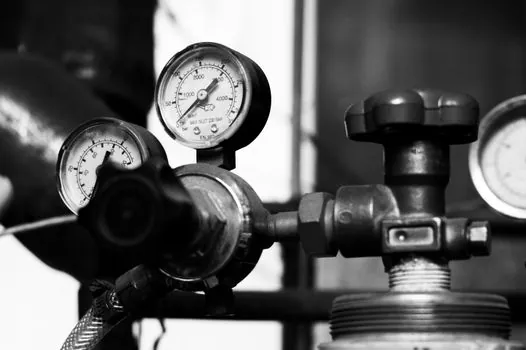
Gas precharge is the most common field failure cause, and it is also the parameter buyers most often set wrong. Accumulators ship with a nitrogen precharge specified at a defined temperature, and the precharge decays slowly through the elastomer; re-checking precharge every 6 to 12 months is industry standard practice. Operating the vessel with Pmax/Pprecharge above about 4:1 collapses the bladder against the gas valve before useful work is done, and below about 1.5:1 wastes the vessel's capacity and may damage the bladder on full extension. [S2]
For fast cycling (shock and pulse duties) use the adiabatic exponent n = 1.4; for slow energy-storage cycling use the isothermal exponent n = 1.0, because heat has time to leave the gas [S6]. The MDPI review shows that foam-filled gas chambers can hold gas temperature nearly constant and cut thermal losses to about 1% of the un-foamed case, which is the underlying reason foam-backed bladders are specified for long hold-and-release profiles in regenerative circuits [S2]. Setting the right exponent is not academic: a 10-litre bladder at 200 bar max with 100 bar precharge and n = 1.4 delivers about 5.0 litres of useful fluid, but only 3.3 litres if the cycle is slow enough to count as isothermal.
Decision Matrix: Bladder vs Piston vs Diaphragm on 4 Buyer Criteria
Lining the three families against four decision criteria that come up on every RFQ:
Response speed: bladder is fastest (milliseconds), diaphragm is fast (tens of ms), piston is slowest (hundreds of ms because of seal friction) [S2].
Maximum working pressure: piston leads (350 bar standard, higher available), bladder sits around 350 bar for standard ranges with lower ratings more common, diaphragm is the most pressure-limited of the three [S2].
Usable volume per kg: bladder wins for sub-50-litre sizes, diaphragm is competitive in 0.1 to 4-litre sizes, piston wins above about 50 litres because the metal separator scales efficiently [S2].
Contamination tolerance: piston is the most tolerant (metal seals survive particle contamination that would score a bladder); bladder and diaphragm require ISO 4406 fluid cleanliness in the 18/16/13 to 20/18/15 class range depending on duty.
If your duty is high-cycle energy recovery on a mobile machine, the bladder answer is almost always correct; if your duty is subsea BOP (blowout prevention) pressure reserve where a hydraulic pump supply pump must recharge a large vessel on demand, piston wins on capacity and ruggedness, and Graco's aluminium-bodied, air-powered supply pump family is designed exactly for that oil-rig charging role [S4]. A useful sister reference for the upstream circuit is Hydraulic Power Unit Selection: Spec Gates, Variant Map, and Failure Traps, and for the downstream actuator side Hydraulic Motor Sizing and Selection: 4 Inputs, 4 Family Gates, 3 Failure Modes lines up against the same five-input pattern.
Who Should NOT Pick the Default Bladder

The bladder is the safe default for most general industrial and mobile duties, but it is the wrong pick in three well-defined cases. First, very high-pressure circuits above the bladder's rated maximum (verify against the manufacturer's pressure derating curve, not the catalogue headline number) where a piston unit becomes mandatory. Second, very large reservoir duties above about 50 to 100 litres where the bladder becomes physically large, expensive to recertify, and slow to respond; a piston or weighted-gas vessel fits better. Third, dirty-fluid environments where ISO 4406 cleanliness cannot be held consistently: bladder and diaphragm failures from particle scoring are among the most common field root causes. Buyers in subsea BOP, heavy press, and large steel-mill hydraulic servo loops typically route around bladder units for these reasons. [S2]
For lower-pressure or compact-volume duties, the diaphragm's small size and low cost make it the right pick even though its pressure ceiling is lower. The MDPI review specifically flags diaphragm units as the compact, low-volume answer, complementing the bladder-as-workhorse and piston-as-rugged-large-volume trio [S2].
Standards, Sourcing and Verification
No single international standard covers accumulator selection in one clause, but the relevant reference set includes the European Pressure Equipment Directive (PED 2014/68/EU) for the vessel itself, ASME BPVC Section VIII for pressure-vessel certification in North America, ISO 4413 for hydraulic system safety, and ISO 10770 for hydraulic cylinder and accumulator test methods. Nitrogen precharge purity (typically 99.9% or better) and precharge tolerance (commonly +/- 3 bar at 20 deg C) belong in the purchase spec because they are field-checkable and the dominant cause of early-life failure when out of spec. HYDAC publishes a full hydraulic-accumulator product line covering bladder, piston and diaphragm types in shop catalogue form [S3], and the MATLAB Simscape Hydraulics documentation gives buyers a free pre-build model of the gas-charged behaviour before committing to a part number [S6].
Trackable signals before ordering: (1) confirm the gas precharge value and tolerance in writing on the supplier's datasheet, not in marketing copy; (2) confirm the fluid port thread standard (BSPP, NPT, SAE 4-bolt flange) and the test certificate to PED or ASME VIII as the installation jurisdiction requires; (3) confirm the recommended re-precharge interval and the spares kit (seal, bladder, gas valve) availability for the chosen nominal volume.