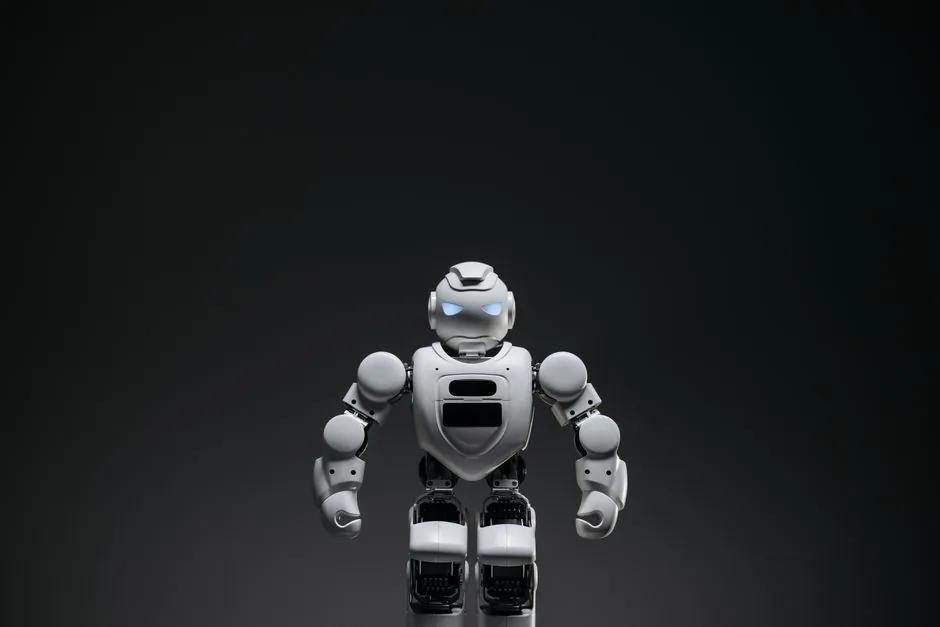
Published estimates of per-robot magnet content converge on 2-4.5 kg of sintered NdFeB per humanoid, against roughly 1.4 kg in a typical electric car, with each unit embedding 0.57-1.3 kg of NdPr and 35-79 g of dysprosium (Dy-equivalent after the 2.5:1 Dy-to-Tb substitution factor) [S1][S3].
Applied at a one-million-robot annual production rate, that 2,000-4,500 tonne NdFeB increment equals 7-15% of current electric-vehicle magnet demand, and it materialises in roughly 30 actuators per robot, all sintered NdFeB rings on permanent-magnet synchronous rotors [S3].
Per-robot magnet loading: where the 2-4.5 kg sits
Every rotary joint in a humanoid spins on a ring of neodymium-iron-boron magnets: a 30+ actuator count per robot is consistent across published schematics, and sintered NdFeB delivers around 400 kJ/m³ of magnetic energy, more than any other commercially viable material, which is the only way a palm-sized motor can deliver biped-class torque without the limb becoming a club [S3].
Per-robot composition: 0.57-1.3 kg of NdPr for magnetisation, 35-79 g of Dy (or Tb at 2.5× efficiency), with the heavy rare earth share set by the operating-temperature grade the actuator is wound for [S1][S3]. A 2022 Department of Energy magnet table places H-grade NdFeB at 28 g Dy and 272 g NdPr per kg, versus 42 g Dy and 258 g NdPr per kg for SH-grade, with grain-boundary diffusion allowing manufacturers to lower the dysprosium load without surrendering coercivity [S1].
Three production scenarios, three demand step-changes
Production-rate forecasts diverge by orders of magnitude: Goldman Sachs's bear case puts 700,000 robots/year by 2035, while the 10 billion-by-2040 bull case implies a sustained ~1 billion/year run rate through the 2030s, and Adamas Intelligence's 10-billion-robot extrapolation consumes 186× today's global annual NdFeB output on its own [S1][S6].
Translated into tonnage at the 2-4.5 kg/robot unit factor: a 700,000/year bear case adds 1,400-3,150 tonnes/year of NdFeB; a 1 million/year mid case adds 2,000-4,500 tonnes, equivalent to the entire 2024 incremental addition to global sintered magnet capacity outside China (~40 million units/year on a ~100 million-unit base case) [S2][S3]; and the 10 billion cumulative scenario is bounded by upstream ore rather than magnet-making capacity [S6].
Heavy rare earth is the real binding constraint
The bottleneck is not "rare earths" in aggregate but the heavy-rare-earth fraction: today, the global EV industry already consumes as much dysprosium and terbium per year as 26 million humanoid robots would, more than all but the most aggressive humanoid forecasts, so any humanoid build-out that assumes parallel EV growth is operating against the same constrained heavy-REE pool [S1].
Per-tonne heavy-REE loading falls into a narrow range dictated by the chosen magnet grade: 28 g Dy/kg for H-grade, 42 g Dy/kg for SH-grade, with terbium reserved for motors that need both high torque (from a higher NdPr quantity) and high heat resistance, and Tb prices running more than 4× Dy's despite only 2.5× the unit efficiency [S1][S3]. The October 2025 Chinese export controls on heavy rare earths, suspended and scheduled to return 10 November 2026, are the operational chokepoint on any humanoid programme that must specify SH-grade or above [S3].
Comparison: bear, base, bull cases against criteria
Three scenarios lined up on annual NdFeB tonnes, heavy-REE load, and the 2024 EV magnet baseline they would displace: bear case (700,000 units/yr by 2035) at 1,400-3,150 t NdFeB and 24.5-56.1 t Dy-equivalent, well under current EV magnet consumption; base case (1 million/yr sustained) at 2,000-4,500 t NdFeB and 35-79 t Dy-equivalent, roughly 7-15% of the EV magnet demand on the books today; bull case (1 billion/yr implied by the 10 billion-by-2040 forecast) at 2-4.5 million t NdFeB and 35,000-79,000 t Dy-equivalent, which exceeds the 2024 global sintered NdFeB output by a factor of 5-10× [S1][S3][S6].
Sinistered NdFeB already commands 94% of global sintered permanent-magnet production in 2024, almost all of it inside the Chinese sphere, so any non-Chinese humanoid programme has to underwrite both ex-China ore supply and ex-China grain-boundary diffusion capacity to meet SH-grade loading, not just sintering [S3].
Substitutes do not close the gap at humanoid torque density
Ferrite motors must be roughly 30% heavier to match the torque of a NdFeB motor of the same size, and that mass penalty is non-compounding in a walking machine: a heavier leg loads the joint below it, which then needs a bigger motor of its own, a cascade that nullifies the ferrite cost saving within three or four joints [S3].
Engineers can trade magnet grade for copper cross-section, peak current, and active cooling, but they cannot trade it for nothing: there is no third option commercially available at humanoid-class torque density, and samarium-cobalt (SmCo) substitutes at the high-temperature end only, while trading away the energy-density advantage and a meaningful cost premium [S3]. The near-term path is grain-boundary diffusion plus heavy-REE thrifting, not a substitute material.
Forecast range and the next data point to watch
Published 2026-2036 outlooks put total humanoid-robotics materials demand on a 47% CAGR by mass through the forecast window, with high-performance NdFeB incremental demand framed between 3,400 tonnes and 34,000 tonnes depending on which humanoid production curve is used [S4][S7].
The 26-million-robot Dy-equivalent figure from the EV baseline is the cleanest falsification point: any humanoid forecast above that level without a parallel drop in EV magnet intensity implies a heavy-REE supply gap that no current mine-to-magnet pipeline can close [S1]. Track the 10 November 2026 resumption date for the suspended October 2025 Chinese heavy-REE export controls and the first quarterly ex-China sintered NdFeB output post-resumption, both of which will set the realistic ceiling on the 2-4.5 kg/robot loading for the next 12 months.