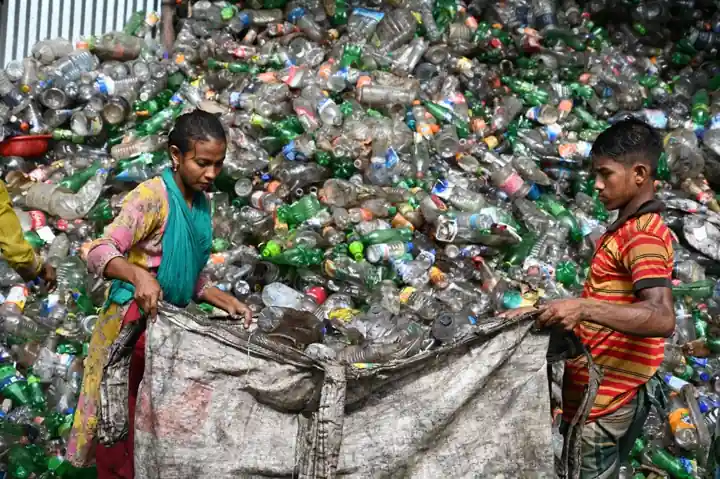
Hyperspectral imaging combined with machine learning is being investigated to detect and sort food-contaminated compostable and recyclable plastics [S5].
The technology measures spectral information from reflected or transmitted light to distinguish polymer types, contamination, and food-related material beyond visible color [S3][S5].
What Hyperspectral Sorting Measures
Hyperspectral cameras record a spectrum at each image pixel, allowing an industrial sorter to compare intermediate peaks and valleys rather than relying on visible appearance alone [S3].
Hyperspectral cameras provide a richer dataset of spectral information for each pixel than the multispectral cameras commonly used in optical sorters [S3]. RGB cameras provide shape and visible color data comparable to human perception, while NIR and hyperspectral systems expose material-specific spectral information [S3].
The technique is non-contact, non-destructive, and compatible with automated identification of visually similar plastics [S6]. Its value is greatest when material color is insufficient, packaging changes frequently, or contamination masks the spectral features needed by conventional sorting systems [S5][S6].
Food Sorting Requirements
Food sorting must detect composition, contamination, and quality defects rather than classify only visible color, and hyperspectral imaging supports these decisions through wavelength-dependent reflectance or transmission [S3][S4].
Food and recycling are separate application classes, but both depend on spectral discrimination. Hyperspectral equipment for food applications spans visible-to-near-infrared, near-infrared, short-wave infrared, and combined short-wave infrared with RGB configurations [S4].
Available wavelength bands include VNIR at 500–1000 nm, NIR at 700–1050 nm, and SWIR at 950–1750 nm [S4]. These ranges overlap, so a system intended for food inspection should be matched to the physical features of the target material rather than selected solely by resolution.
A machine-learning layer converts spectral data into a usable class decision. For contaminated plastic packaging, one study combined hyperspectral imaging with several machine-learning algorithms and measured how darkness, object size, and contamination level affected model performance [S5].
Plastic Types the Technology Can Separate

These polymers can overlap in visible color, while differences in their spectral behavior provide classification variables for machine-learning models [S7]. HSI therefore offers a richer dataset than RGB color sorting and conventional NIR when packaging shapes and surface colors are similar [S3][S8].
Compostable and Recyclable Packaging
The study investigates the use of hyperspectral imaging and machine learning to identify food-contaminated compostable and recyclable plastics [S5].
Darkness had the largest negative effect on model performance among the tested plastic features, with size and contamination level also evaluated [S5]. This matters in food-waste streams because compostable packaging is commonly mixed with organic residues, and conventional NIR can fall short when contamination masks polymer signatures [S5].
Compostable plastics need to be processed with food waste using industrial composting facilities to realize their value [S5].
Where It Fits in a Sorting Line
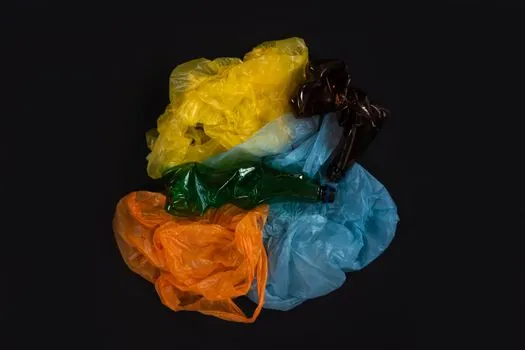
In a material recovery facility, the camera can analyze material flowing across the belt and feed polymer or contamination classes into the ejection logic [S3].
For a moving conveyor, a scanning system can project a narrow flying beam onto the measured point, with successive scan lines forming a two-dimensional hyperspectral image in which each pixel contains a full spectrum [S3].
A complete installation also needs material presentation, controlled illumination, calibrated spectral acquisition, classification software, and an ejection mechanism. The sensing stage is only one element of the sorting system, while integration into a production conveyor sorting line determines whether class decisions can be executed at the required rate and spacing.
Limits, Failure Modes, and Sourcing
Dark samples reduced classification performance in the contaminated-packaging study, making illumination design, exposure, and representative training data central engineering issues [S5]. Spectral resolution alone does not guarantee useful sorting if surface geometry, moisture, food residue, belt speed, or object spacing produces unstable spectra.
Hyperspectral systems can demand more data processing than RGB or multispectral NIR because every pixel carries a spectral trace [S3]. Their value should therefore be justified against the failure cost of mis-sorts, not treated as a universal upgrade for every inspection task.
For procurement, specify the target material classes, required polymer list, contamination conditions, spectral bands, line speed, belt width, smallest acceptable object, ejection rate, and lighting geometry. A camera advertised as “hyperspectral” does not by itself define suitability, while training data must cover packaging colors, grades, shapes, and contamination states encountered in the intended stream [S3][S5].
Track two measurable signals during commissioning: class-level false-sort rates for each polymer and contamination category, and spectral stability under the line’s actual belt speed and lighting conditions. These figures provide a defensible basis for scaling from a pilot to a production hyperspectral camera installation.