
Three pulley families dominate belt-driven power transmission and they are not interchangeable: V-groove sheaves, multi-rib (poly-V) sheaves, and toothed timing pulleys. The classification comes from groove geometry and tooth profile, not outside diameter or bore, and pairing the wrong belt to a given sheave produces localized heat, rib jump, or tooth shear within hours of load [S1][S3].
For a process engineer staring at a bare steel or cast-iron wheel, the first decision is whether the working surface is smooth-sided wedges, parallel micro-grooves, or molded teeth. Each family has its own pitch-diameter definition, minimum wrap, and standard designation, which is why the same physical-looking pulley can accept three completely different belt specifications [S4][S5].
V-Groove (Classical and Wedge) Sheaves
V-groove pulleys carry a single trapezoidal groove (or several, side by side) defined by a top width and a wedge angle, with classical profiles A/B/C and narrow wedge profiles SPA/SPB/SPC as the most common industrial pairings [S3]. The standard groove angle on classical A/B/C sections is 40°, and the top width/depth pair is fixed by profile: A is 13 mm wide by 8 mm deep, B is 17 mm by 11 mm, C is 22 mm by 14 mm, and Z is 10 mm by 6 mm [S4].
Wedge (narrow) profiles share the classical top width but sit deeper: an SPA groove is 13 mm wide like an A but 10 mm deep, giving a higher contact angle and a smaller minimum pulley diameter for the same power rating [S4]. The pitch diameter is the functional dimension for speed-ratio calculation and is calculated by subtracting a profile-specific addendum from the outside diameter, for example roughly 0.160 to 0.200 inches on a classical A-section [S3].
Visual ID: a single deep V cut into the rim, often one to six grooves in parallel for multi-belt drives. The belt must contact the groove walls, not the bottom; if it bottoms out, the drive slips and heats rather than transmits torque [S3].
Ribbed (Poly-V) Sheaves and Their Fixed Rib Pitch
Ribbed pulleys replace the single deep V with many parallel micro-V grooves whose rib pitch is fixed by ISO profile designation, and the pulley groove geometry must match the belt pitch exactly or the ribs crack and jump under load [S2]. The standard family covers five profiles with very different torque ranges: PH at 1.6 mm pitch, PJ at 2.34 mm, PK at 3.56 mm, PL at 4.70 mm, and PM at 9.40 mm [S2].
PK at 3.56 mm pitch is the dominant automotive serpentine-drive profile, defined by ISO 9981, and a part number like 6PK1550 fully specifies 6 ribs, PK profile, 1550 mm pitch length in a manufacturer-interchangeable form [S2][S6]. PH handles the lightest accessory loads at sub-30 mm pulley diameters, PJ covers mid-range industrial and HVAC equipment, PL is used on heavy industrial drives, and PM targets the largest industrial applications with the highest torque per rib [S2].
The truncated rib shape multiplies contact area relative to a single classical V, which is why a poly-V drive can run at lower tension and smaller wrap while transmitting the same horsepower, and why the smooth back of the belt allows backside idlers in serpentine routing without damage [S1][S2]. Visual ID: a wide flat-faced sheave with many fine parallel grooves, never one or two deep Vs. For a closer look at how ribbed belts behave in real drive layouts, see this ribbed belt profile reference.
Timing (Synchronous) Pulleys and Toothed Drives

Timing pulleys carry molded teeth around the rim that mesh with the molded teeth of a synchronous belt, eliminating slip and fixing the speed ratio at the tooth pitch [S5]. The pitch diameter is calculated directly from the geometry as (tooth pitch × number of teeth) / 3.14159, not measured across a groove, which is the cleanest way to tell a timing sheave from a V-groove or ribbed sheave on the bench [S4].
Common pitch standards include MXL, XL, L, H, T2.5, T5, T10 and the metric HTD/STD profiles, each with its own tooth pitch and minimum pulley count; running an HTD belt on an XL pulley, or vice versa, shears teeth within minutes of loaded engagement [S5]. Synchronous drives are the right choice when positional accuracy, zero slip, or a fixed ratio under varying load is required, and they are increasingly specified on CNC axes, packaging lines, and linearactuator drives up to 7,000 hp class [S5]. Visual ID: small, evenly spaced teeth around the full circumference, frequently with flanges on one or both sides to keep the belt tracked.
Decision Criteria: Which Pulley Fits the Application
Selection is driven by four criteria that are not negotiable once fixed: required power, minimum pulley diameter, speed-ratio accuracy, and environment. Classical V-belt drives remain the cheapest per kilowatt and tolerate misalignment and shock loading better than the other two families, which is why they still dominate fractional-horsepower farm, HVAC, and general machinery [S1][S3]. Ribbed drives win where wrap angle, backside idlers, or compactness matters, especially above 5 kW where the lower bearing load and longer service life offset the higher sheave cost [S1][S2].
Timing drives win where zero slip and fixed ratio matter, and they trade tolerance of misalignment and shock for that accuracy [S5]. A side-by-side comparison helps frame the call: contact area is two side flanks on classical V, many micro-rib flanks on poly-V, and positive tooth engagement on timing; high-speed stability is moderate on classical V, high on poly-V, and highest on timing because there is no slip phase; tolerance of misalignment and contamination is highest on classical V, moderate on poly-V, and lowest on timing; positional accuracy is approximate on classical V and poly-V, exact on timing [S1][S2][S5]. For a deeper treatment of the related classical and wedge belt families, this V-belt profile overview covers the A/B/C and SPB/SPC groove geometry in more detail.
Measurement Sequence When Identifying an Unknown Pulley
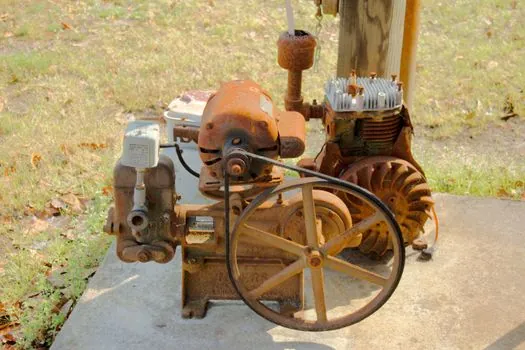
When the part is off the shaft and unmarked, the measurement sequence fixes the answer in three steps. Step one: count and look at the working surface. One or two deep Vs means a V-groove sheave; many fine parallel Vs means a ribbed sheave; evenly spaced teeth means a timing pulley [S3][S4].
Step two: measure outside diameter across the grooves (or teeth) with calipers or a pi tape, then look up the catalog OD for the suspected profile to confirm [S4]. Step three: measure groove top width and depth with calipers (or count teeth and measure tooth pitch) and cross-reference to the standard table; for V-groove sheaves the A 13×8 mm, B 17×11 mm, C 22×14 mm, Z 10×6 mm set covers most industrial replacements, while ribbed sheaves are identified by rib pitch against the PH/PJ/PK/PL/PM list [S2][S4]. Bore and keyway complete the replacement specification: common imperial bores run 1/2″, 5/8″, 3/4″, 7/8″, 1″ with keyway widths standardized to shaft diameter, for example a 1″ to 1-1/4″ shaft takes a 1/4″ wide keyway [S4].
Common Failure Modes from Mismatched Pairing
Each family has a signature failure when paired wrong. A V-belt on a ribbed sheave bottoms in the wide groove, slips, and overheats; a ribbed belt on a V-groove sheave rides on the rib tips only, wears the rib walls within hours, and sheds rubber debris into the housing [S1]. A timing belt on a V-groove sheave has nothing to mesh with and just slips, while a V-belt running on a timing pulley sits on the tooth tips, slips, and burns through the belt carcass within one shift [S5].
The cheapest diagnostic in any failure investigation is to confirm profile match before suspecting material or tension: misalignment, under-tension, and contamination cause similar symptoms, but a profile mismatch causes them within hours rather than months, which is the cleanest signal a maintenance log can carry [S1][S3]. Engineers comparing pulley families against bearing selection will recognize the same discipline of matching the standard to the load case, as covered in this TDO vs TDI double row tapered roller bearing geometry note.
Trackable signals for the next revision of this reference: any new ISO rib pitch added to the PH/PJ/PK/PL/PM family, changes to ISO 9981 PK profile tables, and the appearance of higher-pitch (above 9.40 mm) industrial ribbed profiles for large-frame wind or heavy conveyor drives. Engineers specifying replacement sheaves should keep the ISO 9981 PK profile table and the classical A/B/C groove-dimension table printed on the shop floor; those two tables resolve roughly 80% of field identification questions without a micrometer.
For component-level specifications, see timing pulley.