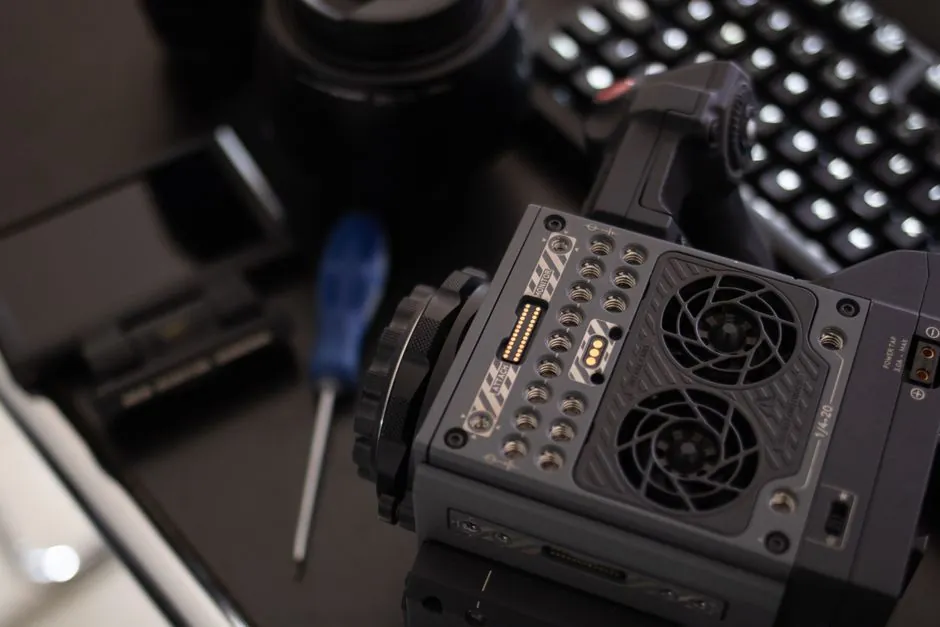
Industrial camera selection in 2026 is driven by four linked decisions: sensor format and pixel pitch, shutter architecture (global vs rolling), physical interface (GigE Vision, USB3 Vision, CoaXPress, Camera Link), and housing/IP rating, per the Omron Sentech/Basler datasheet family published 2025-07-03 [S1].
Spec-led buying is now standard: the same source enumerates eight Sentech SKUs ranging from 720x540 (STC-MBS43POE) up to 4000x3000 (STC-MBS1242POE) on Sony IMX sensors, all sharing PoE IEEE802.3af Class 2, GigE Vision 2.1, and GenICam SFNC 2.4 compliance [S1]. The Imaging Source markets over 100 industrial models spanning 2.3 MP to 42 MP across USB3 Vision, GigE Vision, and GenICam-compliant interfaces, with Sony Pregius S (global) and STARVIS (rolling) sensor families [S2].
Sensor Format, Pixel Pitch, and Exposure Range
Sensor format is expressed as an inch-fraction inherited from 1950s vidicon tubes, where a "1/1.8 in" sensor has roughly a 16 mm-class diagonal but never matches the stated fraction dimensionally, a point the Opto Engineering camera-basics reference calls out directly [S3].
Pixel pitch trades light sensitivity against spatial resolution: the Sentech STC-MBS43POE uses a 6.9 µm cell, while the 12 MP STC-MBS1242POE drops to 1.85 µm, and exposure time scales inversely, from 1 µs minimum on the IMX287-based unit up to 213 µs minimum on the 12 MP IMX226 device, with maximum exposure topping out at 16.777 s across the family [S1]. The Imaging Source confirms 2.3 MP to 42 MP coverage is now mainstream, and the 42 MP flagship is positioned specifically for quality inspection with automatic color correction [S2].
Shutter Architecture and the Global-vs-Rolling Decision
Global shutter is mandatory for any moving target; rolling shutter is acceptable only when the object, camera, and light source are all static, the cardinal rule in machine-vision setup, per the Vicoimaging selection write-up [S5].
Teledyne's industrial line-scan family exemplifies this: 2k, 4k, 8k, 16k, and 32k resolution options on advanced CMOS with NIR/SWIR variants, all delivered over GigE, Camera Link, Camera Link HS, or fiber interfaces for continuous-web inspection where area-scan cameras fail [S7]. Sentech's STC-MBA503POE-HS is the one rolling-shutter outlier in the otherwise global-shutter Sentech list, paired with the onsemi AR0521 sensor at 2592x1944 [S1].
Interface Selection: GigE Vision, USB3 Vision, CoaXPress

GigE Vision 2.1 over Cat5e/Cat6 with Power over Ethernet (IEEE802.3af Class 2, 1000BASE-T) is the dominant 2026 industrial default, with PoE power defaulting to external supply when both are present on Sentech units [S1]. The Imaging Source splits its catalogue cleanly into USB 3.1 (38U/37U/Aptiris series), USB 3.0 (33U/27U), and GigE (Visus, Visus IP67, 38G, 33G) product trees, all GenICam-compliant [S2].
Bandwidth dictates the choice: a 21 MP Keyence CA-H2100M monochrome head at 5104x4092 reads in 109.9 ms per frame in standard mode, against 27.6 ms/50.3 ms for a 5 MP CA-HX500M at 2432x2040, illustrating why higher pixel counts often force a move from USB3 to GigE or CoaXPress [S4]. For high-frame SWIR and 16k/32k line-scan, Teledyne still recommends Camera Link HS or fiber over GigE [S7].
Resolution vs Frame Rate: A Numeric Trade-off
Resolution and frame rate are inversely coupled at fixed interface bandwidth, a constraint the Keyence selection table makes concrete: a 2 MP sensor at 1600x1200 runs at 11.6 ms/20.1 ms exposure (standard mode), while a 21 MP head at 5104x4092 sits at 109.9 ms, a roughly 9.5x slowdown for ~10.5x more pixels [S4].
Cell size shrinks as resolution climbs: 6.9 µm at 0.4 MP, 3.45 µm across the 1.6 MP to 5 MP IMX265/MX264 band, and 1.85 µm at 12 MP, with smaller pixels capturing less light per unit exposure [S1]. Adimec's 12 MP vs 25 MP OEM comparison frames the same trade for inspection buyers: more pixels do not automatically mean better images, since lens MTF, illumination, and pixel pitch must be matched [S6].
Area-Scan vs Line-Scan: Topology Choice
Area-scan cameras (matrix sensors) capture 2D images in one exposure and dominate discrete-part inspection, while line-scan cameras use a single pixel row and are preferred for continuous webs, rotating cylinders, or any object where height is unbounded, per the Opto Engineering reference [S3].
Teledyne's industrial catalogue splits cleanly along this line: the area-scan tree covers 2D parts, while the line-scan tree spans 2k through 32k pixels with GigE, Camera Link, Camera Link HS, and fiber interfaces, including NIR and SWIR models for spectroscopy and semiconductor inspection [S7]. Basler likewise positions area-scan GigE/USB3 cameras as the everyday pick and reserves specialty line-scan and 3D for niche duties [S8].
Environmental and Mechanical Constraints
Thermal management is non-optional: Sentech specifies that the internal temperature sensor must read under 65 °C to keep the housing top plate under 57 °C, and recommends a mounted lens plus an aluminum tripod plate to assist heat dissipation [S1].
Ingress protection splits the market: the Imaging Source Visus IP67 series is the first GigE IP67 family in that maker's line, with Sony and onsemi sensors, while the rest of the GigE/USB3 range sits at lower IP ratings suitable for cabinets and clean jis [S2]. For harsh-environment deployments, the same source lists IP67 extension tubes and tube-style lens holders as standard accessories, signalling that ruggedization is treated as a system-level kit, not a camera attribute alone [S2].
Who Should NOT Buy the Mainstream GigE Area-Scan
Buyers running continuous-web inspection at line rates above ~10 kHz should skip GigE area-scan entirely, since 1 Gbit/s Ethernet ceilings cap realistic frame rates well below web speeds, and move to line-scan over Camera Link HS, CoaXPress, or fiber, per Teledyne's interface guidance [S7].
Engineers specifying a camera for a vibrating or rotating target with a rolling-shutter sensor should likewise reject that matchup, because rolling shutter on moving parts produces geometric skew, and a global-shutter IMX287/IMX273/IMX265/IMX226 family device is the correct floor, per the Sentech model matrix [S1]. A reader cross-referencing the industrial camera baseline can use these exclusions as a hard shortlist filter before comparing pixel pitch and interface.
Selection Criteria: A Four-Option Comparison
Cross-comparing the dominant 2026 form factors on four decision axes: (1) Sentech STC-MBS163POE (1440x1088, IMX273, 3.45 µm, global shutter, GigE Vision 2.1) suits low-cost 2D parts inspection with PoE simplicity [S1]; (2) Keyence CA-H2100M (21 MP, 5104x4092, 109.9 ms) suits high-resolution static metrology where frame rate is secondary [S4]; (3) Teledyne line-scan (2k to 32k, NIR/SWIR, Camera Link HS or fiber) suits continuous web and spectroscopy [S7]; (4) Imaging Source Visus IP67 GigE suits washdown food or outdoor deployments where housing, not pixel count, is the gating spec [S2].
Two anchor facts to retain when shortlisting: a 12 MP IMX226 sensor at 1.85 µm pixel pitch and a 213 µs minimum exposure is the high-resolution ceiling in the Sentech PoE GigE family [S1], while the Imaging Source 42 MP USB3 flagship is positioned specifically for quality inspection with automatic color correction rather than high-speed throughput [S2]. Buyers comparing across machine vision camera categories should match pixel pitch to lens MTF, not chase megapixels, since lens resolution and pixel size must be properly matched to ensure optimal system performance [S3].
Standards, Protocols, and Sourcing
Two protocols dominate 2026 industrial camera compliance: GigE Vision 2.1 with GenICam SFNC 2.4 and IEEE 1588 PTP timing on the GigE side, and USB3 Vision with GenICam on the USB side, both implemented across Sentech, Basler, Imaging Source, and Keyence lines [S1][S2][S4].
Power over Ethernet follows IEEE 802.3af Class 2 for the Sentech family, with +10.8 to +26.4 VDC external supply accepted and the camera defaulting to external power when both are present [S1]. Buyers specifying an industrial camera for a regulated line should confirm the GenICam and GigE Vision version numbers in the vendor's SFNC conformance statement, since SDK compatibility is gated by these revisions, not by marketing labels. Trackable next nodes: vendor SFNC 2.4 conformance certificates (Q4 2026 refresh cycle), and IEEE 1588 PTP grandmaster support for multi-camera synchronised lines.
Component reference pages worth checking: industrial adhesive, and industrial borescope.
See also our earlier report, SCADA Platform Selection 2026: Vendor Specs, Licensing, and Fit Map.