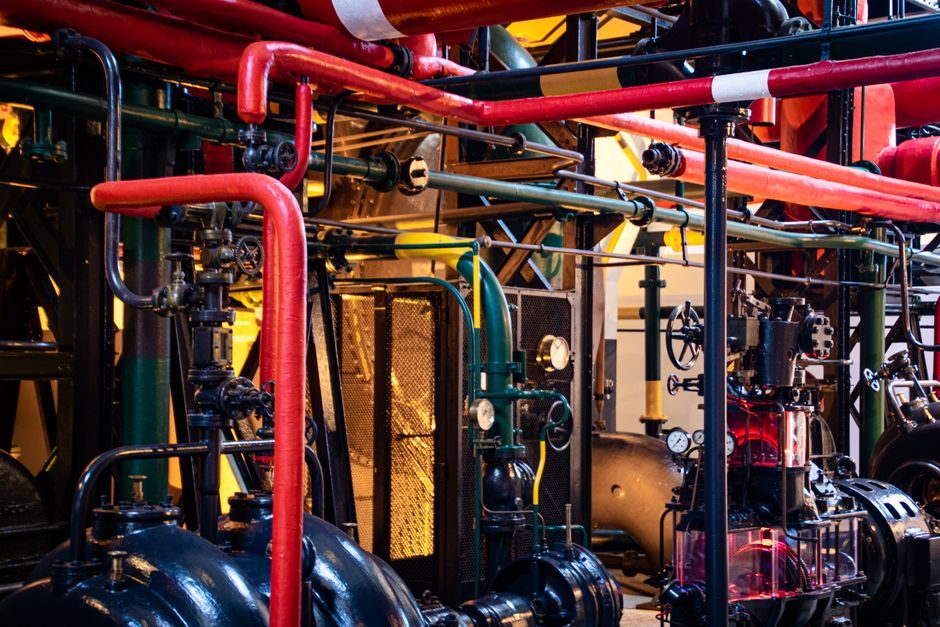
Industrial gases (oxygen, nitrogen, argon, hydrogen, acetylene, and CO2) are delivered in three supply modes: high-pressure cylinders (200-300 bar), bulk liquid tankers with on-site vaporization, and direct pipeline supply for large tonnage consumers. Each mode has a distinct purity, pressure-stability, and capex profile that has to be matched against flow rate, purity class, and consumption pattern before a plant engineer can sign a supply contract.
The core engineering trade-off is between capital deployed on the gas-handling skid and the recurring cost of gas lost through boil-off, leakage, and pressure letdown.
Purity and Supply-Mode Trade-Off Matrix
Cylinder banks remain standard for low-flow, high-purity, or remote applications because the cylinder itself acts as a quality-preserving pressure vessel, eliminating pump and vaporizer contamination points. [S2]
For high-purity electronics-grade gas, the comparison flips: on-site generation rarely achieves the sub-ppb impurity classes that bundled delivery systems can guarantee, so foundries and semiconductor fabs keep cylinders or Y-cylinders in service for the cleanest streams even when they generate bulk nitrogen for inerting.
Key Engineering Advantages Across Modes
Cylinder supply offers zero on-site stored inventory of low-temperature liquid, which simplifies the ATEX / IEC 60079 zone classification and removes the need for a vaporizer skid and emergency-vent sizing calculations. Bulk liquid supply delivers flow stability within roughly 1-2% of the metered value at steady state, which is critical for laser cutting and analytical instrument feed where pressure droop translates directly to cut quality or detector baseline drift. On-site PSA nitrogen achieves purity grades of 95-99.9% in a single bed and up to 99.999% with a polishing module, and modern twin-tower designs hold dew point below -70 °C at line pressure. [S2]
Hydrogen behaves differently: it is delivered either as compressed gas in 200-300 bar cylinders, as liquid in super-insulated dewars, or generated on-site via electrolysis or steam methane reforming (SMR). A cylinder manifold for H2 keeps the simplest leak-management footprint; an SMR unit producing 100-500 Nm3/h reduces long-run fuel cost but requires a Class I, Division 1 / Zone 1 hazardous-area envelope around the reformer and PSA section, plus flame arrestors on every hydrogen line per ISO 23251 and ASME B31.3 process-piping practice.
Real Failure Modes and Operating Constraints

Cylinder supply fails the opposite way: residual pressure can drop to unusable levels below roughly 10-20 bar, and operators must swap cylinders before this floor or downstream pressure transmitters lose their reference signal. Acetylene is the special case in the gas family: it is never shipped above roughly 1.5 bar absolute because of its decomposition hazard, and cylinder packs must include a porous monolithic filler and acetone solvent that is gradually consumed on every draw. [S2]
Hydrogen embrittlement is the silent failure mode for any steel piping above 1,000 psi hydrogen service; specifying NACE MR0175-compliant materials and in-line leak detection is not optional when a plant is running >99.9% H2 at 200 bar or above.
Selection Criteria: Who Industrial Gas Fits, and Who It Does Not
Industrial gas supply fits any process that needs a controlled atmosphere, an oxidizer, an inert blanket, or a calibration stream; the supply model just changes. A 50-200 Nm3/h continuous flow almost always points to on-site PSA or membrane nitrogen, and the same logic applies to a 1-10 Nm3/h analytical feed where cylinders, a gas chromatograph reference stream, and a single fixed gas detector are the standard architecture. It does not fit small intermittent consumers, where the cylinder rental fee plus lost-gas residual pressure penalties can push the effective unit cost to 3-5x the bulk-liquid rate. [S2]
Comparing the main options on a fixed set of decision criteria: on-site PSA nitrogen wins on unit cost at high continuous flow and on logistics simplicity, but loses on purity ceiling and on capex exposure; bulk liquid supply wins on flow stability and purity guarantee, but loses on daily boil-off and on the footprint of the storage tank; cylinder supply wins on capex, footprint, and purity ceiling, but loses on operator labor and on residual pressure losses. Hydrogen follows a parallel table with compressed gas, liquid hydrogen, and on-site electrolysis, with electrolysis the rising option where renewable electricity is under 0.05 USD/kWh.
Standards, Sourcing, and Audit Trail
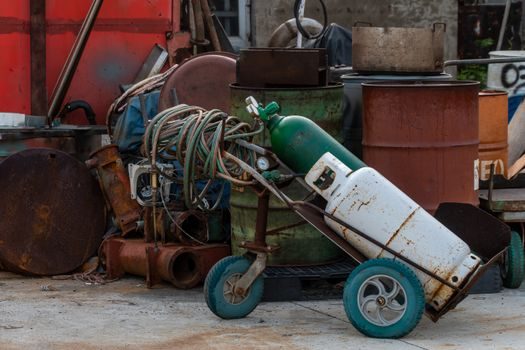
Cylinder gas traceability rests on the CGA / ISO 9809 series for seamless and welded gas cylinders and on the regional transport code, ADR for road in Europe, DOT 49 CFR in the US, and IMDG for sea. Bulk liquid and on-site systems fall under the pressure-vessel codes (PED 2014/68/EU in the EU, ASME BPVC Section VIII in the US), and the process side follows ASME B31.3 for piping plus the relevant electrical-area code (NFPA 70 / NEC 500, IEC 60079-0 and IEC 60079-10-1 for zone classification). Hydrogen-specific lines additionally reference ISO 23251 and CGA G-5.5 for venting and flame-arrestor selection. [S2]
Specifying any industrial-gas package should be a 4-step exercise: define the purity class and the maximum impurity list (H2O < 5 ppm, O2 < 2 ppm are common analytical-class targets); pin the supply mode against the demand profile; lock the standards list in the datasheet so a combustible gas detector or gas analyzer loop can be matched to the same zone classification; and write the residual-pressure floor plus boil-off loss into the supply contract as acceptance criteria, not as a verbal understanding. The industrial gear advantages and disadvantages spec map treats a similar breakdown for mechanical drivetrains, and the same scoring logic (capex, opex, purity, footprint) applies when ranking gas-supply modes. For very small cylinder-fed operations, the synthetic resin total cost of ownership discussion shows the same fixed-versus-variable split in a different process gas, and that parallel is worth keeping on the procurement desk.