
Knife gate valves suit solids-bearing oil and gas isolation when the blade can shear slurry, scale or debris and the seat, body and packing suit the actual pressure and temperature.
For upstream, produced-water, sand, slurry and oil-sands service, specify bidirectional shutoff for dead-end or reverse-pressure conditions, confirm the pressure class independently from flange drilling, and reserve the valve for on-off duty.
Knife gate valve duty and applicability
A knife gate valve is a gate-valve variant with a thin, beveled-edge blade that travels perpendicular to the flow and can shear through slurry, sediment, fibrous material and viscous media during closure [S2][S4]. The blade enters the seat in a bonnetless body, which removes the enclosed gate pocket that can collect solids in a conventional wedge gate [S2].
Oil and gas applications include produced-water lines, sand or solids handling, oil-sands slurry service, mining-derived fluids and other energy installations where isolation must remain reliable in dirty service [S1][S3][S5]. The valve is intended for on-off isolation, not throttling. A partially open blade exposes the seat and blade edge to high-velocity flow, vibration and erosion; use a control valve for modulation [S2].
The basic distinction is functional. A knife gate is the better candidate where solids would pack a wedge or obstruct a rising-stem gate, while a conventional gate is generally better suited to clean liquid or gas isolation where pressure capability and tight shutoff matter more [S2].
Compare the main knife gate configurations
Conventional knife gate valves are simple, economical and rated to 150 CWP; unidirectional designs use system pressure to assist shutoff, while bidirectional designs provide isolation in either flow direction [S3]. The choice for oil and gas depends on pressure direction, dead-end service, solids severity and maintenance access.
Use the following comparison to narrow the configuration before selecting a manufacturer model:
For a standard oil and gas project, the E5400 general-purpose unidirectional design is listed at 150 psi maximum under MSS SP-81, with stainless steel or high-alloy construction and sizes from 2 to 60 in; it accepts resilient or metal seats [S5]. A contractor should not treat that model listing as a universal pressure-temperature approval.
Pressure rating, flange drilling and temperature limits
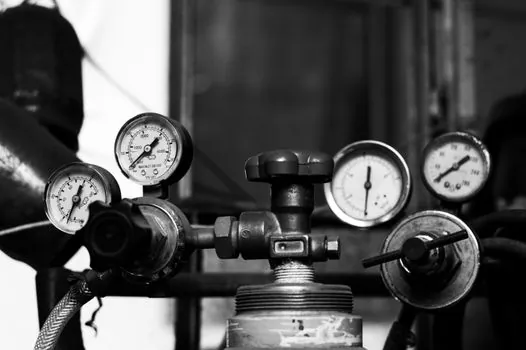
Flange drilling and pressure rating are separate requirements. “ANSI B16.5 Class 150 drilling” identifies the physical bolt pattern, not permission to operate at a Class 150 pressure rating [S2]. The purchase specification must state the valve’s cold working pressure, CWP basis, allowable temperature, seat rating and governing design standard independently of the pipe flange class.
The 40 psi test value is not a universal operating-pressure ceiling, but it is a specific benchmark that should be reconciled with the manufacturer’s stated rating and actual service pressure [S3].
High-performance carbon-steel designs are described for ASME Class 150 at up to 285 psi and Class 300 at up to 740 psi [S3]. The E5500 high-temperature model is rated to 1,200°F, or 650°C, and is identified with ASME Class 150 and MSS SP-135; it is available in 2 to 12 in sizes [S5]. For oil and gas projects, high-temperature capability does not replace material compatibility, seat selection or pressure-temperature verification for the exact trim.
Check the operating pressure at every extreme, including start-up, slugging, water hammer and blocked-in conditions. A knife gate should be fully open or fully closed, so a control-valve sizing calculation is not the right basis for its actuator torque or pressure drop.
Seat, material and corrosion decisions
Resilient seats use elastomeric or plastic sealing surfaces and provide tighter shutoff, while metal seats tolerate higher temperatures and pressures but generally offer less severe-duty sealing performance [S4]. For oil and gas, resilient seating is reasonable when the medium, temperature, pressure and chemical exposure suit the elastomer; metal seating is the starting point for high-temperature service, but the seat material still needs compatibility review [S4].
Body and blade materials must be selected separately from seat and packing materials. Carbon steel is commonly used where pressure and temperature dominate, ductile iron is associated with lower-pressure service, and stainless steel or another corrosion-resistant alloy is appropriate for corrosive fluids and gases [S4].
The final packing grade, stem material, actuator force and allowable stroke must be confirmed for the media and temperature, not selected from a generic materials table.
Oil and gas failure modes to control
Solid bridging is the primary failure mechanism addressed by the knife blade: a wedge gate can land on settled solids and fail to close, while a sharpened knife shears the obstruction [S2]. Misalignment can still prevent a blade from fully seating, so installation should preserve the required stem orientation, upstream approach and operator clearance.
Installation position and pressure direction are critical for unidirectional knife gates, and the manufacturer’s specified flow orientation must be retained [S7]. A unidirectional valve that relies on flow-assisted sealing will not provide equivalent performance when pressure reverses. Bidirectional seats solve a different problem, not an actuator or alignment problem.
Avoid using a standard knife gate as a general control valve unless the design and manufacturer’s recommendation specifically permit throttling [S8]. Partial opening creates erosion and vibration, and a damaged edge or washed-out seat can destroy isolation performance [S2]. The knife gate valve should therefore be specified as a full-open/full-close isolation element, with separate throttling equipment where required.
Actuation, installation and the procurement shortlist
Manual operation is acceptable for infrequent isolation, but electric, pneumatic or hydraulic actuation requires a documented torque or force calculation at the worst operating condition. The actuator must accommodate the full stroke, maximum differential pressure, packing friction and closing force, while preventing the blade from bottoming against the seat. [S1]
For a solids-bearing oil and gas line, the shortlist is straightforward: specify bidirectional construction when reverse pressure or dead-end isolation is possible; select a high-performance guided shear gate when the duty reaches ASME Class 300 or 600; use push-through construction for heavy slurry discharge; and retain a conventional unidirectional valve only where pressure direction is fixed and the seat arrangement is compatible [S3][S5].
Require the manufacturer to confirm valve model, size, body and blade material, seat type, CWP, pressure-temperature rating, flow direction, shutoff class, end connection, actuator, packing, stem, wear components and applicable standard on the submittal. Also request installation orientation and maintenance instructions. For broader oil and gas isolation selection, select gate valves for oil and gas isolation duty provides a useful comparison boundary.
Track two signals during procurement: a datasheet that separates flange drilling from pressure rating, and a model-specific pressure-temperature table that covers the full design point. If either remains unresolved, do not release the valve for purchase.