
Large-format additive manufacturing can produce tooling several meters long by depositing thermoplastic pellets layer by layer, with common configurations spanning gantries and 6-axis or 7-axis robotic cells [S2][S4].
For industrial tooling, the process combines CAD-to-part production with robotics, pellet extrusion and heated build platforms, targeting molds, fixtures, jigs and composite layup tools across automotive, aerospace, construction, marine and energy applications [S1][S2][S4].
What LFAM Changes for Tooling Production
Large-format additive manufacturing is the deposition of thermoplastic material in successive layers to create components extending from several hundred millimetres to multiple metres in length [S4]. It differs from filament-based desktop printing through higher material throughput, pellet feeding and a build scale suited to industrial fixtures and full-scale molds [S2][S4].
The process starts with a CAD model, followed by slicing, material preparation, pellet extrusion, layer deposition and any required post-processing [S4]. This route can use LFAM-produced molds and tooling for industrial reuse [S1].
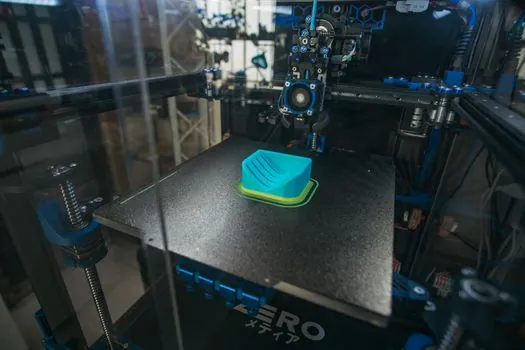
Two principal machine architectures dominate the decision. A gantry gives a fixed, rectangular build area, while a robotic arm provides multi-axis access for curved surfaces, changing print angles and parts extending beyond a conventional table [S2]. Modular heated beds support layer adhesion and dimensional stability during extended builds, making thermal control part of the process rather than an optional accessory [S2].
The additive manufacturing material choice determines whether LFAM tooling is suitable for a forming operation, a handling fixture or a structural demonstration part. ABS, PETG, PP and PLA cover many general tooling needs, while carbon fibre and glass fibre reinforcement increases stiffness and dimensional performance [S2].
Comparing LFAM Tooling Architectures and Materials
Pellet extrusion has higher throughput and lower feedstock cost than filament extrusion, while robotic cells offer greater placement flexibility than fixed gantries [S2][S4]. Heated gantry beds favor controlled builds over large planar areas, whereas robotic deposition can serve parts and tools that exceed those areas or require access from several directions [S2].
Material selection should be compared by heat resistance, reinforcement and forming role. ABS, PETG, PP and PLA are general thermoplastics associated with ease of processing and resistance, carbon fibre and glass-filled grades serve tooling and lightweight structures, and PEI, PPS and PA-based composites address heat resistance, strength and chemical resilience in demanding applications [S2].
These options are not interchangeable. A lightweight thermoplastic tool may shorten iteration time but cannot be selected from material family alone; temperature exposure, contact pressure, joining method, expected cycles, dimensional tolerance and surface finish need separate qualification [S2][S4].
Where LFAM Tooling Fits
Aerospace tooling is a principal LFAM application because aircraft production tools can combine large dimensions with complex geometry, low mass and rapid design iteration [S1][S7]. Carbon fibre and glass fibre composites are used for composite layup tooling, while the broader aerospace supply chain still requires controlled and certified manufacturing processes for production tooling [S2][S5].
Construction and infrastructure applications can use LFAM for formwork and site components, while automotive teams use large tools and fixtures during vehicle development [S1][S2]. Marine and energy applications can also use large thermoplastic structures or tooling where corrosion resistance, low mass and customized geometry are valuable [S2].
The strongest business case is usually temporary or configuration-specific tooling: prototypes, jigs, fixtures, molds and parts that change frequently. LFAM is less compelling where a small conventional tool has an established material, tight tolerance, high contact load and a proven service life, because deposition rate alone does not determine total cost [S4].
The reuse question therefore belongs in the purchase decision. A 2025 study covering 15 pages examined industrial reuse of LFAM molding and tooling through mechanical recovery, including shredding, melt compounding and reprocessing into LFAM equipment [S1].
Engineering Constraints That Decide the Print
Dimensional control begins with thermal management because a multi-metre polymer build can accumulate heat and distortion across many layers [S2]. Heated beds, controlled nozzle conditions and toolpath strategy affect interlayer bonding and dimensional stability, so machine configuration alone is not enough to predict accuracy [S2].
Tool geometry must also respect robotic reach, nozzle access, build orientation and support strategy. A 6-axis or 7-axis cell can reach curved surfaces and varying angles, but the part still needs a printable orientation and a support strategy that can be removed without damaging functional surfaces [S2][S4].
Material preparation is equally important because pellets must flow consistently through the extruder and bond to the preceding layer. Carbon fibre reinforcement changes stiffness, flow behavior and machining characteristics relative to unreinforced polymer, while the moisture sensitivity of engineering polymers creates drying requirements before extrusion [S2][S4].
LFAM is not a drop-in substitute for every metal or conventional plastic tool. Aerospace organizations require certified processes for tooling, and composite layup tools may demand stable surfaces under vacuum, temperature and repeated handling [S5]. For high-temperature or heavily loaded applications, alloy or engineering-grade composite tooling may be more appropriate than a general-purpose polymer [S2].
Process Qualification and Reuse Economics
Tooling must pass qualification against the actual process it supports, including forming temperature, pressure, vacuum condition, fastening loads, cycle count and dimensional repeatability. The published LFAM material set includes ABS, PETG, PP and PLA for general resistance and processing, plus PEI, PPS and PA-based composites for demanding heat and chemical exposure [S2].
Composite reuse can improve the economics when recovered feedstock is re-compounded and printed again. Oak Ridge National Laboratory reported that CF-filled polycarbonate recovered at laboratory and pilot scales could be mechanically recycled with minimal effect on functional performance and printability while significantly reducing feedstock cost [S1].
That result does not remove qualification requirements. Recovery history, contamination, fiber length, drying, melt compounding and printability all affect consistency, so a recycled grade should be validated as a controlled input rather than treated as equivalent to virgin material without evidence [S1].
Industrial-scale production also requires documented equipment capability, process parameters and inspection, particularly where tooling affects certified aerospace or automotive work [S5]. Additive manufacturing should not be presented as a certification shortcut, and the relevant process must be approved by the customer or regulated production environment.
Building a Tooling Business Case
The procurement decision should compare total lead time, material use, rework, fixture weight and tool change frequency rather than printer price alone. LFAM can create full-scale tools and molds in hours rather than weeks when the geometry suits the machine, but print duration still depends on part volume, deposition rate, reinforcement, orientation and required finishing [S2][S4].
A practical comparison places LFAM against machined metal, machined polymer and conventionally produced composite tooling. LFAM leads where geometry is complex, part size is large and iteration speed matters; machined metal leads where stiffness, heat resistance or surface precision governs; conventional composites remain attractive where layup expertise, low weight and established repair methods dominate.
Automotive, aerospace, construction, marine and energy are named application sectors for LFAM tooling and end-use parts, but sector fit does not remove the need for a tool-specific material decision [S2]. Carbon fibre reinforcement can bring mechanical performance comparable to metal in out-of-autoclave applications at a materially lower cost, according to the 2025 ORNL study, yet that comparison must be tied to the relevant load and temperature conditions [S1].
The first trackable signal is a production package that records pellet grade, drying, machine build envelope, layer and toolpath settings, post-processing and inspection results. The second is reuse evidence based on recovered CF-PC feedstock with measured printability, functional performance and cost, not an assumption that recycled pellets remain equivalent [S1].